


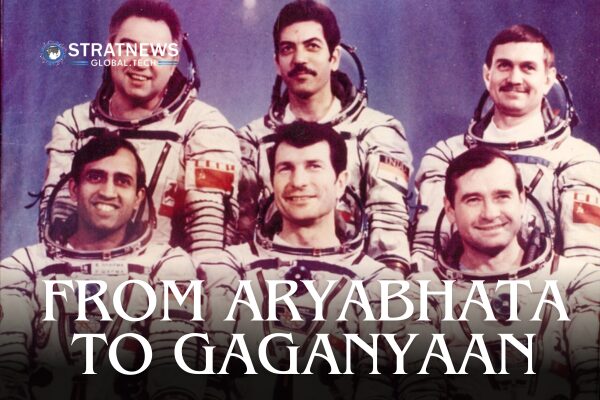
India-Russia space cooperation has evolved into one of the world’s most significant partnerships, spanning five decades of achievements. In 1975, Russia (then the Soviet Union) launched India’s first satellite, Aryabhata, aboard a Soviet Kosmos-3M rocket, kick-starting India’s space program. This foundational achievement was followed by Rakesh Sharma’s historic spaceflight on Soyuz T-11 in 1984, making him the first Indian citizen in space aboard a Soviet spacecraft.
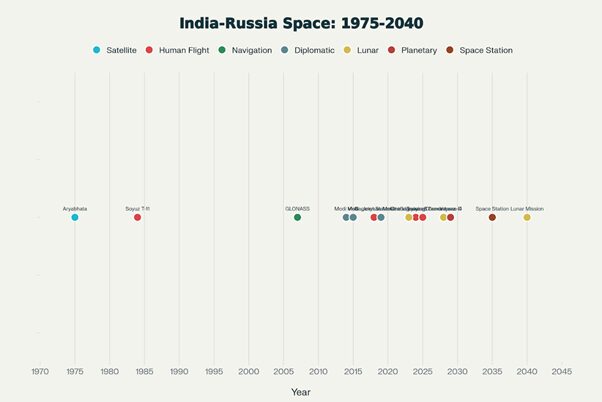
India-Russia space cooperation spans five decades, from the 1975 Aryabhata satellite launch to planned missions through 2040, demonstrating sustained commitment to joint exploration across satellite, human spaceflight, navigation, lunar, and planetary missions.
The partnership was formalized through multiple international agreements, including the landmark 2015 Memorandum of Understanding signed by ISRO and ROSCOSMOS to expand cooperation in space exploration and utilization for peaceful purposes. This MoU provides scope for developing joint activities in satellite navigation, launch vehicle development, critical technologies for human spaceflight, remote sensing, space science, and planetary exploration.
Current Major Initiatives
The Gaganyaan mission represents the apex of India-Russia space cooperation. Announced by Prime Minister Modi in 2018, these USD 1.4 billion (Rs 9,023 crore) programs aims to send a three-member Indian crew to a 400 km Low Earth Orbit for a 3-7 day mission, making India only the fourth country after the USA, Russia, and China to achieve independent manned space capability.
Russia is providing critical support across multiple dimensions:
- Astronaut Training: Four Indian astronauts completed advanced training at Russia’s Gagarin Cosmonaut Training Centre in 2024, with more under preparation
- Spacesuits and Life Support: Russia supplies custom Sokol spacesuits, life-support systems, and emergency safety equipment
- Technical Systems: Russian expertise in radiation shielding, crew modules, rendezvous and docking systems, and flight suits enhances the spacecraft’s capabilities
- Medical and Flight Training: Glavkosmos, a ROSCOSMOS subsidiary, provides consulting support, medical examinations, and comprehensive space flight training
- Russia’s Ambassador to India, Denis Alipov, emphasized in 2024 that cooperation extends beyond technology transfer to “laying groundwork for India’s space future,” with exploration of private sector involvement and start-ups in joint ventures.
Satellite Navigation: GLONASS-NavIC Integration
A cornerstone of bilateral space cooperation is the mutual deployment of ground stations for satellite navigation systems. Following an agreement signed in October 2016, Russia established a ground base station in Bengaluru to receive communications signals from its GLONASS (Global Navigation Satellite System), while ISRO set up India’s NavIC (now called Indian Regional Navigation Satellite System) ground stations in Russia
This integration enhances precision for civilian and military applications, supports Earth observation for geological surveys and pipeline monitoring, and facilitates real-time tracking of logistics and infrastructure. The GLONASS-NavIC system has become instrumental in resource mapping for oil exploration and monitoring of energy infrastructure.
Additionally, in 2007, India and Russia agreed to share GLONASS military signals, enabling optimized utilization of advanced navigation hardware for strategic applications.
Lunar and Planetary Exploration
India and Russia are collaborating on multiple lunar and planetary missions:
Lunar Missions: Chandrayaan-4, planned for 2028, will involve sample return from the Moon with Russian technical expertise in propulsion and landing systems. The Luna 27 joint mission combines India’s rover technology with Russia’s proven lander capabilities. Both nations have demonstrated their independent capabilities, India successfully landed Chandrayaan-3 on the lunar south pole in 2023, while Russia’s Luna-25 made an earlier approach (though it ultimately failed)
Planetary Exploration: Russia is developing the Venera-D Venus mission (targeted for 2029) with an orbiter and lander to study Venus’s atmosphere and surface, leveraging Russian expertise as the world leader in Venus exploration. India is exploring participation in payload development and research collaboration.
A long-term joint Mars mission is under planning phases, with Russia contributing advanced propulsion technologies developed through decades of planetary exploration. Additionally, both nations are exploring opportunities for joint lunar bases and deep-space missions as part of their extended cooperation framework.
Launch Vehicle Technology and Cryogenic Engines
Russia has provided critical technology for India’s launch vehicle development. Seven cryogenic functional units and ground demonstrator units supplied by Russia to ISRO were used for the GSLV MK-I and became seeds for India’s development of the GSLV MK-II and III’s home-grown cryogenic stage.
Currently, both nations are developing semi-cryogenic rocket engines with scope for collaboration in producing and utilizing these engines for different applications. India and Russia have agreed to explore prospects of “mutually beneficial cooperation in rocket engine development, production and use”.
Space Station and Future Collaboration
India has announced plans to establish the Bharatiya Antariksh Station (Indian Space Station) by 2035, to enable permanent human presence and research in low Earth orbit. Russian Ambassador Alipov commended this goal as a “new milestone” and pledged Russia’s encouragement for the project.
The two nations are also working together within BRICS on broader space initiatives, including a remote satellite constellation project and efforts to prevent an arms race in outer space. Both countries maintain in-depth dialogue on space security and have been collaborating on Russia’s initiative for non-placement of weapons in outer space.
Space Science and Education
Russian and Indian specialists collaborate extensively on space science research through:
- Joint projects at the Russian Academy of Sciences
- Collaborative work at the Moscow Aviation Institute
- Research in space medicine, astronomy, spectroscopy, materials science, and nanotechnology
- Testing of new coatings and structural materials for lunar and orbital missions
- In August 2025, India formally invited Russian companies to invest in its space ventures, opening opportunities for private sector participation in satellite communications, Earth observation systems, AI-driven logistics, and cybersecurity for space infrastructure.
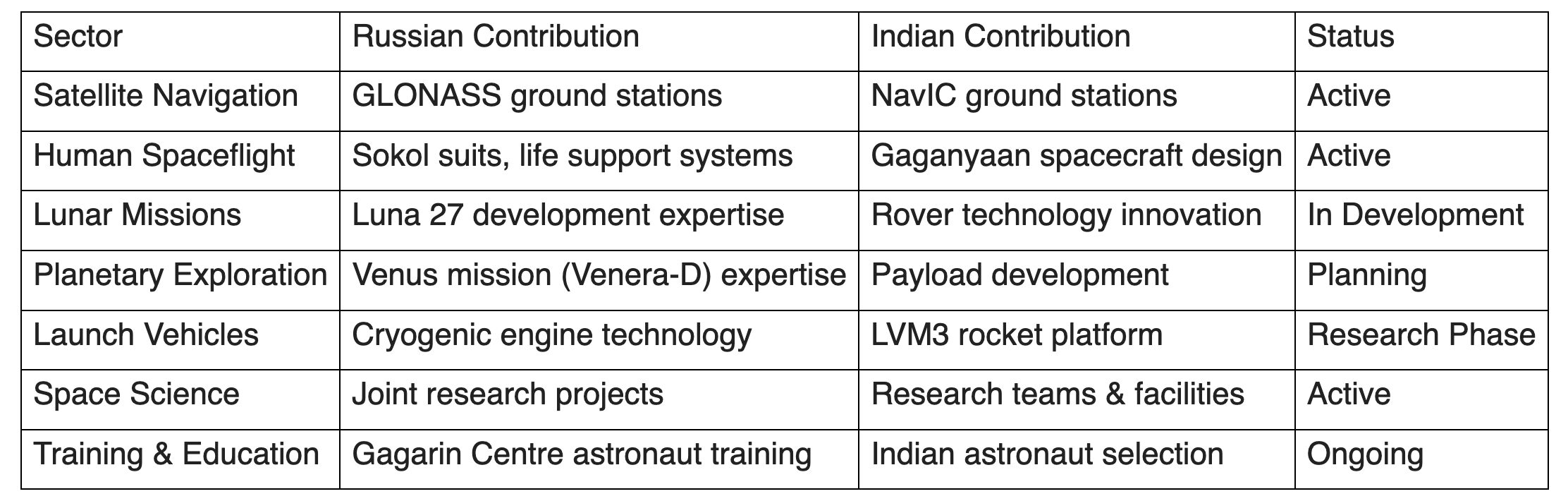
India-Russia space cooperation spans seven key areas, with Russia contributing advanced technologies (cryogenic engines, life support systems, navigation infrastructure) and India providing innovative solutions (spacecraft design, rover technology, satellite payloads) and human resources (astronaut training and research teams).
The India-Russia partnership encompasses complementary strengths across seven key space sectors:
Strategic Imperatives and Future Vision
The India-Russia space partnership reflects strategic complementarity. Russia maintains world-class capabilities in human spaceflight, heavy launch vehicles, cryogenic propulsion, and deep-space exploration refined through Soviet and post-Soviet achievements. India brings innovative solutions in cost-effective spacecraft design, rover technology, satellite manufacturing, and downstream services coupled with demographic advantage and emerging startup ecosystem.
Both nations recognize that space cooperation strengthens their geopolitical positioning, demonstrates technological self-sufficiency, and creates economic opportunities. The partnership also addresses global challenges through BRICS collaboration on space security, environmental monitoring via satellites, and peacefully using outer space.
The trajectory is clear: India’s space sector moving from hardware production to service monetization, Russia leveraging India’s market and innovation ecosystem, and both nations building toward ambitious 2030-2040 goals encompassing space stations, planetary missions, and sustained human presence in orbit. This partnership exemplifies how strategic allies can combine resources, expertise, and ambition to achieve goals neither could accomplish alone.