

Close Menu
Stratnews GlobalStratnews Global
    Facebook X (Twitter) Instagram
    Trending
    • Italian Scientists Create 3D-Printed Snacks from Lab-Grown Plant Cells
    • Korea Zinc to Build $7.4 Billion U.S.-Backed Smelter in Tennessee
    • Tesla Directors Earn $3 Billion from Stock Options, Raising Governance Concerns
    • Lawmaker Seeks Details on Trump’s Approval of Nvidia H200 Exports
    • Google to Lay Australia-Funded Subsea Cables in Papua New Guinea
    • Protesters in Tomsk Rally Against Russia’s Roblox Ban
    • NTT Chief Urges Japan to Focus on Niche Semiconductor Strategy
    • EU set to roll back 2035 ban on petrol and diesel cars amid automaker pressure
    Stratnews GlobalStratnews Global
    Write for Us
    Tuesday, December 16
    • Space
    • Science
    • AI and Robotics
    • Industry News
    Stratnews GlobalStratnews Global
    Home » Webb Telescope Uncovers Planet’s Final Dive into Host Star

    Webb Telescope Uncovers Planet’s Final Dive into Host Star

    Aishwarya ParikhBy Aishwarya ParikhApril 12, 2025 Space No Comments3 Mins Read
    Webb Telescope

    A Distant Planet Spiralled Into Its Star in a Fiery End

    In a remarkable observation, astronomers witnessed a planet being devoured by its host star—marking the first time such an event has ever been seen. Initially, scientists believed the star expanded into a red giant, engulfing the planet in its path. But new data from the James Webb Space Telescope paints a different picture.

    A Shift in Understanding

    The James Webb Space Telescope, which became operational in 2022, offered fresh insights into this cosmic event. Instead of the star expanding and swallowing the planet, researchers now believe the planet’s orbit gradually decayed. Over time, it spiralled inward, eventually crashing into the star in a dramatic plunge.

    This shift in perspective changes how astronomers view the life cycle of planetary systems. It appears that the planet moved towards the star—not the other way around.

    Webb Telescope detects Evidence of a Violent Demise

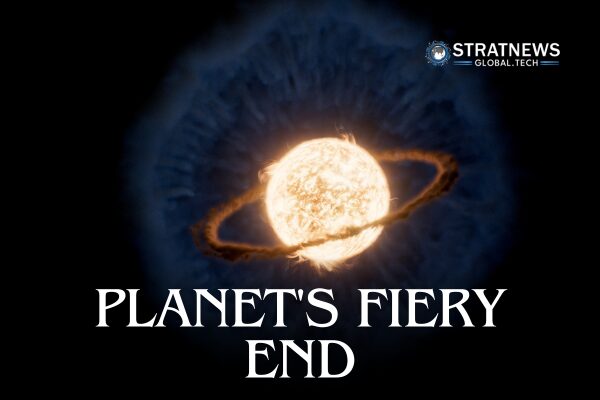
    The Webb Telescope detected hot gas forming a ring around the star and a surrounding cloud of cooler dust. These materials are the remnants of the planet’s final moments. Ryan Lau of the US National Science Foundation’s NOIRLab, who led the study, explained that this dusty material was likely ejected as the planet fell into the star.

    The star in question lies 12,000 light-years away in the constellation Aquila. It is slightly redder and dimmer than our sun, with around 70% of the sun’s mass.

    The doomed planet is thought to have been a “hot Jupiter”—a type of giant gas planet with a very tight orbit, resulting in high surface temperatures. According to researcher Morgan MacLeod of the Harvard-Smithsonian Center for Astrophysics, the planet must have been several times the mass of Jupiter to cause such dramatic effects.

    The Final Plunge

    As the planet’s orbit decayed, it began to skim the star’s outer atmosphere. This caused resistance, much like a headwind, which further slowed the planet and pulled it in faster. As it descended, the planet shed its gaseous layers and heated the star’s gas, which was then ejected into space.

    Although astronomers have a good understanding of the aftermath, the precise events remain uncertain. “We can’t run a lab experiment smashing a planet into a star,” said MacLeod. “But we can model what likely happened using computers.”

    Webb Telescope Discovers Planetary Orbits Decay Often

    The fate of this distant planet is not a direct threat to Earth, but it does offer a glimpse into a possible future. Scientists believe that none of the planets in our solar system currently orbit close enough to the sun for such a plunge. However, about five billion years from now, the sun will expand into a red giant. When that happens, Mercury, Venus, and possibly Earth could be consumed.

    These new observations suggest that planetary orbits might decay more often than stars expanding to consume them. Still, the solar system appears stable for now, giving Earth a lengthy stay of execution.

    with inputs from Reuters

    Author

    • Aishwarya Parikh
      Aishwarya Parikh

      View all posts
    Featured
    Share. Facebook Twitter Pinterest LinkedIn Tumblr Email Reddit Telegram WhatsApp
    Aishwarya Parikh

      Keep Reading

      Italian Scientists Create 3D-Printed Snacks from Lab-Grown Plant Cells

      Korea Zinc to Build $7.4 Billion U.S.-Backed Smelter in Tennessee

      Tesla Directors Earn $3 Billion from Stock Options, Raising Governance Concerns

      Lawmaker Seeks Details on Trump’s Approval of Nvidia H200 Exports

      Google to Lay Australia-Funded Subsea Cables in Papua New Guinea

      Protesters in Tomsk Rally Against Russia’s Roblox Ban

      Add A Comment
      Leave A Reply Cancel Reply

      Anti Drone System (CUAS)
      Latest Posts

      Italian Scientists Create 3D-Printed Snacks from Lab-Grown Plant Cells

      December 15, 2025

      Korea Zinc to Build $7.4 Billion U.S.-Backed Smelter in Tennessee

      December 15, 2025

      Tesla Directors Earn $3 Billion from Stock Options, Raising Governance Concerns

      December 15, 2025

      Lawmaker Seeks Details on Trump’s Approval of Nvidia H200 Exports

      December 15, 2025

      Google to Lay Australia-Funded Subsea Cables in Papua New Guinea

      December 15, 2025

      Protesters in Tomsk Rally Against Russia’s Roblox Ban

      December 15, 2025

      NTT Chief Urges Japan to Focus on Niche Semiconductor Strategy

      December 15, 2025

      EU set to roll back 2035 ban on petrol and diesel cars amid automaker pressure

      December 15, 2025

      U.S. Bill Targets Chinese Lidar Sensors Over Fear of Space Hack

      December 15, 2025

      President Murmu honours winners at National Energy Conservation Awards 2025

      December 15, 2025

      Subscribe to News

      Get the latest sports news from NewsSite about world, sports and politics.

      • Astronomical Events
      • Space Missions
      • Industry News
      • Science
      StratNewsGlobal Tech
      Facebook X (Twitter) Instagram LinkedIn YouTube
      © 2025 StratNews Global, A unit of BharatShakti Communications LLP
      • About Us
      • Contributors
      • Copyright
      • Contact
      • Write for Us

      Type above and press Enter to search. Press Esc to cancel.