


Close Menu
Stratnews GlobalStratnews Global
    Facebook X (Twitter) Instagram
    Trending
    • Budget 2026: Is India Attempting A Moonshot?
    • Google And Sea Partner To Develop AI Tools For E Commerce And Gaming
    • Microsoft Says ICE Not Using Its Technology For Mass Surveillance
    • Telegram Denies Russian Allegation Of Encryption Breach
    • Bill Gates Exit Deepens India AI Impact Summit Crisis
    • India AI Summit Robot Controversy Triggers Political Backlash
    • Instagram Youth Mental Health Trial Puts Mark Zuckerberg In Court
    • Telegram Military Messages Exposed To Foreign Intelligence Claims
    Stratnews GlobalStratnews Global
    Write for Us
    Thursday, February 19
    • Space
    • Science
    • AI and Robotics
    • Industry News
    Stratnews GlobalStratnews Global
    Home » ISRO to Launch Bharatiya Antariksh Station Module by 2028

    ISRO to Launch Bharatiya Antariksh Station Module by 2028

    Kanika SharmaBy Kanika SharmaJuly 29, 2025 India in Space No Comments3 Mins Read
    Bharatiya Antariksh Station

    India’s Bharatiya Antariksh Station to Launch First Module by 2028

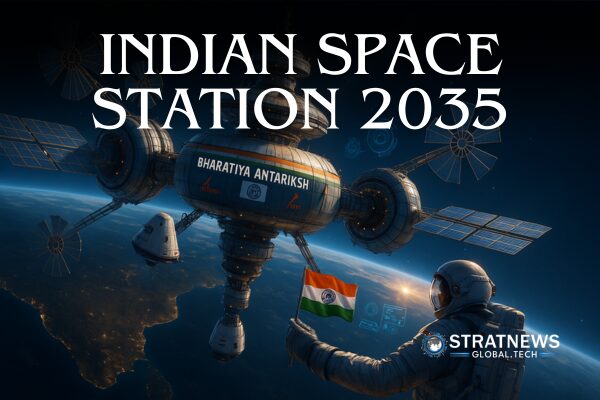
    India is preparing to launch its first space station, the Bharatiya Antariksh Station (BAS), a modular orbital facility set to operate around 400 to 450 kilometres above Earth. Managed by the Indian Space Research Organisation (ISRO), the station will support human spaceflight missions for up to six months at a time. Initially planned for completion by 2030, the project now aims to be fully operational by 2035 due to delays linked to the Gaganyaan mission and the COVID-19 pandemic.

    Weighing 52 tonnes in total, the station will consist of five modules, connected via a Common Berthing Mechanism. The structure will measure approximately 27 metres by 20 metres. The first module, BAS-1, is scheduled for launch aboard an LVM3 rocket in 2028. Subsequent modules will be deployed using the Next Generation Launch Vehicle.

    Decades of Development and International Cooperation

    The idea of an Indian space station was first introduced in 2019 by then-ISRO chief K. Sivan. Since then, the Gaganyaan programme has moved into the testing phase, paving the way for long-term human presence in space.

    ISRO Chairman S. Somanath revealed that the space station project forms part of India’s long-term space roadmap extending to 2047. This includes the full deployment of BAS by 2035 and aims for a manned lunar landing by 2040. During his visit to India in 2023, NASA administrator Bill Nelson offered US support if India seeks international collaboration for the station’s commercial development.

    In September 2024, the Union Cabinet approved the development of BAS-1 as part of the expanded Gaganyaan programme, which now includes eight missions, both manned and unmanned. The programme has received an additional ₹11,170 crore, bringing the total budget to ₹20,193 crore (approximately US$2.4 billion).

    Station Features and Capabilities

    BAS will have a nominal crew of 3-4 astronauts, with emergency support for up to six. The modules will include a base, core, science, lab, and common working unit, with individual solar panels for all but the latter. Initially, the station will run on two large solar panels, with robotic operations beginning in 2028 and human occupancy targeted for 2035.

    Docking systems compatible with the International Space Station are under development. A permanently docked emergency escape crew module will be available for rapid evacuation. The station’s electronics will be manufactured at the U R Rao Satellite Centre, and its hardware will be developed at the Vikram Sarabhai Space Centre.

    ISRO envisions the station as a foundation for future lunar missions and economic activity in space. Developmental testing is expected to begin by 2025, with Phase-1 design work already completed as of June 2024.

    Author

    • Kanika Sharma
      Kanika Sharma

      View all posts
    Featured
    Share. Facebook Twitter Pinterest LinkedIn Tumblr Email Reddit Telegram WhatsApp
    Kanika Sharma
    Kanika Sharma

      Keep Reading

      Google And Sea Partner To Develop AI Tools For E Commerce And Gaming

      Microsoft Says ICE Not Using Its Technology For Mass Surveillance

      Telegram Denies Russian Allegation Of Encryption Breach

      Bill Gates Exit Deepens India AI Impact Summit Crisis

      India AI Summit Robot Controversy Triggers Political Backlash

      Instagram Youth Mental Health Trial Puts Mark Zuckerberg In Court

      Add A Comment
      Leave A Reply Cancel Reply

      Anti Drone System (CUAS)
      Latest Posts

      Budget 2026: Is India Attempting A Moonshot?

      February 19, 2026

      Google And Sea Partner To Develop AI Tools For E Commerce And Gaming

      February 19, 2026

      Microsoft Says ICE Not Using Its Technology For Mass Surveillance

      February 19, 2026

      Telegram Denies Russian Allegation Of Encryption Breach

      February 19, 2026

      Bill Gates Exit Deepens India AI Impact Summit Crisis

      February 19, 2026

      India AI Summit Robot Controversy Triggers Political Backlash

      February 18, 2026

      Instagram Youth Mental Health Trial Puts Mark Zuckerberg In Court

      February 18, 2026

      Telegram Military Messages Exposed To Foreign Intelligence Claims

      February 18, 2026

      AI Scientific Discovery Era Heralded By Demis Hassabis

      February 18, 2026

      China Nuclear Test Allegation Raises Fresh Arms Control Concerns

      February 18, 2026

      Subscribe to News

      Get the latest sports news from NewsSite about world, sports and politics.

      • Astronomical Events
      • Space Missions
      • Industry News
      • Science
      StratNewsGlobal Tech
      Facebook X (Twitter) Instagram LinkedIn YouTube
      © 2026 StratNews Global, A unit of BharatShakti Communications LLP
      • About Us
      • Contributors
      • Copyright
      • Contact
      • Write for Us

      Type above and press Enter to search. Press Esc to cancel.