


Close Menu
Stratnews GlobalStratnews Global
    Facebook X (Twitter) Instagram
    Trending
    • Atomic Clock Failure On IRNSS-1F Pushes India’s NavIC Navigation Constellation Below Operational Threshold
    • Ukraine Opens Battlefield Data For AI Drone Training
    • Data Centres Become Election Issue In France
    • Apple Slashes App Store Fees In China
    • Google Names London HQ ‘Platform 37’ After AlphaGo Move
    • Pentagon Allows Limited Use Of Anthropic AI
    • Why Venture Capital Is Suddenly Betting on Indian Deep Tech
    • UK Warns Social Media Firms Over Child Safety
    • Support Us
    Stratnews GlobalStratnews Global
    Write for Us
    Saturday, March 14
    • Space
    • Science
    • AI and Robotics
    • Industry News
    • Support Us
    Stratnews GlobalStratnews Global
    Home » India Details Nuclear Waste Management Plan for 100 GW Power Expansion by 2047

    India Details Nuclear Waste Management Plan for 100 GW Power Expansion by 2047

    Aditya LenkaBy Aditya LenkaAugust 21, 2025 Technology No Comments3 Mins Read
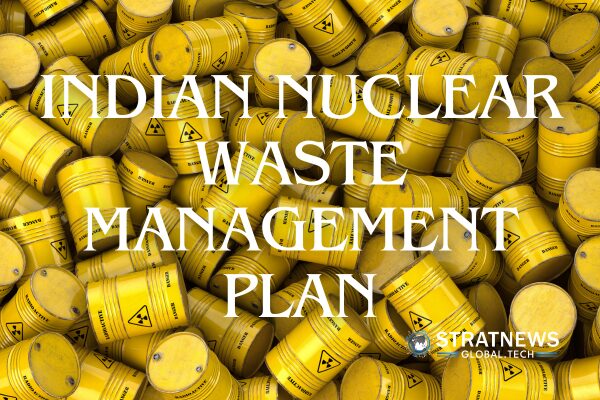
    India Nuclear Waste Management Plan

    India Outlines Nuclear Waste Management Plan for 100 GW Expansion by 2047

    The Government of India has reaffirmed that the planned expansion of nuclear power capacity to 100 GW by 2047 will be supported by a robust nuclear waste management plan. The system will continue to follow international best practices and the safety standards prescribed under Indian law.

    Current Practices in Nuclear Waste Management

    Nuclear waste generated from power plants and fuel cycle facilities is managed under The Atomic Energy Act, 1962 and the Atomic Energy (Safe Disposal of Radioactive Wastes) Rules, 1987. No waste is released into the environment unless cleared, exempted, or excluded by regulation.

    Most radioactive waste produced in India is of low and intermediate activity. Such waste is managed at the plant site itself through treatment, compaction, and immobilisation in materials like cement. It is then stored in reinforced concrete trenches and tile holes designed for long-term safety.

    These facilities are monitored continuously through bore-wells and soil sampling to ensure no leakage into groundwater or surrounding soil. This approach is aligned with guidelines of the International Atomic Energy Agency (IAEA).

    High-Level Waste and Reprocessing

    India follows a closed nuclear fuel cycle, where spent fuel is reprocessed to recover usable fissile material. This reduces the overall burden of waste management. High-level waste from reprocessing is vitrified into an inert glass matrix and stored in Solid Storage Surveillance Facilities for safe interim storage, in line with global standards.

    Research is ongoing into partitioning technologies that could recover long-lived radioactive elements, extract useful isotopes for industrial and medical use, and reduce waste volume. Work is also underway to develop technologies that can incinerate long-lived actinides, potentially eliminating the need for long-term disposal in the future.

    Roadmap to 100 GW and Funding Mechanism

    Following the Budget 2025–26 announcement, a roadmap for achieving 100 GW of nuclear power capacity by 2047 has been prepared. This includes legal, regulatory, and technological reforms in areas such as spent fuel reprocessing and waste management.

    The Nuclear Energy Mission, launched with an initial outlay of ₹20,000 crore for developing Small Modular Reactors (SMRs), is a critical part of this expansion. However, the overall mission will require significant financial resources. Along with extra-budgetary support, private investment will play a role.

    Importantly, nuclear energy has been recognised under India’s Climate Finance Taxonomy (Draft) as part of climate action. This recognition will make nuclear projects eligible for climate-linked funding, helping ease the financial burden of expanding nuclear infrastructure.

    With these measures, India aims to balance its ambitious nuclear expansion with safe, sustainable, and internationally compliant waste management practices.

    Author

    • Aditya Lenka
      Aditya Lenka

      A multi-faceted professional with a diverse range of skills and experiences. He currently works as a Producer, Digital Marketer, and Journalist for several well-known media outlets, namely StratNewsGlobal, BharatShakti, and Interstellar. With a passion for storytelling and a keen eye for detail, Aditya has covered a wide range of topics and events across India, bringing a unique perspective to his work.When he's not busy producing content, Aditya enjoys exploring new places and cuisines, having traveled extensively throughout India. He's also an avid writer and poet, often penning his thoughts and musings in his free time. And when he wants to unwind and relax, Aditya spends time with his two loyal companions, Zorro and Pablo, his beloved dogs.Aditya's dynamic personality and varied interests make him a unique individual, always eager to learn and experience new things.

      View all posts
    Featured
    Share. Facebook Twitter Pinterest LinkedIn Tumblr Email Reddit Telegram WhatsApp
    Aditya Lenka
    Aditya Lenka

      A multi-faceted professional with a diverse range of skills and experiences. He currently works as a Producer, Digital Marketer, and Journalist for several well-known media outlets, namely StratNewsGlobal, BharatShakti, and Interstellar. With a passion for storytelling and a keen eye for detail, Aditya has covered a wide range of topics and events across India, bringing a unique perspective to his work.When he's not busy producing content, Aditya enjoys exploring new places and cuisines, having traveled extensively throughout India. He's also an avid writer and poet, often penning his thoughts and musings in his free time. And when he wants to unwind and relax, Aditya spends time with his two loyal companions, Zorro and Pablo, his beloved dogs.Aditya's dynamic personality and varied interests make him a unique individual, always eager to learn and experience new things.

      Keep Reading

      Atomic Clock Failure On IRNSS-1F Pushes India’s NavIC Navigation Constellation Below Operational Threshold

      Ukraine Opens Battlefield Data For AI Drone Training

      Data Centres Become Election Issue In France

      Apple Slashes App Store Fees In China

      Google Names London HQ ‘Platform 37’ After AlphaGo Move

      Pentagon Allows Limited Use Of Anthropic AI

      Add A Comment
      Leave A Reply Cancel Reply

      Anti Drone System (CUAS)
      Latest Posts

      Atomic Clock Failure On IRNSS-1F Pushes India’s NavIC Navigation Constellation Below Operational Threshold

      March 14, 2026

      Ukraine Opens Battlefield Data For AI Drone Training

      March 13, 2026

      Data Centres Become Election Issue In France

      March 13, 2026

      Apple Slashes App Store Fees In China

      March 13, 2026

      Google Names London HQ ‘Platform 37’ After AlphaGo Move

      March 12, 2026

      Pentagon Allows Limited Use Of Anthropic AI

      March 12, 2026

      Why Venture Capital Is Suddenly Betting on Indian Deep Tech

      March 12, 2026

      UK Warns Social Media Firms Over Child Safety

      March 12, 2026

      Age Check laws gain momentum as nations target teen access

      March 10, 2026

      Space Exercise Device for Astronaut Microgravity Training

      March 10, 2026

      Subscribe to News

      Get the latest sports news from NewsSite about world, sports and politics.

      • Astronomical Events
      • Space Missions
      • Industry News
      • Science
      StratNewsGlobal Tech
      Facebook X (Twitter) Instagram LinkedIn YouTube
      © 2026 StratNews Global, A unit of BharatShakti Communications LLP
      • About Us
      • Contributors
      • Copyright
      • Contact
      • Write for Us

      Type above and press Enter to search. Press Esc to cancel.