


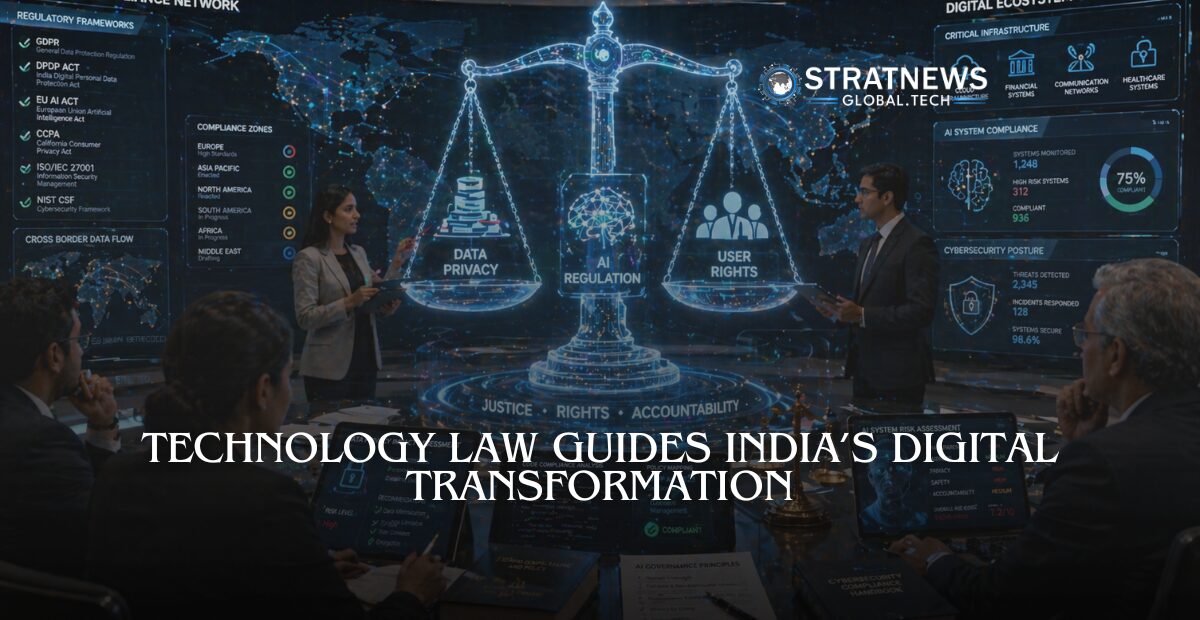
The Technology Revolution is upon us, but as India’s Attorney General R Venkatramani asked, what kind of law will manage it?
“Who defines how technology will give us freedom, and who defines that freedom? No part of our life is free from the regulation of law except our mind. The mind cannot be subject to any regulation except freedom of speech and expression.”
Those remarks were made at the release of a book ‘Technology law: Regulations, Cyber Policy and the Digital Landscape’ by authors Rodney D. Ryder and Nikhil Naren. Ryder is a Founding & Senior Partner at Scriboard, a law firm with specialisation in technology law, intellectural property, new media and telecommunications law. Naren is an assistant professor at the Jindal Global Law School.
The book comes at a time when India’s technology law framework is entering a decisive phase where digital transformation must be built on trust, clear rules on data protection, cybersecurity and artificial intelligence. Naren says, “I believe that the law must be imaginative enough to enable innovation, but rigorous enough to protect rights, dignity, and democratic institutions. I hope the book contributes meaningfully to the growing conversation on technology law in India and beyond.
At the core of the book is a comprehensive and updated overview of India’s evolving digital legal framework. It covers key developments in cybercrimes, digital markets, data protection, cybersecurity, AI governance, fintech regulation, and emerging technologies.
It has been written as an essential resource for lawyers, tech professionals, researchers, compliance officers and students looking to navigate the complexities of India’s digital regulatory ecosystem. Naren, the author, says that the book aims to explain technology law in a way that is conceptually strong, practically relevant, and accessible to readers who may not have a technical background.
At a panel discussion, it was undescored that with rapid AI penetration and India’s own LLM model now in the making, there is need for a transformational, yet citizen-centric, secure, open, interoperable, and inclusive legal technological framework.
Solicitor General Tushar Mehta said that in an era of digital growth and artificial intelligence, there are several challenges that we as a human race have never imagined. “Now, we are virtually called upon to mortgage our intellect to the machine.”
The rapid growth and scaling up of AI has underscored this concern: where does human intelligence end and machine intelligence begin? Are they similar, or how different? ‘Technology law: Regulations, Cyber Policy and the Digital Landscape’ may provide some answers.

