


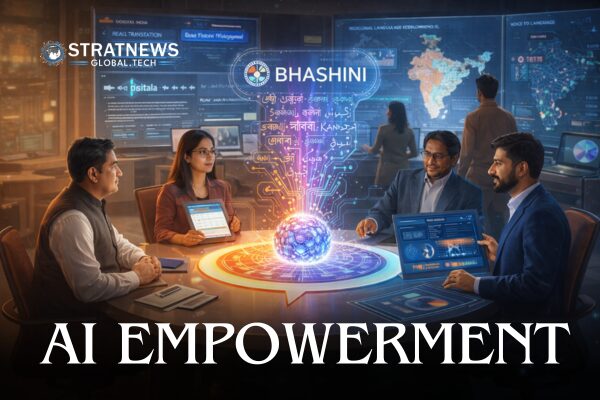
BHASHINI Samudaye: Building India’s Inclusive Language AI Future
The Digital India BHASHINI Division (DIBD) of the Ministry of Electronics and Information Technology (MeitY) successfully hosted BHASHINI Samudaye: Strengthening India’s Language AI Ecosystem at Nalanda Hall, Dr Ambedkar International Centre, New Delhi, in collaboration with Wadhwani AI. The workshop marked a key milestone in uniting India’s growing language AI ecosystem through collaboration, participatory governance, and shared digital infrastructure.
Strengthening India’s Multilingual AI Infrastructure
The event opened with welcome remarks, felicitation of guests, and a formal inauguration by senior MeitY officials. Leaders from the Digital India BHASHINI Division outlined a national vision for an inclusive and sovereign language AI ecosystem. This vision centres on public digital infrastructure, community participation, and ethical data practices that reflect India’s linguistic and cultural diversity.
A fireside discussion explored BHASHINI’s evolution as a national AI platform for multilingual technology, underlining the need for partnerships across government, academia, industry, and civil society. Speakers highlighted how a coordinated ecosystem could scale language AI solutions for governance, education, and public services.
The workshop gathered language experts, data practitioners, and institutional representatives to identify practical pathways for co-creating and governing language AI solutions under the National Language Translation Mission (NLTM).
Key Highlights and Collaborative Roadmap
The session Scaling BHASHINI Together: Platform, Priorities, and Pathways detailed strategies for platform expansion, institutional engagement, and state-level collaboration. Participants reviewed the BHASHINI Samudaye Platform to strengthen participatory governance and shared contribution mechanisms.
Live demonstrations showcased BHASHINI in Action, including real-world use cases and a walkthrough of BhashaDaan, the citizen contribution platform encouraging public participation in language data creation. An Expression of Interest (EoI) session further invited partnerships to align with BHASHINI’s ethical and inclusive data creation standards.
Delegates discussed long-term data partnerships, institutional collaborations, and methods to sustain India’s language AI ecosystem. Emphasis was placed on responsible data practices, robust quality standards, and scalable systems to ensure inclusive access to AI technologies.
Voices from the Ecosystem
“BHASHINI moved from rule-based systems to AI-powered inclusive engines, providing language services to all citizens and advancing towards full societal inclusivity,” noted officials from the Digital India BHASHINI Division.
“Samudaye is about building a living ecosystem—data creators, annotators, translators, developers, users, and governments—co-developing language technology together, with shared value and responsibility,” said Shri Amitabh Nag, CEO, Digital India BHASHINI Division (MeitY).
“Through sustained partnerships with government, academia, civil society, and industry, BHASHINI is creating a multilingual AI ecosystem that is inclusive, scalable, and aligned with public service objectives,” added Shri Tarun Pandey, Scientist ‘E’, MeitY.
Prof. Girish Nath Jha from Jawaharlal Nehru University highlighted the value of structured datasets and community participation, noting that “AI systems must reflect India’s linguistic diversity and societal needs.”
Smt. Shobha L. from AU-KBC Research Centre stressed BHASHINI’s comprehensive translation capabilities across all 22 scheduled and several non-scheduled languages, calling for expanded datasets to address challenges in Dravidian languages.
Sukhna Sawhney from Rocket Learning shared practical outcomes, stating that “AI and BHASHINI are helping us translate and dub educational content into multiple languages, reaching children and caregivers more effectively.”
Expanding the Language AI Network
The workshop concluded with a collective pledge to strengthen India’s language AI ecosystem through coordinated action and shared ownership. It reaffirmed the commitment to ensure that language does not remain a barrier to digital participation and that AI development remains ethical, inclusive, and accessible to all.
As part of this broader effort, BHASHINI, in partnership with the Gates Foundation and implemented by Civic Data Lab, launched the Dataset Onboarding Supporting Team (DOST). This initiative will systematically identify and integrate high-value datasets into BHASHINI and AI Kosh, addressing gaps in multilingual text, speech, and regional data. It aims to build a robust, bias-aware AI infrastructure serving key sectors such as education, governance, healthcare, agriculture, and climate resilience.
with inputs from PIB