


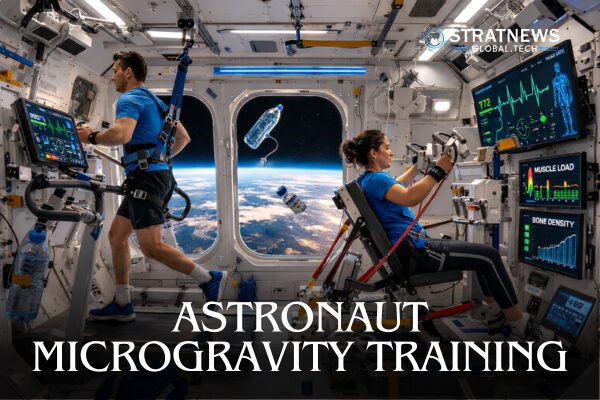
British startup Physical Mind London is developing a compact exercise system for astronauts on long space missions. Space agencies want smaller and more efficient solutions than the bulky machines used on the International Space Station. Therefore the company designed a device that focuses on movement, resistance and repeated jumping in microgravity.
The machine is called HIFIm, which stands for High Frequency Impulse for Microgravity. It allows astronauts to perform jumping, hopping and resistance exercises while floating in space. As a result, astronauts can train their muscles and bones without relying on large powered equipment.
Compact system for microgravity workouts
John Kennett founded Physical Mind and invented the HIFIm system. He explained that the machine uses mechanical balance to reduce forces and vibrations that reach a spacecraft. Consequently the device operates without electrical power and remains suitable for use in sensitive space environments.
Kennett said the design enables more than 300 exercises in microgravity. Moreover the system allows individuals to jump repeatedly in zero gravity. This ability matters because repeated loading helps build bone strength and muscle mass during long missions.
Astronauts often face serious health challenges in microgravity. Bones lose density and muscles weaken over time. Therefore regular exercise remains essential for maintaining strength and cardiovascular health during spaceflight.
Microgravity testing on parabolic flights
The company tested the device during parabolic flight campaigns. These flights create short periods of weightlessness and are often called vomit comets. During each flight, an aircraft follows steep arcs that briefly simulate microgravity conditions.
Kennett said the team needed to answer two key questions. First, they needed to confirm that astronauts could jump repeatedly in zero gravity. Second, they had to reduce the forces transferred to the aircraft structure.
Testing confirmed both goals. The system allowed repeated jumps while limiting the loads on the surrounding structure. Furthermore the device demonstrated its function as a microgravity exercise countermeasure.
Kennett said the design cancels its own forces through a simple mechanical principle. As a result the system maintains stability while astronauts exercise.
Research support and future space missions
The test team also included a single leg amputee. This step helped researchers study the potential use of the device for both astronauts and parastronauts. Additionally the technology may support rehabilitation programmes on Earth.
NASA states that astronauts currently spend around two hours exercising each day. They use equipment such as treadmills, cycle ergometers and resistance machines. However these systems require space, power and vibration control.
Physical Mind continues validation work with St Mary’s University Twickenham, the University of Salford and Northumbria University. Meanwhile the company hopes the technology may support future lunar missions.
One possible destination is the planned Gateway station. NASA intends to place this station in lunar orbit as part of the Artemis programme later this decade.
With inputs from Reuters
Author
 View all posts
A multi-faceted professional with a diverse range of skills and experiences. He currently works as a Producer, Digital Marketer, and Journalist for several well-known media outlets, namely StratNewsGlobal, BharatShakti, and Interstellar. With a passion for storytelling and a keen eye for detail, Aditya has covered a wide range of topics and events across India, bringing a unique perspective to his work.
When he's not busy producing content, Aditya enjoys exploring new places and cuisines, having traveled extensively throughout India. He's also an avid writer and poet, often penning his thoughts and musings in his free time. And when he wants to unwind and relax, Aditya spends time with his two loyal companions, Zorro and Pablo, his beloved dogs.
Aditya's dynamic personality and varied interests make him a unique individual, always eager to learn and experience new things.