


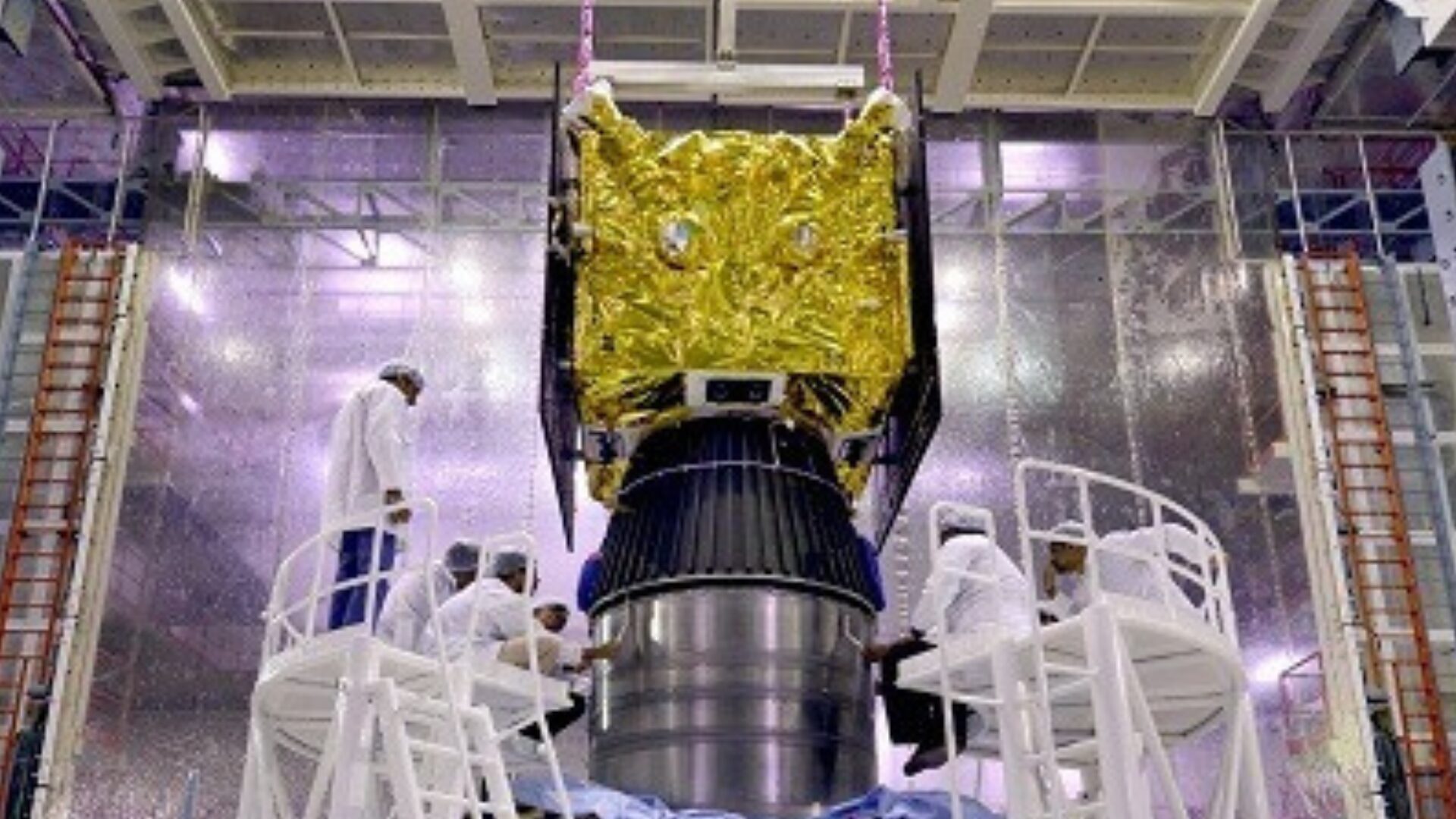
India’s regional satellite navigation system NavIC has slipped below the minimum operational threshold after the final functioning atomic clock aboard the IRNSS-1F satellite failed on March 13, leaving the constellation with only three satellites capable of supporting navigation services.
Satellite navigation systems require signals from at least four satellites with functioning atomic clocks to calculate a precise three-dimensional position on Earth. With IRNSS-1F no longer able to transmit reliable timing data, India’s indigenous navigation constellation currently lacks the minimum satellite geometry required for a standalone positioning solution.
The development has drawn attention within the space community because NavIC , short for Navigation with Indian Constellation, was built specifically to ensure that India has independent access to positioning, navigation and timing services.
Developed by the Indian Space Research Organisation (ISRO), the system was originally established under the Indian Regional Navigation Satellite System (IRNSS) programme. The first satellite was launched in July 2013, and a constellation of seven spacecraft placed in geostationary and geosynchronous orbits was completed over the next three years. By 2016, NavIC was declared operational, providing navigation coverage across India and extending roughly 1,500 kilometres beyond its borders.
Navigation signals from NavIC are used for maritime operations, disaster warning services for fishermen, vehicle tracking, aviation navigation and precise timing for telecommunications and financial networks.
Before NavIC became operational, India depended largely on foreign satellite navigation systems such as the United States’ GPS, Russia’s GLONASS and Europe’s Galileo. While these constellations provide global coverage, countries increasingly view independent navigation infrastructure as strategically important because access to positioning and timing data underpins a wide range of modern technologies.
At the heart of every navigation satellite are atomic clocks that keep extremely accurate time. Navigation receivers determine their location by measuring how long it takes signals to travel from satellites to the ground. Even tiny timing errors can translate into large positioning errors, which is why navigation satellites carry multiple high-precision clocks.
Each NavIC satellite carries rubidium atomic clocks that generate the timing signals required for navigation calculations. If these clocks fail, the satellite can no longer contribute to the positioning solution even if other parts of the spacecraft remain functional.
IRNSS-1F was launched in March 2016 aboard a Polar Satellite Launch Vehicle mission. The spacecraft carried three imported rubidium atomic clocks. Two of those clocks had stopped working over the years, leaving the satellite dependent on its final backup clock until its failure earlier this week.
“With the last atomic clock on IRNSS-1F now non-functional, the constellation effectively drops below the minimum satellite requirement for standalone navigation,” said Dr Srimathy Kesan, the founder and CEO of SpaceKidz India. “The infrastructure itself has not disappeared, but the system cannot provide an independent navigation fix in the way it was designed to.”
Several NavIC satellites, including IRNSS-1B, IRNSS-1I and NVS-01, continue to transmit signals. However, with fewer than four satellites able to participate in the navigation solution, the system cannot reliably compute a position using NavIC signals alone.
“In satellite navigation you need four satellites to solve for latitude, longitude, altitude and time,” said a former senior ISRO scientist who requested anonymity. “If the constellation drops below that threshold, the receiver cannot derive a complete solution from that system by itself.”
The scientist noted that clock failures have been one of the recurring technical challenges for the IRNSS programme. An earlier satellite, IRNSS-1A, lost all of its rubidium clocks several years after launch and eventually had to be replaced by IRNSS-1I in 2018.
Those failures prompted ISRO to accelerate work on domestically developed atomic clocks and newer spacecraft designs.
The next generation of navigation satellites, known as the NVS series, is intended to modernise the constellation. The first of these satellites, NVS-01, was launched in 2023 and carries an improved Indian-developed rubidium atomic clock along with additional navigation signals, including the L1 band widely used by commercial navigation devices.
“These upgrades are intended to improve compatibility with smartphones, automotive navigation systems and other consumer electronics that increasingly integrate multiple satellite navigation signals,” added Kesan.
For everyday users, the immediate effect of the current situation may be limited. Many modern navigation receivers combine signals from several constellations simultaneously, meaning that GPS, Galileo or GLONASS can continue to provide positioning data even if NavIC signals are unavailable or reduced.
However, the loss of redundancy weakens NavIC’s ability to operate independently, one of the main goals behind its development.
“The purpose of building NavIC was to ensure India would always have its own navigation capability available,” the former ISRO scientist said. “When satellites age and components fail, replacement spacecraft have to be launched before the constellation falls below the operational requirement.”
Restoring the constellation may take time. India’s launch schedule has slowed in recent months following anomalies that affected several rocket missions, prompting engineering reviews and investigations.
ISRO has already planned additional satellites under the NVS series, including NVS-03, NVS-04 and NVS-05, which are expected to replenish the constellation and extend its operational life.