


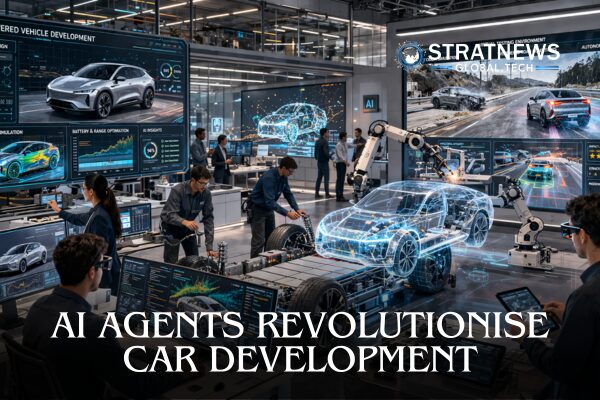
Geely Integrates AI Agents Into Vehicle Development
Chinese automaker Geely is advancing vehicle development by embedding AI agents across every stage of the process. This shift is increasing engineering efficiency while also enabling the creation of more intelligent vehicles.
At its Automobile Research Institute in Ningbo, engineering teams now work alongside an AI-powered digital employee. This system actively supports developers in tasks ranging from writing code to debugging systems. As a result, software development cycles have become significantly faster and more efficient.
Geely has already developed 64 key AI agents. These systems are expected to generate value exceeding 160 million yuan. Moreover, engineers report noticeable improvements in productivity, especially in handling complex software systems.
AI Boosts Engineering Efficiency
A modern vehicle contains thousands of software modules. Traditionally, engineers required extensive coordination to manage this complexity. However, AI assistance has changed this process considerably. Overall software development efficiency has increased by about 30 percent. In addition, coding efficiency alone has improved by up to 50 percent.
Hundreds of researchers at the institute have adapted to this new working model. Instead of simply acting as tools, AI agents now function as collaborative partners. Consequently, this approach represents a fundamental shift in automotive research and development.
Smarter Vehicles With Advanced AI Interaction
AI integration is not limited to development processes. It also enhances vehicle intelligence. In the institute’s smart cockpit, an advanced AI agent named EVA demonstrates this capability. It can interpret vague instructions and generate detailed outputs within seconds.
For example, when asked to plan a road trip, EVA quickly creates a full itinerary. It also includes key attractions and route details. Therefore, users experience a more intuitive and responsive system.
Developers describe this new generation of AI agents using three defining traits. These include strong interaction capabilities, independent reasoning, and advanced execution skills. As a result, vehicles can respond more intelligently to user needs.
Autonomous Capabilities And Continuous Learning
AI also enables vehicles to operate independently. During testing, a vehicle successfully performed unmanned pick-up and drop-off functions. Users simply used a smartphone app to summon the car. The vehicle then navigated traffic, responded to pedestrians, and arrived accurately without human input.
This capability relies on extensive simulation and training. Engineers have trained driving assistance systems using 25 million scenario fragments. Furthermore, computing systems allow continuous model training throughout the day.
Geely is also extending its AI innovations beyond internal development. The company is sharing these technologies with numerous suppliers. Consequently, this collaboration is improving efficiency across the automotive supply chain.
Additionally, Geely has introduced a unified AI framework known as the world behaviour model. This system integrates powertrain, chassis, and cockpit functions into a single structure. Therefore, vehicles can achieve better coordination and faster response. With this advancement, future product development cycles are expected to accelerate significantly.
With inputs from Reuters

