


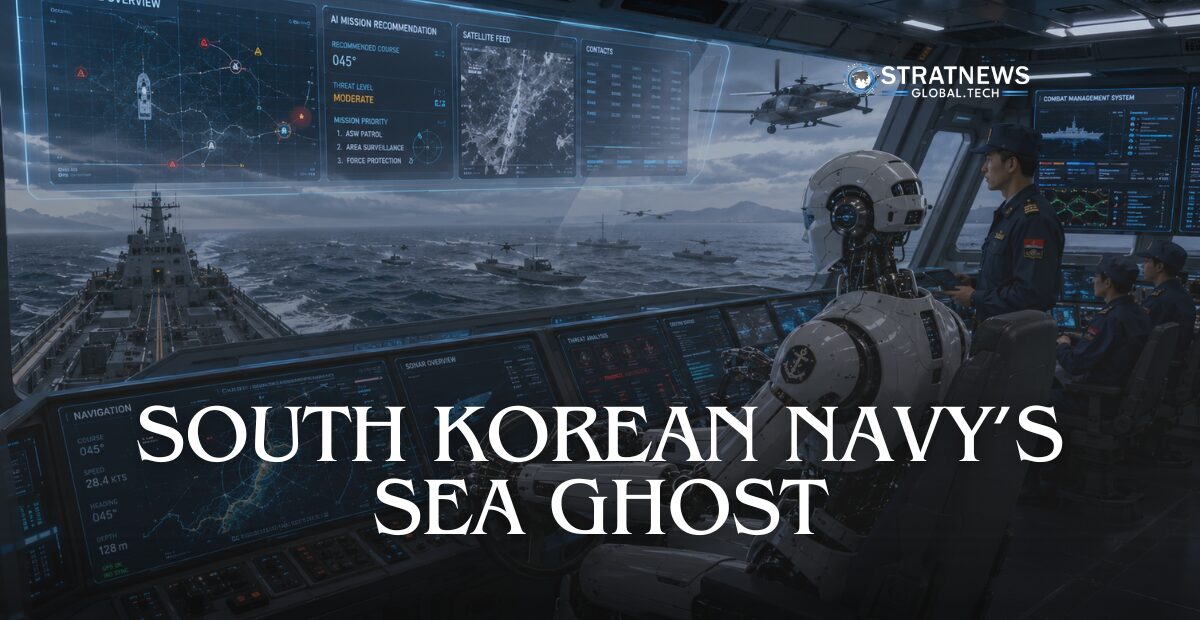
South Korea has taken a major step towards integrating artificial intelligence into military operations by testing a humanoid robot as a naval helmsman, underscoring how demographic decline is reshaping defence planning.
According to The Korea Times, the South Korean Navy recently conducted its first combat simulation with PIBOT, a humanoid robot developed by the Korea Advanced Institute of Science and Technology (KAIST) with government defence funding. The trial was carried out at a naval bridge simulator in Changwon.
Unlike conventional autonomous navigation systems, PIBOT is designed to interact like a human sailor. It receives spoken navigation orders, repeats them back to minimise communication errors, and physically operates a ship’s steering controls. During the simulation, the robot successfully handled demanding scenarios, including narrow waterways, rough seas, night operations and severe weather.
The exercise is part of the Navy’s Sea GHOST initiative, which envisions future fleets where human crews work alongside autonomous and robotic systems. Officials say the trial is the first of four development phases, with PIBOT expected to progress from simulator testing to moored vessels before eventually being evaluated aboard operational warships in both daytime and nighttime conditions.
The project reflects a growing challenge facing South Korea’s armed forces. With one of the world’s lowest birth rates and a rapidly ageing population, the country is seeing a steady decline in the number of conscription-age recruits. Rather than simply reducing force levels, the military is investing heavily in AI and robotics to preserve operational readiness while modernising its capabilities.
Researchers at KAIST describe PIBOT as an example of “physical AI” moving beyond laboratories into real-world defence applications. If future trials prove successful, humanoid robots could eventually assist or replace sailors in routine ship-handling tasks, allowing human personnel to focus on more complex combat and decision-making roles.
The experiment also highlights a broader global trend, with militaries increasingly viewing artificial intelligence not just as a battlefield advantage, but as a practical solution to long-term manpower shortages.
(With inputs from agencies)

