


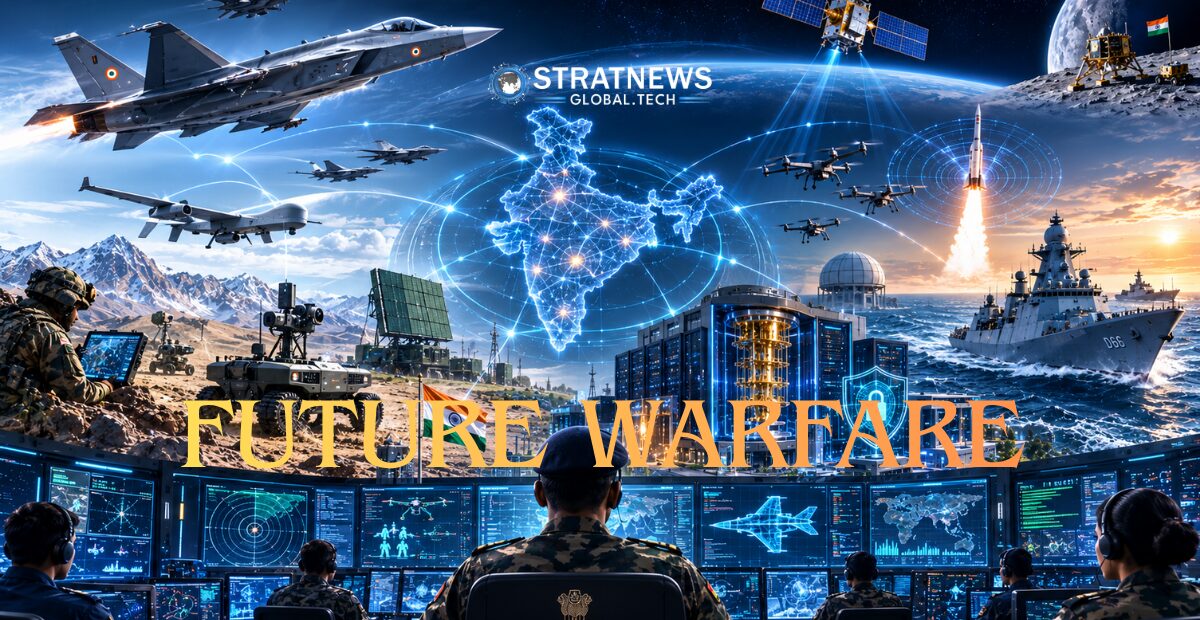
Technology-Driven Warfare Is Redefining National Security: Dr Jitendra Singh
Technology-driven warfare is transforming the future of national security, with Artificial Intelligence (AI), Quantum Technologies, Biotechnology and Space capabilities emerging as the key pillars of strategic preparedness, Union Minister Dr. Jitendra Singh has said. Delivering a special address at the National Defence College (NDC), the Minister emphasised that scientific innovation has become central to national security, economic resilience and global competitiveness.
Speaking on the theme “Future Trajectory of Science & Technology and its Impact on National Security,” Dr. Jitendra Singh said India must remain ahead of the technology curve to effectively address emerging security challenges and safeguard its strategic interests in an increasingly complex global environment.
Technology Reshaping Modern Warfare
Dr. Jitendra Singh said warfare is rapidly shifting from conventional combat towards technology-driven strategic operations. He noted that modern conflicts are increasingly determined by technological superiority rather than physical force alone.
According to the Minister, recent military operations across the world have demonstrated the decisive role of advanced technologies in space, communications, surveillance, precision systems and strategic decision-making. He added that India’s growing indigenous technological capabilities have significantly strengthened the country’s defence preparedness while enhancing its global standing.
He stressed that scientific and technological advancements have moved beyond military establishments and now play a central role in ensuring the security, prosperity and resilience of nations.
India Strengthening Defence Manufacturing
Highlighting India’s progress in defence production, Dr. Jitendra Singh said the country has steadily transitioned from being heavily dependent on imported defence systems towards greater self-reliance and indigenous innovation.
He stated that defence production has increased by nearly 174 per cent since 2014, reaching approximately ₹1.54 lakh crore. Defence exports have also expanded nearly 34-fold to more than ₹23,000 crore, reflecting the growing strength of India’s defence manufacturing ecosystem.
The Minister said private industry has emerged as a key contributor to this transformation, accounting for a significant share of defence exports. He also highlighted the contribution of more than 16,000 MSMEs and hundreds of startups engaged in defence manufacturing and technology development.
According to him, the expanding ecosystem demonstrates how innovation, entrepreneurship and national security objectives can work together to drive industrial growth and technological advancement.
AI, Quantum, Biotechnology And Space To Define Future Security
Dr. Jitendra Singh identified Artificial Intelligence, Quantum Technologies, Biotechnology and advanced Space capabilities as the technologies that will shape the future security landscape.
On Artificial Intelligence, he said future military systems will increasingly rely on autonomous platforms, intelligent surveillance, predictive analytics, cognitive warfare capabilities and rapid decision-making systems. He added that AI and Machine Learning will transform military training, logistics, operational planning and threat assessment by enabling faster and more accurate responses.
Discussing Quantum Technologies, the Minister said advancements in quantum sensing, quantum communication and quantum cryptography are set to redefine strategic capabilities worldwide. He noted that the launch of the National Quantum Mission in 2023 reflects India’s determination to remain among the global leaders in secure communications and advanced computing.
He also emphasised the importance of deploying quantum-secure communication networks and post-quantum cryptography to safeguard critical national and military infrastructure in the coming years.
Speaking on Biotechnology and Synthetic Biology, Dr. Jitendra Singh highlighted the growing importance of preparing for emerging biosecurity challenges, including engineered pathogens and advanced biological threats. He said sustained investments in biotechnology will strengthen India’s resilience against future health and security risks.
Focus On Predictive Security And Cyber Protection
Dr. Jitendra Singh said India’s future security architecture should prioritise predictive and proactive threat management, stronger protection of digital and cyber frontiers, and greater self-reliance in strategic technologies and supply chains.
He explained that emerging technologies will enable dynamic threat detection, autonomous response systems and advanced cybersecurity mechanisms capable of protecting national interests in an interconnected world.
The Minister also called for deeper collaboration between government institutions, industry, academia, startups and research organisations. He said public-private partnerships will play a critical role in accelerating innovation and ensuring that scientific discoveries move quickly from laboratories to operational deployment.
Civilian Innovation Must Support Defence Needs
Emphasising the need for an integrated innovation ecosystem, Dr. Jitendra Singh said India’s long-term strategic strength will depend on closer alignment between civilian scientific research and military requirements.
He said stronger collaboration across sectors will help convert technological breakthroughs into deployable capabilities, strengthening both national security and India’s position as a leading technology-driven economy.
The Minister also expressed appreciation for the Armed Forces, acknowledging their service not only in safeguarding the nation during conflicts but also in responding to disasters, emergencies and humanitarian crises. He said their dedication continues to strengthen the fabric of national life.
The address concluded with an interactive discussion involving senior officers and course participants of the National Defence College on emerging technologies, innovation-led security strategies and evolving national security challenges in the twenty-first century.
With inputs from Reuters