


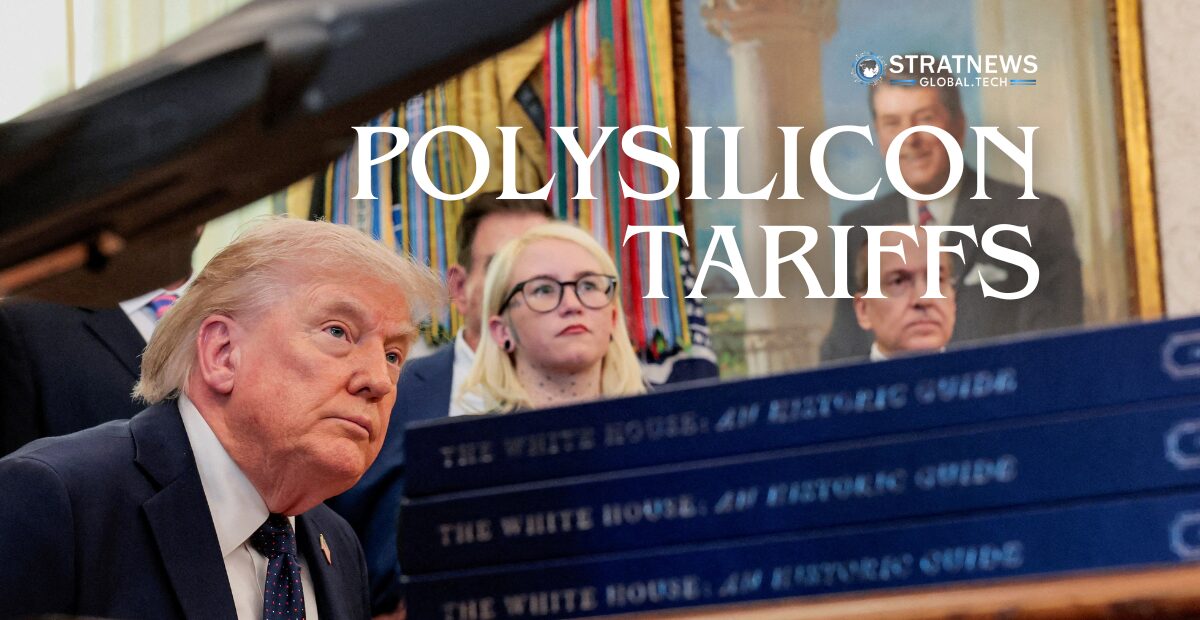
White House Imposes Tariffs and Price Floors on Polysilicon Imports
The White House has announced new trade measures on polysilicon and related products, introducing a 15% tariff alongside minimum import prices aimed at strengthening domestic semiconductor and solar manufacturing. The action is intended to bolster U.S. supply chains considered vital for artificial intelligence, energy security and competition with China.
President Donald Trump issued the proclamation under Section 232 of the Trade Expansion Act of 1962. According to the order, the measures are designed to support the long-term commercial viability of U.S. production of polysilicon and its derivatives, which the administration considers essential to the country’s economic and national security.
Polysilicon is an ultra-pure form of silicon used at the beginning of the semiconductor and solar manufacturing process. Manufacturers convert polysilicon into silicon wafers, which are then used to produce solar cells before being assembled into solar panels.
New Measures Target Domestic Supply Chains
For more than a decade, U.S. solar manufacturers have accused Chinese competitors of dumping solar panels into the American market, benefiting from unfair government subsidies and relocating manufacturing to other countries to avoid existing U.S. tariffs.
The United States currently has two polysilicon manufacturing facilities. Hemlock Semiconductor operates a plant in Michigan through a joint venture between Corning and Japan’s Shin-Etsu Handotai. Meanwhile, Munich-based Wacker Chemie operates a production facility in Tennessee.
Corning welcomed the decision, saying the measures encourage continued investment in domestic manufacturing capacity and strengthen the long-term competitiveness of U.S. industry.
Wacker Chemie said it was reviewing the new measures to assess their full impact. The company added that it appreciated the administration’s continued engagement on an issue with significant implications for semiconductor supply chain resilience, advanced computing infrastructure and broader U.S. defence and security interests.
Solar Industry Supports Semiconductor Production
Domestic semiconductor manufacturing relies heavily on the solar industry’s demand for polysilicon, which helps sustain production volumes needed for chip manufacturing.
According to the Semiconductor Industry Association, the semiconductor sector accounts for approximately 2.4% of global polysilicon demand.
U.S. solar manufacturing has expanded since Congress introduced tax incentives in 2022. However, much of that growth has focused on assembling solar panels rather than producing the wafers and cells used to manufacture them. As a result, many manufacturers continue to depend on imported components that require longer-term investment to produce domestically.
Several companies with manufacturing operations in the United States welcomed the administration’s decision, including T1 Energy, First Solar and Qcells, the U.S. solar business of South Korea’s Hanwha.
T1 Energy Chief Executive Dan Barcelo described the announcement as a significant victory for advanced American manufacturing and domestic energy supply chains. In addition to operating a solar panel plant in Texas, the company is investing $510 million in a new solar cell manufacturing facility.
Price Floors and Tariffs Take Effect in December
The White House said the trade protections will take effect on 4 December.
Tim Brightbill, a trade attorney with Wiley Rein who has represented cases against Chinese solar companies, warned that the delayed implementation could trigger a surge in imports before the new measures come into force.
Meanwhile, companies that purchase solar panels have argued that the delay provides time to adjust existing supply agreements to accommodate higher prices.
Under the proclamation, minimum import prices have been set at $21 per kilogram for polysilicon, $100 per kilogram for polysilicon ingots and wafers, $0.22 per watt for solar cells and $0.38 per watt for solar modules.
In addition, the order authorises the Commerce Department to establish an incentive programme for companies investing in facilities that manufacture polysilicon or products derived from it.
With inputs from Reuters

