


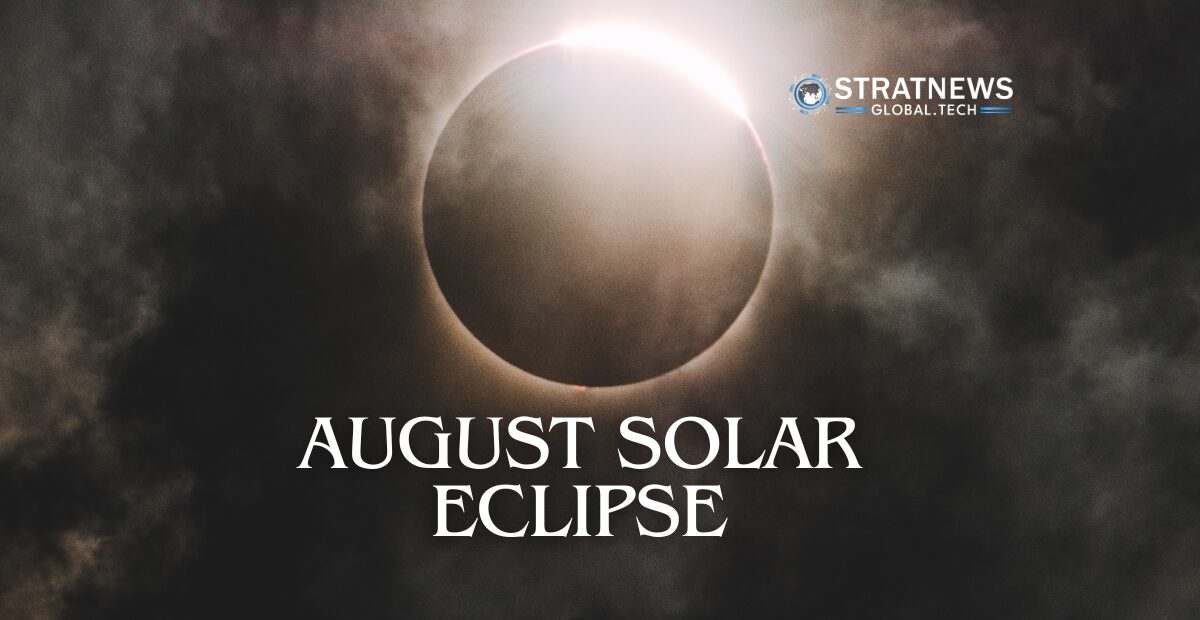
NASA Science Soars During August Total Solar Eclipse
NASA-funded science teams will take to the skies during the Aug. 12 total solar eclipse to study the Sun’s corona and changes in Earth’s atmosphere.
As the Moon passes in front of the Sun, the eclipse will darken daytime skies across parts of Russia, Greenland, Iceland, Spain and Portugal. The event will also give scientists a rare opportunity to study the Sun and its effects on Earth.
NASA teams will use a high-altitude WB-57 research jet and scientific balloons to collect observations before, during and after the eclipse.
High-Altitude Jet To Study Solar Corona
NASA’s WB-57 will carry four cameras in its nose cone to capture high-resolution images of the solar corona in several visible and infrared wavelengths.
The cameras, part of an instrument developed by NASA’s Scientifically Calibrated In-Flight Imagery team, will capture at least 20 images per second. Scientists will use the observations to examine structures, outflows and rapid changes in the corona.
The research could provide more insight into the formation of solar prominences, which are streams of solar material suspended above the Sun’s surface. Scientists also want to better understand how the corona reaches temperatures of nearly one million degrees.
In addition, the observations could help researchers investigate the relationship between material in the corona and the solar wind that flows from the Sun across the solar system.
The aircraft will fly at 50,000 feet and travel at about 460 miles per hour along the eclipse path. As a result, the jet will extend the observation period of the corona to nearly three minutes, compared with a maximum of two minutes and 18 seconds for observers on the ground.
The high altitude will also keep the aircraft above clouds. Furthermore, it will allow the cameras to observe infrared wavelengths that are absorbed by Earth’s lower atmosphere before reaching the ground.
Scientists Build On Earlier Eclipse Research
The instrument, known as the SCIFLI Multispectral Airborne Imager, or SAMI, also flew aboard a WB-57 during the April 8, 2024, total solar eclipse.
That mission produced imagery and information about the corona. However, scientists say every eclipse presents different conditions because the Sun is constantly changing.
For the 2026 campaign, researchers have adjusted exposure times to capture bright features that were overexposed in 2024. They will also use software developed since the earlier mission to process and analyse data more quickly.
The experiment is funded through NASA’s Heliophysics Low Cost Access to Space Program.
Balloons To Track Atmospheric Changes
NASA-supported researchers will also use scientific balloons to examine how the temporary darkness of a total solar eclipse affects Earth’s atmosphere.
The Nationwide Eclipse Ballooning Project, led by Angela Des Jardins at Montana State University, is sending students from several U.S. universities to Iceland and Spain.
In Iceland, two teams will launch a total of 80 balloons from 18 hours before the eclipse until eight hours afterwards. The balloons will study the atmosphere’s boundary layer, which is the part of the atmosphere closest to the ground.
Previous balloon observations during eclipses in October 2023 and April 2024 showed that the boundary layer became thinner at locations with clear skies. However, researchers did not observe the same change where skies were cloudy.
Scientists want to determine whether the same pattern will occur in Iceland during the 2026 eclipse. Conditions could differ because Iceland has long days and short nights in August, potentially reducing the influence of nighttime changes.
Spain Teams To Measure Eclipse Effects
In Spain, three balloon teams will launch six balloons equipped with 360-degree cameras. The balloons will capture images of the eclipse shadow from above.
The balloons will also carry instruments to measure ozone levels in the atmosphere. Sunlight is required for ozone to form, so researchers expect eclipse-related changes to provide another opportunity to study atmospheric behaviour.
Similar balloon experiments during the April 2024 eclipse found that ozone levels decreased during totality.
Researchers will compare the new observations with earlier results. The August 2026 eclipse occurs at a different time of day and during a different season, which could produce different atmospheric effects.
Together, the aircraft and balloon experiments will give scientists multiple perspectives on the eclipse. The observations are intended to improve understanding of both the Sun’s changing corona and the atmosphere’s response to the sudden loss of sunlight.