


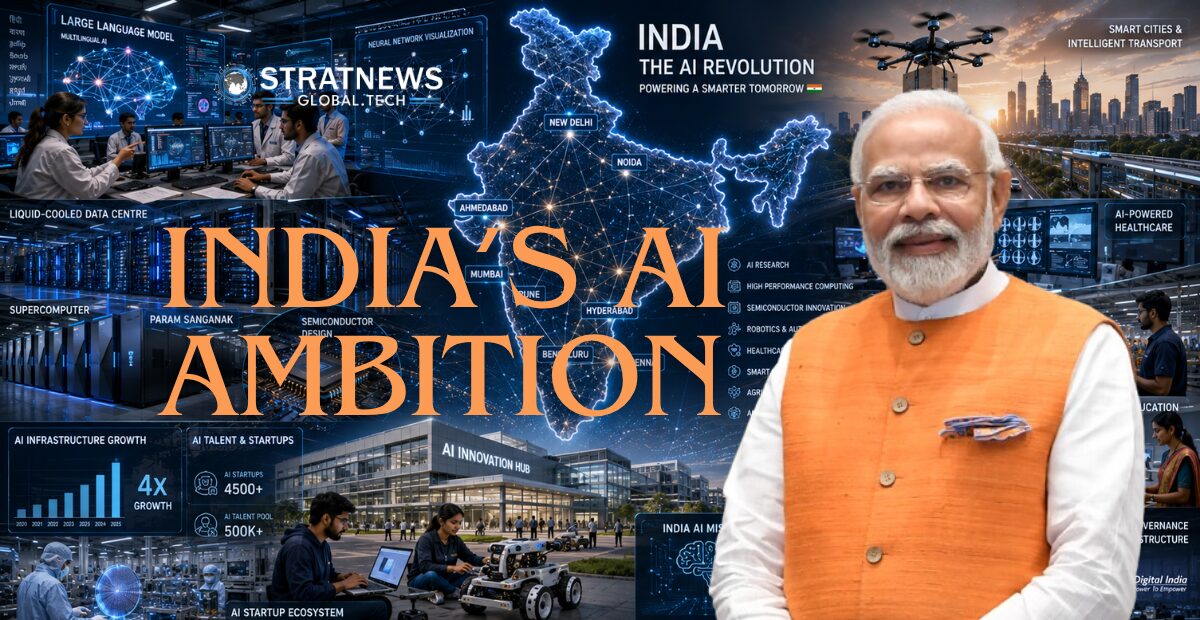
India’s $1 Trillion AI Ambition: The Roadmap to 2030
India’s digital economy is set to cross $1 trillion by fiscal year 2027-28, according to targets set by the Ministry of Electronics and Information Technology (MeitY). Artificial intelligence sits at the center of that push, not as a side project but as the primary growth engine behind it. A NITI Aayog report released in September 2025, titled “AI for Viksit Bharat,” estimates that rapid AI adoption could add $500-600 billion to India’s GDP by 2035, arriving on top of the country’s existing growth trajectory.
B.V.R. Subrahmanyam, CEO of NITI Aayog, framed the stakes in the report’s foreword. Reaching the 8% annual growth rate required for the Viksit Bharat 2047 vision leaves the country “no option but to significantly raise productivity across the economy.” Viksit Bharat 2047 is the national plan to make India a developed economy by its centenary of independence, and AI now anchors the strategy for closing the gap between today’s 5.7% growth path and that 8% ambition.
Infrastructure: The Compute and Data Backbone
None of this growth happens without infrastructure, and India has built two layers of it in parallel. The first is Digital Public Infrastructure (DPI) — the India Stack of identity, payments, and data-sharing rails built over the past decade. DPI already handles billions of transactions and now doubles as training ground for AI models tuned to Indian conditions: multiple languages, patchy connectivity, and a population that skipped straight from cash to mobile payments.
The second layer is compute. The IndiaAI Mission, a ₹10,372 crore government initiative funded to provide sovereign compute, data platforms, and startup capital, has onboarded more than 38,000 GPUs for common use as of early 2026. Union IT Minister Ashwini Vaishnaw announced plans in February 2026 to add another 20,000 units under what officials are calling “AI Mission 2.0,” pushing capacity well past the original 10,000-GPU target set in 2024. Startups and researchers access this compute at roughly ₹65 per hour, a fraction of global market rates. Vaishnaw also pointed to more than $200 billion in AI-linked investment expected to flow into India’s ecosystem over the next two years.
| Growth Enabler | 2024 Status | 2030 Projection |
|---|---|---|
| AI Market Size | $7.6B | $131B+ |
| GPU Count | 38,000 | 100,000+ |
| AI Professionals | 400,000 | 1,000,000+ |
Stanford’s 2025 Global AI Vibrancy rankings placed India third worldwide, up from seventh the year before, trailing only the United States and China. The jump reflects gains across research output, talent, infrastructure, and policy rather than strength in a single pillar — evidence that the compute build-out is translating into measurable standing, not just spending.
Sectoral Adoption: From Consumer to Creator
Adoption patterns are shifting from consumption to creation. India already leads the world in raw AI usage — OpenAI and Z47 reported more than 100 million monthly ChatGPT users in the country by May 2026 — but enterprise deployment tells a different story. Banking, financial services, and insurance (BFSI) firms use AI for underwriting, fraud detection, and customer service at scale. Manufacturing is moving toward AI-run quality inspection and predictive maintenance on factory floors. Healthcare providers use AI-assisted diagnostics and drug discovery pipelines, with software-defined and increasingly autonomous vehicles cited as a parallel frontier in automotive.
The pattern across all three sectors is the same: companies that once imported AI tools now build models trained on Indian data, in Indian languages, for Indian regulatory conditions. NITI Aayog’s “AI for All” strategy formalizes this shift, pushing for AI benefits to reach small businesses, farmers, and public services rather than concentrating in metro-based tech firms. AI Kosh, the government’s open dataset platform, already hosts several hundred public datasets meant to support that broader base of builders.
GenAI and the Productivity Question
EY India’s “AIdea of India” report puts a number on the labor side: generative AI could transform 38 million jobs by 2030 while lifting organized-sector productivity by 2.61%. The unorganized sector, which employs a majority of India’s workforce, could add another 2.82% if GenAI tools reach informal businesses and gig workers. Combined, EY estimates the broader GenAI impact at $1.2-1.5 trillion over seven years.
The gap between opportunity and readiness is wide. EY’s survey of enterprise leaders found only 3% of Indian companies report having sufficient in-house AI talent, with the remaining 97% citing skills shortages as a primary barrier to deployment. Rajiv Memani, Chairman and CEO of EY India, said building talent pipelines and prioritizing upskilling need to sit at the center of every organization’s AI strategy. That gap, more than compute or capital, looks like the binding constraint on how fast the $1 trillion target arrives.
Closing the Loop: What Enterprises Do Next
For business leaders, the strategic message is not subtle: AI investment now determines competitive position later. Companies waiting for certainty on regulation or ROI risk falling behind competitors already retraining workforces and rebuilding data infrastructure around AI-native workflows. Talent pipelines need attention years ahead of demand, not after a skills gap becomes a bottleneck.
Policymakers face a parallel task — extending DPI-style public infrastructure and compute access to smaller cities and informal-sector businesses, so productivity gains do not concentrate among firms that already had the capital to move first. NITI Aayog’s own report frames this as a governance problem as much as a technology one: AI creates new roles while displacing routine and clerical work, and managing that transition sector by sector will determine whether the $500-600 billion projection becomes reality or stays aspirational.
India’s path to a trillion-dollar AI-driven economy runs through indigenous model-building, sovereign compute, and a workforce retrained faster than automation displaces it. The infrastructure exists. The GPUs are provisioned, the DPI rails are built, and the capital is committing. What remains is execution — sector by sector, skill by skill, between now and 2030.
How AI impacts India’s GDP by 2030:
- $500-600 billion potential GDP addition by 2035 (NITI Aayog)
- $85-100 billion from manufacturing productivity gains alone
- $50-55 billion from financial services efficiency gains
- 38 million jobs transformed by GenAI adoption
- $1.2-1.5 trillion broader GenAI economic impact over seven years (EY)
- 1,000,000+ AI professionals projected by 2030, up from 400,000 in 2024