


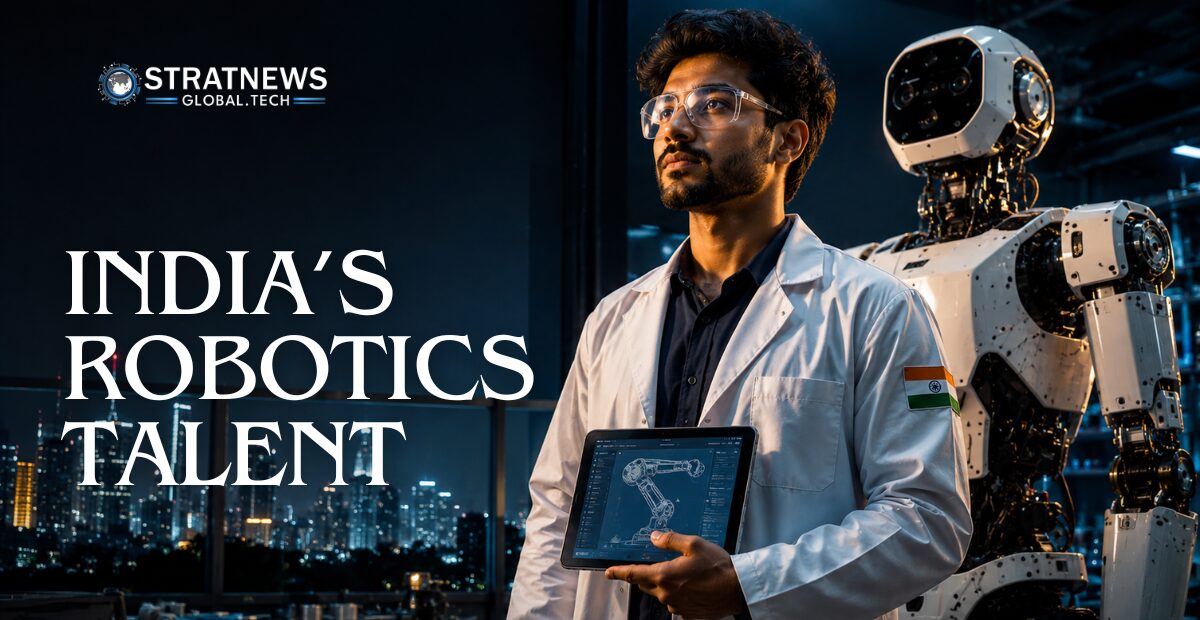
The Brain Gain Flywheel: Shaping Elite Robotics Talent
For three decades, India’s best engineers left for Silicon Valley, and the country counted their absence as a cost. That equation is shifting. LinkedIn data shows a 40% rise in tech professionals relocating to India, feeding $100 billion worth of Global Capability Center hubs that now compete directly with the US offices these engineers once chased. Call this reversal the “Brain Gain Flywheel”: talent leaves, gains frontier expertise abroad, and returns to build the exact domestic capability that used to be missing.
[Backlink insertion opp: Future of Industrial Automation in India]
Robotics sits at the center of that flywheel because domestic demand finally matches the ambition returnees bring home. India’s AI talent pool needs to grow from roughly 600,000 in 2022 to more than 1.25 million professionals by 2027, a 15% compound annual growth rate, according to a Deloitte-NASSCOM report. Industrial robot installations reached 9,100 units in 2024, per IFR data, evidence that manufacturers are finally buying the hardware this talent pool will need to program, integrate, and maintain. The gap between what returnees bring and what the domestic market now demands is closing from both sides at once.
From brain drain to brain circulation
Brain circulation describes something narrower than simple return migration: professionals who left, absorbed genuinely frontier expertise, and bring that expertise home as a net addition rather than a wash. A senior engineer who spent eight years building perception systems at a US robotics firm returns with knowledge no Indian program could have taught them locally. That knowledge does not disappear when they move; it compounds inside whichever Indian team hires them next.
[Backlink insertion opp: STEM Education Reform and Robotics]
GCCs drive much of this circulation today. Global firms now run deep-tech engineering functions out of Bengaluru, Pune, and Hyderabad, not just support and back-office operations, giving returnees senior technical roles without requiring a US relocation to reach them. Reports describe these centers offering “Tier-0” exposure: work on the same frontier problems a firm’s headquarters team handles, executed from an Indian campus instead of a Bay Area one. Returnees increasingly lead product innovation and shape global strategy from India directly, rather than executing specifications written elsewhere. That distinction, senior technical ownership versus delegated execution, is what converts a returnee hire into a flywheel input instead of a one-off relocation.
Robotics-specific returnees add a layer GCCs alone cannot replicate: startup experience. Founders who built or worked at US and European robotics ventures bring product instincts, not just engineering depth, and several have gone on to found or lead Indian robotics companies directly. That combination, technical depth plus product judgment, is scarcer than either skill alone and harder for India to grow purely through domestic training pipelines.
Building the supply side through education reform
The National Education Policy 2020 set a target of exposing 50% of students to vocational education by 2025, integrating subjects including AI, data analytics, mechatronics, and IoT starting at Grade 6. States have moved unevenly on that mandate: Chhattisgarh introduced robotics and AI education across 800 government schools, while Gujarat’s technology-enabled education infrastructure now reaches over 1.15 crore students across 54,000 schools. Coverage remains inconsistent nationally, but the direction is set at the policy level.
Mechatronics, engineering that combines mechanical systems, electronics, and control software in one discipline, sits closer to what a robotics employer actually needs than a pure computer science degree does. A robot’s software runs the intelligence, but its mechanical joints, sensors, and actuators need engineers who understand torque, kinematics, and circuit design alongside code. India’s traditional CS-heavy pipeline underproduces graduates who can move fluently between those layers.
IITs carry the research depth and brand recognition that anchors India’s robotics talent pipeline, producing the founders and senior engineers driving today’s headline companies. Private universities move faster on curriculum, adding mechatronics and AI-integrated hardware tracks years before public institutions revise formal syllabi. Neither model alone closes the gap; IITs supply research rigor, private institutions supply adaptability, and the strongest talent pipeline draws on both simultaneously.
Closing the gap where academia falls short
Formal education, even reformed, will not close a demand gap moving from 600,000 to 1.25 million professionals inside five years. Companies have responded by building internal academies that finish training a formal degree only starts. Large IT services firms have already trained hundreds of thousands of employees on applied AI skills internally, and robotics-focused firms run comparable internal programs to convert general engineering graduates into robotics-ready specialists within months rather than years.
| Role Category | Skills Required | Projected Growth (2025-2030) |
|---|---|---|
| Robotics Systems Integrator | PLC, ROS, Sensor Fusion | High |
| Computer Vision Engineer | PyTorch, SLAM, OpenCV | Very High |
| Mechatronics Specialist | Kinematics, Actuators, PCB Design | Moderate-High |
Startups run a leaner version of the same model. A robotics firm hiring mechanical engineers straight out of university typically pairs them with senior returnee engineers for six to twelve months, transferring perception, control-systems, or actuator-design expertise the university curriculum did not cover. That mentorship structure functions as an informal academy, and it depends directly on having returnee talent senior enough to run it. Remove the returnees, and the informal academy model loses its most effective instructors.
Government-tech industry partnerships have started to formalize what individual firms do ad hoc. Platforms combining public funding with industry-designed curricula are pushing structured AI and robotics upskilling toward learners who would otherwise wait years for university reform to reach them, narrowing the demand-supply gap faster than degree programs alone can manage.
Keeping the flywheel turning
Policy leaders should treat NEP 2020’s mechatronics and vocational targets as infrastructure spending, not curriculum guidance, funding lab equipment and teacher training at the pace state rollouts actually require. Uneven state-level implementation, strong in Gujarat and Chhattisgarh, slower elsewhere, remains the single biggest drag on turning policy intent into graduate supply.
Corporate leaders should treat internal academies as permanent infrastructure rather than a stopgap, since formal education will not close the talent gap on its own inside this decade. Firms that invest in structured internal training now build a defensible advantage in hiring, retaining, and deploying scarce robotics talent ahead of competitors still waiting on universities to catch up.
The flywheel keeps spinning only as long as returning talent finds work worth returning for. India’s robotics sector, still forming relative to global density benchmarks, offers exactly that kind of open frontier today. Sustaining GCC growth, funding the education reforms already legislated, and scaling internal academies together determine whether India becomes a lasting global robotics R&D hub or loses this generation of returnees to the next market that moves faster.