


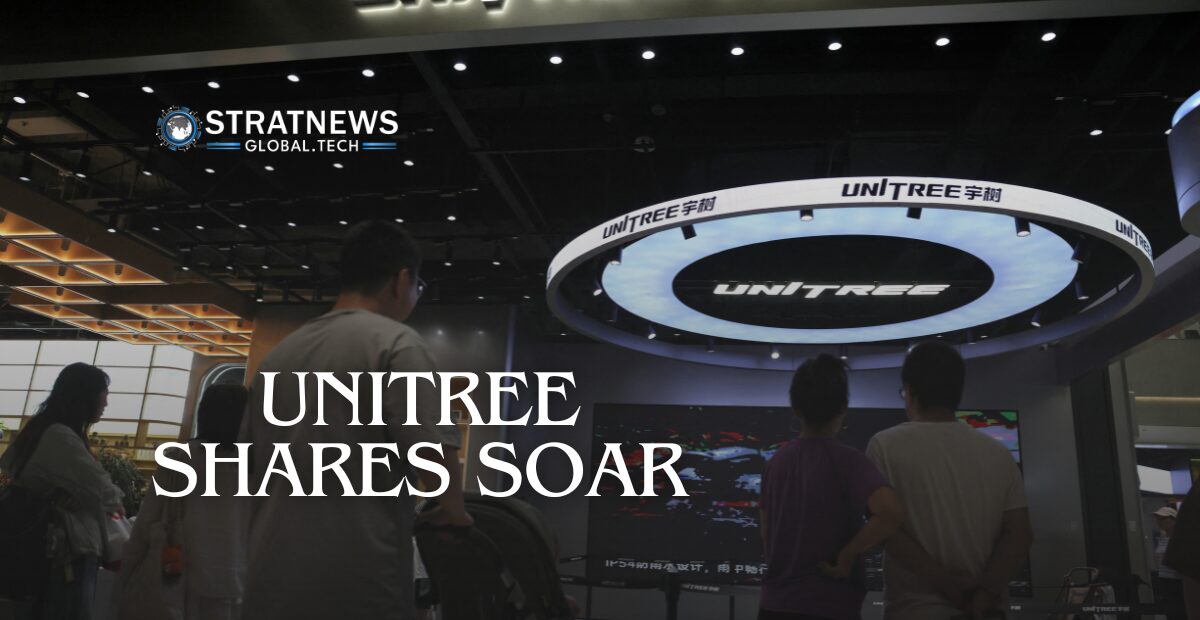
Unitree Shares Soar Nearly Six-Fold in Landmark Robotics Debut
Shares in Unitree, one of China’s best-known humanoid robot makers, surged nearly six-fold during its trading debut in Shanghai, marking a major moment for the country’s rapidly expanding robotics sector.
The company, which competes with Hyundai Motor Group-owned Boston Dynamics and Tesla, has attracted global attention for robots capable of running, dancing and performing martial arts. It is also one of the world’s largest producers of humanoid and quadruped robots.
For China, Unitree has become a symbol of national pride. Influential private technology companies and state-run organisations have backed the company as robotics becomes an increasingly important area of competition in the Sino-U.S. tech war.
Unlike many of its peers, Unitree is profitable, although relatively few of its robots are currently deployed in commercial applications. Moreover, while it is not the first Chinese humanoid robot maker to pursue a public listing, its market debut is expected to influence a growing group of domestic rivals preparing to follow.
“It is a top-tier player, and its uniqueness commands premiums,” said Yan Kai, a venture capitalist and partner at Ivy Capital in Shanghai.
“Its price is dictated by political and economic considerations, rather than valuation models.”
First-Mover Advantage
Unitree shares finished the morning session at 883.87 yuan on the tech-focused STAR Market. That was substantially above the company’s IPO price of 150.8 yuan and gave it a valuation of about $50 billion.
The stock opened at 1,100 yuan before giving up some of its gains. Even so, its rise was far above the average first-day gain of 279% for new Chinese listings so far this year.
The performance also stood out against the wider Chinese market. Benchmark indexes fell 2%, while technology shares faced heavy selling pressure.
The debut coincided with the opening of the World Robot Conference in Beijing. Hundreds of mostly Chinese companies are launching products and demonstrating technological advances at the event.
Meanwhile, the Chinese government is betting that robotics can help address a labour shortage linked to the country’s demographic crisis.
Unitree’s blockbuster debut could strengthen its first-mover advantage as competition intensifies. Many other robotics companies are still losing money, while Unitree has already achieved profitability.
“At this early stage of competition, whoever gets listed and has visibility can grab the resources and have staying power,” said William Xin, chairman of Spring Mountain Pu Jiang Investment Management.
Future Products Cut Off From U.S. Market
Despite the strong investor response, some analysts have raised concerns about Unitree’s commercial prospects. Many of its sales so far have been one-off purchases, while relatively few robots are operating in commercial settings.
Instead, research institutions and universities account for many of the company’s customers.
In July, the U.S. Federal Communications Commission banned imports of future models of foreign-made humanoid and quadruped robots, including Unitree products, citing national security concerns.
As a result, Unitree faces restrictions in a major potential market. The company has also become an example of China’s ability to scale up strategically important industries, even when some underlying technologies were initially developed in the United States.
Unitree based designs for its most successful robot dogs on innovations funded by the U.S. military, according to a former U.S. defence technology official and three senior researchers involved in the project. The U.S. Army research was publicly released to encourage progress in the field, and Unitree did not use it improperly.
Unitree has not responded to Reuters requests for comment.
In June, the Pentagon added Unitree to a list of Chinese military companies, describing it as a “contributor to the Chinese defence industrial base”. The designation does not amount to a sanction, but it restricts the U.S. military’s future use of Unitree technology. Unitree has said its robots are intended for civilian use.
More Chinese Robot Makers Prepare to List
About 10% of Unitree’s shares were sold through the IPO, raising roughly $900 million. Founder Wang Xingxing continues to own around a fifth of the company.
The surge in Unitree’s share price has also pushed Wang’s wealth above $12 billion on paper.
The startup has backing from several influential Chinese technology firms, including Tencent, Alibaba and DeepSeek. Wang also secured a prominent front-row seat at a summit with technology business leaders hosted by Chinese President Xi Jinping early last year.
Unitree’s market debut comes as several other Chinese humanoid robotics companies prepare to go public.
At least half a dozen domestic firms are moving towards listings. Deep Robotics and Leju Robotics have applied to list on mainland Chinese exchanges, while Mech-Mind Robotics, X Square Robot and AgiBot have opted to pursue listings in Hong Kong.