

Close Menu
Stratnews GlobalStratnews Global
    Facebook X (Twitter) Instagram
    Trending
    • Atomic Clock Failure On IRNSS-1F Pushes India’s NavIC Navigation Constellation Below Operational Threshold
    • Ukraine Opens Battlefield Data For AI Drone Training
    • Data Centres Become Election Issue In France
    • Apple Slashes App Store Fees In China
    • Google Names London HQ ‘Platform 37’ After AlphaGo Move
    • Pentagon Allows Limited Use Of Anthropic AI
    • Why Venture Capital Is Suddenly Betting on Indian Deep Tech
    • UK Warns Social Media Firms Over Child Safety
    • Support Us
    Stratnews GlobalStratnews Global
    Write for Us
    Monday, March 16
    • Space
    • Science
    • AI and Robotics
    • Industry News
    • Support Us
    Stratnews GlobalStratnews Global
    Home » An Indian Space Station by 2035: Recollecting a Takshashila Institution Study

    An Indian Space Station by 2035: Recollecting a Takshashila Institution Study

    StratNewsGlobal Tech TeamBy StratNewsGlobal Tech TeamOctober 22, 2023 Space No Comments3 Mins Read

    On August 15, 2018, Prime Minister Narendra Modi announced the Gaganyaan programme, India’s first steps to making indigenous space flight a reality. As India comes closer to achieving its first ever human spaceflight effort, Prime Minister Modi has laid down yet another bold goal for the country — to build an Indian space station by 2035. Although the former chairman of ISRO Dr K Sivan, had contemplated the idea of a space station as a natural step after Gaganyaan, the goal was never set in stone. 

    India’s attempt to build a space station, even on a small scale, is certainly ambitious. However, taking the space station path could divert policymkers’ attention from addressing India’s more immediate challenge of substantially increasing the country’s satellite capacity, the Earth’s orbits and improving situational awareness in space. Moreover, in an attempt to pursue the construction of a fully indigenous space station, India might be closing its doors to gaining access to critical technologies and eschewing an opportunity to strengthen its relationship with like-minded partners. Therefore, a prudent move for India would be to build a space station with an experienced partner nation in order to leverage their expertise and maximise the diplomatic value of international collaboration. 

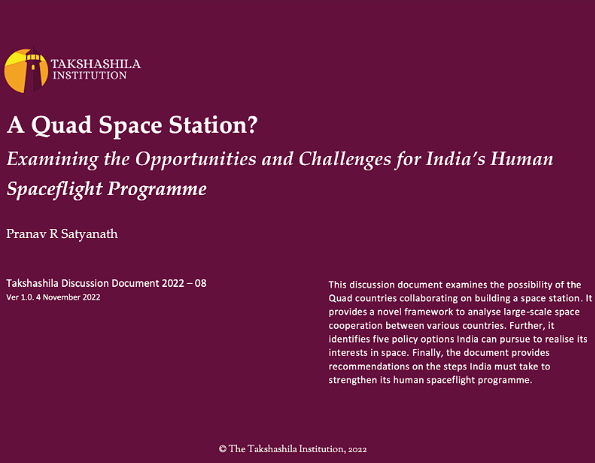
    In this context, a discussion document published by the Takshashila Institution in November 2022 examines the collaborative potential between the Quad countries, namely Australia, India, Japan and the United States. It compares each Quad member’s space policy priorities, technological capabilities and the degree of past cooperation to assess the modality of space station collaboration. The analyses point to the following findings:

    1. India, Japan and Australia share a strong collaborating potential. In this arrangement, India and Japan can be symmetric partners. Australia, in this case, can contribute to the project as a minor partner.
    2. The potential for collaboration with the U.S. is low, as it prioritises its space policy to reach the Moon and beyond. However, India might collaborate with private players in the US who play a prominent role in the development of space stations.
    3. India can collaborate with other partners, such as European spacefaring countries. On the other hand, India might build a space station indigenously without the help of foreign partners. This option, however, would be expensive and impose opportunity costs on the country.
    4. Finally, India can forgo the construction of a space station entirely. In this case, India can continue its human spaceflight programme by purchasing commercial services from other entities.

    While the document exclusively examines the collaborative potential between Quad countries, India could explore other avenues of cooperation. These modalities are explored in greater detail in the document.

    Pranav R Satynath is currently a Research Associate at the Council for Strategic and Defense Research (CSDR). The opinion expressed here is strictly personal.

    Author

    • StratNewsGlobal Tech Team
      StratNewsGlobal Tech Team

      View all posts
    Featured
    Share. Facebook Twitter Pinterest LinkedIn Tumblr Email Reddit Telegram WhatsApp
    StratNewsGlobal Tech Team
    • Website

    Keep Reading

    Atomic Clock Failure On IRNSS-1F Pushes India’s NavIC Navigation Constellation Below Operational Threshold

    Ukraine Opens Battlefield Data For AI Drone Training

    Data Centres Become Election Issue In France

    Apple Slashes App Store Fees In China

    Google Names London HQ ‘Platform 37’ After AlphaGo Move

    Pentagon Allows Limited Use Of Anthropic AI

    Add A Comment
    Leave A Reply Cancel Reply

    Anti Drone System (CUAS)
    Latest Posts

    Atomic Clock Failure On IRNSS-1F Pushes India’s NavIC Navigation Constellation Below Operational Threshold

    March 14, 2026

    Ukraine Opens Battlefield Data For AI Drone Training

    March 13, 2026

    Data Centres Become Election Issue In France

    March 13, 2026

    Apple Slashes App Store Fees In China

    March 13, 2026

    Google Names London HQ ‘Platform 37’ After AlphaGo Move

    March 12, 2026

    Pentagon Allows Limited Use Of Anthropic AI

    March 12, 2026

    Why Venture Capital Is Suddenly Betting on Indian Deep Tech

    March 12, 2026

    UK Warns Social Media Firms Over Child Safety

    March 12, 2026

    Age Check laws gain momentum as nations target teen access

    March 10, 2026

    Space Exercise Device for Astronaut Microgravity Training

    March 10, 2026

    Subscribe to News

    Get the latest sports news from NewsSite about world, sports and politics.

    • Astronomical Events
    • Space Missions
    • Industry News
    • Science
    StratNewsGlobal Tech
    Facebook X (Twitter) Instagram LinkedIn YouTube
    © 2026 StratNews Global, A unit of BharatShakti Communications LLP
    • About Us
    • Contributors
    • Copyright
    • Contact
    • Write for Us

    Type above and press Enter to search. Press Esc to cancel.