


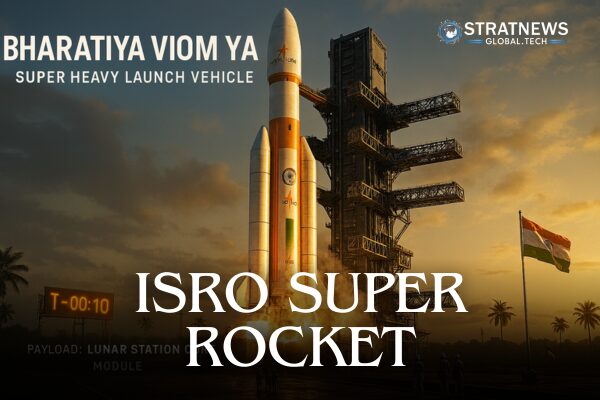
The Indian Space Research Organisation (ISRO) has announced plans to build its most powerful rocket yet—a monumental 40-storey-high launcher designed to carry up to 75,000kg (75 tonnes) to orbit. This marks a dramatic step-change in India’s space capabilities, aiming to place the country alongside the leading spacefaring nations like the United States, China, and Russia.
ISRO Chairman V. Narayanan unveiled this vision at a recent convocation ceremony, highlighting India’s evolution from launching 35kg payloads six decades ago to planning a rocket capable of orbiting massive clusters of satellites, space station modules, and deep-space probes in a single flight. The proposed rocket, referred to as the N1 super-heavy-lift vehicle, will stand as a transformative platform for future Indian missions, including crewed spaceflight, lunar and Martian expeditions, and international satellite launches.
Globally, the heaviest satellites launched have typically been American or European. The US Space Shuttle launched payloads up to 24,400kg to low Earth orbit, and International Space Station (ISS) modules often weighed over 20,000kg per launch by NASA and Russia. India’s GSAT-11 satellite, launched in 2018 aboard the European Ariane 5, weighed 5,854kg, making it ISRO’s heaviest to date. ISRO is preparing to launch a 6,500kg US-built communication satellite, marking a new milestone for its heavy payload capability. This satellite will be launched using an Indian rocket in the coming months.
Launching satellites with such massive weight involves unique engineering, logistical, and technical hurdles. Super-heavy rockets require sophisticated design, robust components, and modular engineering, while customization for each mission adds complexity. Building and testing rockets of this scale is extremely expensive, with any failure leading to millions of dollars in loss and years of work. Simulating extreme space conditions such as vacuum, radiation, and zero gravity is difficult on Earth, making thorough testing a challenge. The stakes are higher during launches, as any malfunction means losing valuable scientific payloads which cannot be repaired post-launch. Furthermore, long development cycles risk some components becoming outdated before deployment. Until now, India’s rockets have struggled to lift more than 4 tonnes to geostationary orbit, but ISRO’s modular heavy rocket program is set to close this gap.
According to experts, if ISRO succeeds in launching a 75,000kg payload rocket, the ripple effects would be profound for both India and the international space sector. India would join the elite group of nations capable of launching exceptionally heavy payloads, opening pathways to its own space station, lunar bases, and large-scale deep-space missions. The ability to launch larger foreign satellites from Indian soil elevates ISRO’s status as a global launch provider, attracting new international customers and fostering cross-border partnerships. India’s reputation for cost-effective space missions could also pressure down launch costs worldwide, making space more accessible.
The rocket can support high-impact science by enabling the launch of massive observational instruments, interplanetary probes, and clusters of satellites in a single flight, capabilities not previously available to ISRO. A successful launch would be a beacon for India’s technological prowess, raising its profile among global powers and inspiring future generations of scientists and engineers.
ISRO’s move to develop a rocket capable of lifting 75,000kg is a watershed moment for Indian and global space exploration. If successful, it will redefine the upper limits of payload delivery, strengthen India’s position among spacefaring nations, and dramatically expand the frontier of what is possible in space research, industry, and international cooperation.