


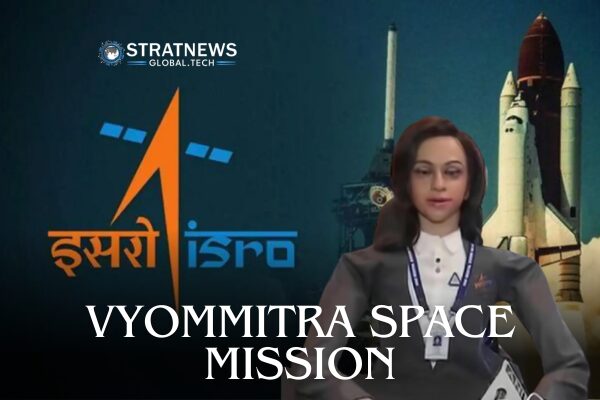
Indian Space Research Organisation (ISRO) has announced that its AI-enabled space robot Vyommitra will fly on the first uncrewed test mission for the Gaganyaan human spaceflight program by December 2025, marking a major milestone in India’s space ambitions.
Vyommitra, a half-humanoid robot, is designed to simulate human responses, monitor environmental conditions, and interact with onboard systems. This innovation will serve as a precursor to India’s first crewed orbital mission, enabling critical validation of life support systems and spacecraft safety features.
Vyommitra will be launched aboard the unmanned Gaganyaan spacecraft into a 400-kilometre orbit for three days before returning to Earth. During the mission, the robot will monitor cabin pressure, temperature, humidity, and carbon dioxide levels while providing real-time feedback. It will also test escape systems, parachute-assisted recovery, and sea landing mechanisms in collaboration with agencies such as the Indian Air Force, Navy, and DRDO. By simulating human physiological reactions in microgravity, Vyommitra will allow ISRO to refine the spacecraft’s environmental controls and support systems, ensuring astronaut safety during future missions.
About the Humanoid
The humanoid incorporates advanced artificial intelligence that enables it to recognize human voices, interact with onboard equipment, operate control panels, and deliver system health updates. These features combine environmental sensing, intelligent automation, and human–machine communication to enhance both safety and operational autonomy. Such innovations will not only prepare India for crewed spaceflight but also establish a technological foundation for the future use of intelligent robotics in both domestic and international space missions.
Globally, humanoid robots have been tested in space by a few pioneering nations. The United States launched Robonaut 2 to the International Space Station (ISS) in 2011. It was built to work alongside astronauts, performing simple maintenance tasks and operating tools. Although it encountered technical difficulties and was eventually brought back to Earth in 2018, Robonaut demonstrated the feasibility of robots handling repetitive and hazardous jobs in microgravity. Russia deployed FEDOR (Skybot F-850) to the ISS in 2019. This robot was able to manipulate tools, connect cables, and conduct operational checks, showing how humanoids can provide critical backup in emergency situations. Japan introduced Kirobo in 2013, a small talking robot focused on social and communication experiments. It successfully tested speech recognition and conversation in orbit, exploring the psychological role of robotic companions for astronauts on long-duration missions.
India’s Vyommitra builds on these global experiments but with a distinctive focus. While Robonaut, FEDOR, and Kirobo explored technical assistance and human–robot interaction, Vyommitra’s mission is aimed at simulating human physiology and validating spacecraft safety systems before astronauts are onboard. By testing life support architecture, environmental controls, and emergency protocols, Vyommitra will directly influence the design and safety of Gaganyaan’s future crewed flights.
The upcoming mission represents a strategic leap for India, enhancing its reputation in space robotics, artificial intelligence, and human spaceflight technology. Successful deployment of Vyommitra will strengthen ISRO’s position in global space leadership while opening opportunities for collaboration in robotic systems, cabin monitoring, and automated safety technologies. This innovation underscores India’s determination not only to send humans into space but also to pioneer the integration of robotics and AI in exploration, ensuring safer, smarter, and more sustainable missions.