


India Strengthens Clean Energy Push With Integrated Strategy
India is positioning itself as a global player in the clean energy landscape through a coordinated strategy that combines policy support, technological advancement, and industry participation, according to Union Minister Dr. Jitendra Singh.
He stated that the country is advancing a multi-pronged approach by promoting green hydrogen, expanding nuclear energy capacity, and strengthening renewable sources. At the same time, India is building domestic capabilities in critical technologies such as electrolyser manufacturing, while encouraging collaboration between public and private sectors.
Focus on Innovation and Industry Collaboration
Dr. Jitendra Singh highlighted that India’s energy roadmap is increasingly centred on innovation, research, and development. He noted that enhanced funding and industry partnerships are key to creating a self-reliant and scalable clean energy ecosystem.
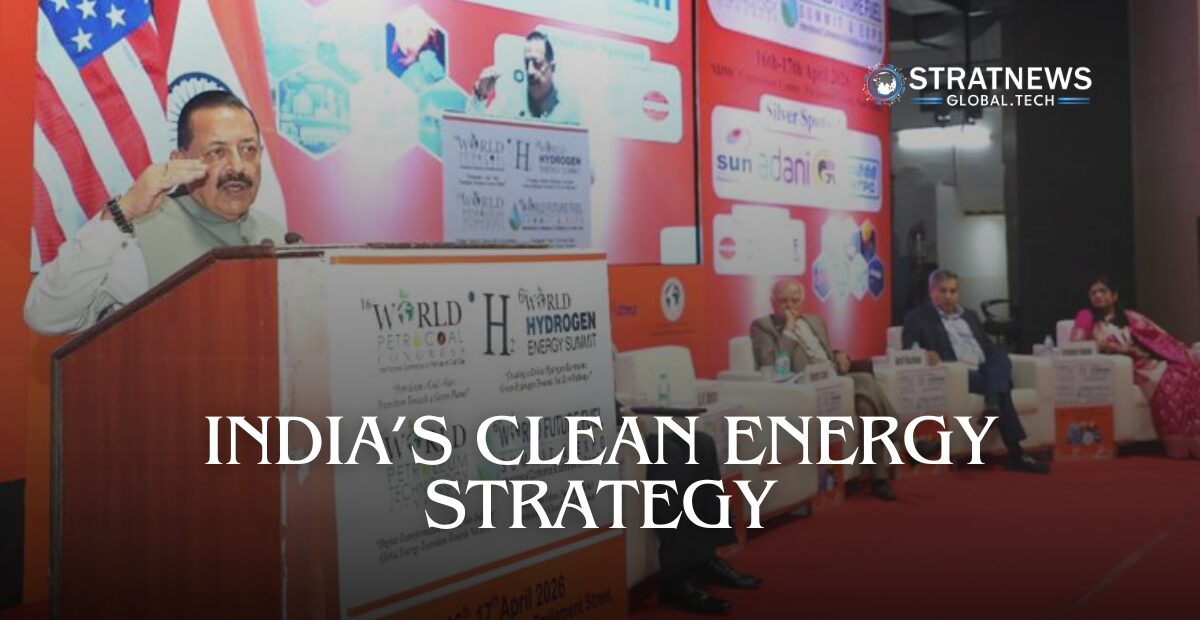
Speaking at the World Hydrogen Energy Summit alongside the World Petrocoal Congress in New Delhi, he said the platform brought together policymakers, industry leaders, and experts from across energy sectors. Consequently, it enabled discussions on future energy pathways and emerging opportunities.
Moreover, India continues to expand its conventional energy investments alongside clean initiatives. The country is targeting nearly $100 billion in oil and gas investments, increasing exploration areas to one million square kilometres, and raising the share of natural gas in the energy mix to 15 percent. In addition, refining capacity is steadily growing, strengthening India’s global standing.
Green Hydrogen Mission Gains Momentum
On the clean energy front, Dr. Jitendra Singh pointed to the National Green Hydrogen Mission, which has an outlay of Rs 19,744 crore. He said the initiative places India among leading nations working to develop alternative fuel ecosystems.
Green hydrogen is expected to play a crucial role in reducing emissions in sectors such as steel and cement, which are traditionally difficult to decarbonise. Furthermore, efforts are underway to lower production costs through domestic innovation and manufacturing capabilities.
Nuclear Expansion and Small Reactor Plans
The Minister also outlined progress in nuclear energy, noting that the Nuclear Energy Mission aims to achieve 100 gigawatts of nuclear power capacity by 2047. He stated that India has entered a new phase of its nuclear programme, driven by indigenous technological developments.
In addition, India plans to develop five small modular or small reactors by 2033. Work has already begun on three of these, including a Bharat Small Modular Reactor, a Bharat Small Reactor based on heavy water technology, and a small-scale hydrogen-linked reactor.
These reactors are expected to offer flexible and decentralised energy solutions while supporting hydrogen-related applications. At the same time, recent policy reforms have opened the nuclear sector to private participation, with revised liability provisions designed to attract wider industry involvement.
Emerging Opportunities in Green Economy
Dr. Jitendra Singh emphasised that the clean energy transition is also creating new economic opportunities. Sectors such as electric mobility, battery recycling, grid management, and renewable manufacturing are generating employment and driving innovation.
Additionally, India is advancing circular economy initiatives, including converting used cooking oil and agricultural waste into biofuels. The country is also exploring new frontiers such as ocean energy under the Deep Ocean Mission.
He concluded that India’s demographic advantage, technological strength, and policy direction position it to play a major role in global decarbonisation efforts while ensuring sustainable growth and energy access.
With inputs from Reuters