


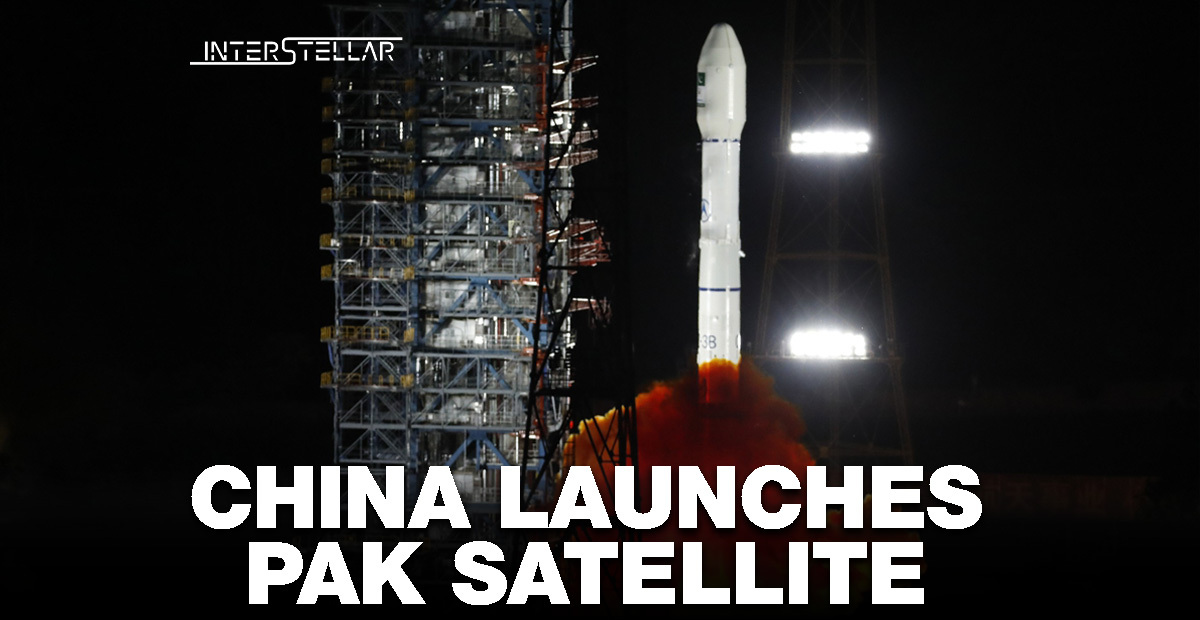
China launched a Pakistani communication satellite, codenamed PakSat MM1, on Thursday via a Long March 3B carrier rocket from the Xichang Satellite Launch Center in Southwest China’s Sichuan Province, as reported by China’s state-run Xinhua news agency. The satellite successfully reached its designated orbit. This marks Islamabad’s second satellite launch within the span of one month. Pakistan expects the satellite’s deployment to significantly boost its internet and communications security and enhance its aerospace technology and industrial capabilities.
The Pakistan Space and Upper Atmosphere Research Commission (SUPARCO) has shared information about its latest satellite launch. In a recent statement, SUPARCO announced that the satellite launch is part of the National Space Programme 2047. The PAKSAT MM1 project was a collaborative effort between SUPARCO and the Chinese aerospace industry to address Pakistan’s increasing communication and connectivity needs.
“PakSat-MM1 will play a pivotal role in the socio-economic uplift of the country. It will prove to be a stepping stone in the transformation of the country into Digital Pakistan,” SUPARCO said Planning Minister Ahsan Iqbal, who attended the launch, shared their future aspirations, saying: “Day is not far when we will launch our satellites on our own rockets from Pakistan’s Space Launch Centre. Congratulations Pakistan.”
Honoured to witness Launch of Pakistan’s Space Satellite Pak Satellite MM-1 from Xichang Space Centre, China. InshaAllah day is not far when we will launch our satellites on our own rockets from Pakistan’s Space Launch Centre.
Congrats Pakistan.#RisingPakistan pic.twitter.com/8zI9pA2ozg— Ahsan Iqbal (@betterpakistan) May 30, 2024
On May 3, Pakistan’s mini satellite ‘iCube-Qamar’ was launched from Hainan province as part of China’s Chang’e-6 lunar mission. Following the May 3 launch, the iCube-Qamar transmitted the first-ever images of the moon from lunar orbit on May 8.
Thriving Presence in Space
Pakistan’s presence in space is not just growing, but it is thriving. The country boasts an impressive array of at least six satellites, each with its unique purpose and contribution. These include BADR-A, BADR-B, PAKSAT 1-R, PRSS-1, PakTes 1-A, and the latest addition, iCube-Qamar. This diverse fleet of satellites is a testament to Pakistan’s increasing prowess in space technology.
As per China’s state-run media outlet, Global Times, both Pakistan and India are influential South Asian countries. India has long received support from the US and Russia, leading to a long-standing advantage over Pakistan in the aerospace field. The PakSat-MM1 project will contribute to the balanced development of space capabilities in the South Asian region and foster long-term cooperation in the aerospace field between China and Pakistan, according to the contractor of the China-Pakistan satellite project, the China Great Wall Industry Corporation (CGWIC,) a subsidiary of the state-owned space giant China Aerospace Science and Technology Corporation (CASC). The MM1 project stands as a testament to the collaborative spirit of China-Pakistan space cooperation.
According to the CGWIC report, it is the third whole-satellite project between CGWIC and Pakistan, following the successful Paksat-1R and PRSS-1.
How Chinese Firm Boosts Pakistan Space Endeavour
The CGWIC has provided Pakistan with comprehensive support for its space endeavours, including satellite systems, launch services, ground monitoring and control stations, ground application systems, joint satellite development, technical personnel training, concessional loans for foreign aid, and insurance arrangements. This successful project highlights CGWIC as the main international platform for China’s aerospace cooperation. Through collaborative efforts, the Chinese firm will train a substantial number of management and technical personnel with expertise in satellite research and manufacturing for Pakistan, thereby establishing a talent pool to enhance Pakistan’s independent space development capabilities. According to the CGWIC, the MM1 project is also noteworthy as the first international satellite project to adopt BeiDou standards, with BeiDou as the primary augmentation target, achieving the implementation of high-precision BeiDou satellite navigation services.

