


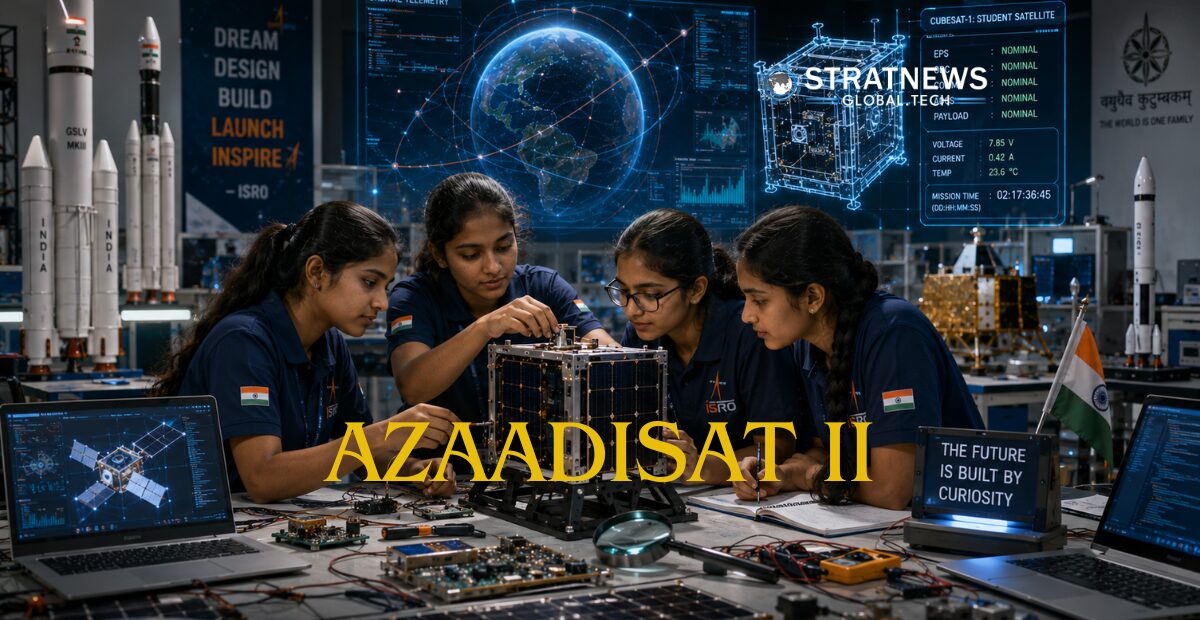
750 Indian Schoolgirls See AzaadiSAT Orbit Earth After Early Setback
An experiment created by 750 Indian schoolgirls first ended in disappointment after a failed satellite mission in 2022. However, the project returned stronger, and the reworked satellite now orbits the Earth near the International Space Station (ISS). According to the Indian Space Research Organisation (ISRO), the achievement highlights how a classroom initiative evolved into a genuine space mission involving students from across the country.
Under the AzaadiSAT project, 75 schools brought together 750 students, including many from rural areas, with support from Space Kidz India. Rather than limiting learning to classroom models, the project enabled students to contribute experiments that became part of a real satellite. Their work endured launch vibrations and was designed to transmit information from space.
First Mission Ended in Failure
The first AzaadiSAT launched on August 7, 2022, aboard ISRO’s Small Satellite Launch Vehicle (SSLV) from the Satish Dhawan Space Centre in Sriharikota. The mission also carried the EOS-02 satellite.
Although the rocket launched successfully, it failed to achieve the required orbital conditions. As a result, the satellites entered an unstable trajectory before re-entering the Earth’s atmosphere.
For a satellite to remain in orbit, it must reach the correct altitude, speed and direction. Otherwise, gravity eventually pulls it back into the atmosphere. Consequently, the first AzaadiSAT mission ended without reaching its intended orbit. Nevertheless, engineers analysed the flight data to identify improvements for a future mission.
Improvements Led to Success
ISRO later introduced several changes based on the findings from the failed mission. These improvements included updates to the rocket stage separation system, navigation software and measures to protect equipment from launch vibrations. Together, these modifications aimed to prevent the issues experienced during the 2022 launch.
Meanwhile, the educational experiments were prepared once again for AzaadiSAT 2. Space Kidz India assembled the student-built components before completing the final satellite integration.
On February 10, 2023, the improved SSLV successfully placed AzaadiSAT 2, EOS-07 and Janus-1 into their planned orbits in a mission lasting around 15 minutes.
AzaadiSAT 2 entered a circular orbit at an altitude of approximately 450 kilometres. Therefore, it now travels around the Earth at a relatively consistent distance from the surface. This altitude is close to the orbital region used by the International Space Station, which typically operates at around 400 kilometres. The comparison illustrates the scale of the achievement made through the school-led initiative.
Students Contributed Real Space Experiments
The project involved about 750 students from 75 schools, with each school preparing small experiments for inclusion aboard the satellite. Many participants from rural communities gained direct exposure to space technology through the programme. They worked with sensors, electronic components and small systems that formed part of an operational space mission.
AzaadiSAT carried 75 educational experiments alongside communication equipment and scientific payloads. Among these were a radiation counter, radio communication equipment, a long-range transmitter and a self-portrait camera. In addition, the communication system was designed to transmit voice and data using frequencies allocated to amateur radio operators, while a ground station received the information sent by the satellite.
The students focused on designing the educational experiments rather than building every satellite subsystem. Specialists remained responsible for the satellite’s primary structure, overall testing and final integration.
Collaboration Between Schools and Space Experts
Space Kidz India guided participating schools throughout the project and supervised the preparation of the experimental components. The organisation also completed the final integration of the payloads into AzaadiSAT 2. ISRO, meanwhile, provided the SSLV launch vehicle and carried out the orbital mission.
The project marked the celebrations of 75 years of India’s independence. At the same time, it aimed to encourage more girls to explore science, technology, engineering and mathematics (STEM). Instead of studying satellites only through textbooks, participants gained practical experience by working with components while learning about sensors, power systems, communication technology and material durability.