


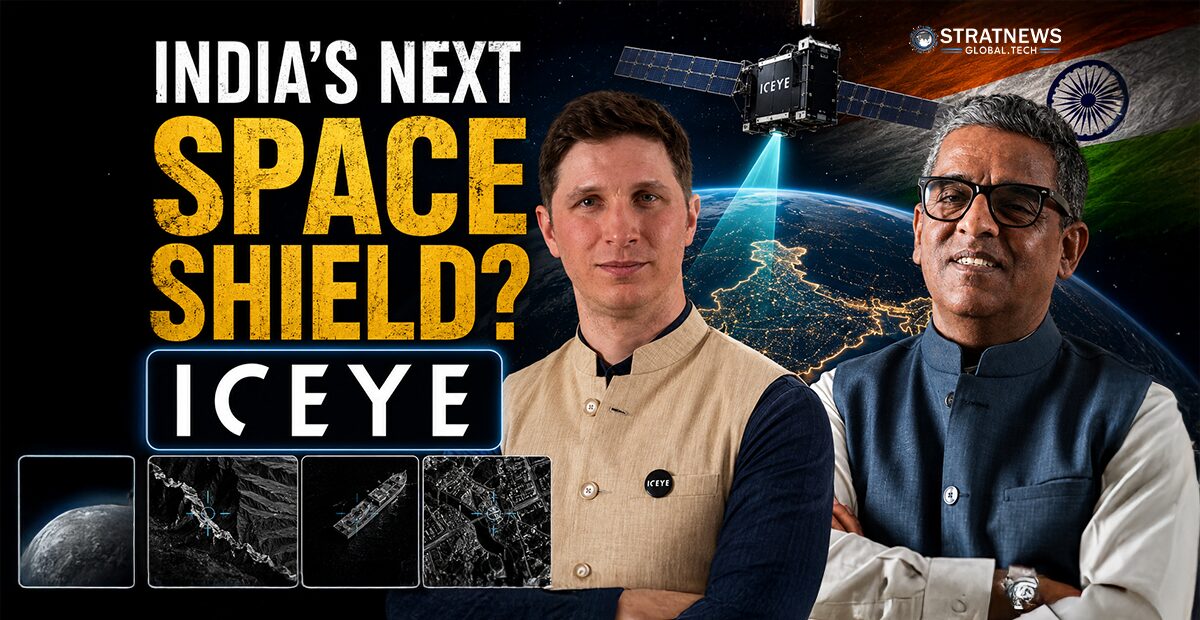
At a quiet office inside BharatShakti’s headquarters in New Delhi, a conversation unfolded that captured a larger shift in how nations now think about security, technology, and space.
Across the table from strategic affairs analyst Nitin Gokhale sat Rafał Modrzewski, the man leading one of the world’s most closely watched Earth observation companies. What he laid out was not just a business pitch. It was a blueprint for how India could plug into the next generation of space-based intelligence.
Modrzewski’s argument begins with a simple but transformative idea: the ability to see the Earth, always.
His company, ICEYE, builds satellites equipped with Synthetic Aperture Radar, or SAR. Unlike traditional optical satellites that depend on sunlight and clear skies, SAR systems actively emit radar signals. These signals bounce off the Earth’s surface and return usable data, regardless of cloud cover, smoke, or darkness. In practical terms, that means uninterrupted visibility—day or night, in peace or conflict.
This is not just a technical upgrade. It is a strategic shift. Modern conflicts, as seen starkly in the Russia-Ukraine War, are increasingly defined by information dominance. Knowing what is moving, where, and when is no longer an advantage; it is a necessity. Satellite-based intelligence has moved from being a niche capability to a central pillar of military planning and execution. Modrzewski is blunt about it: persistent, real-time Earth observation is now foundational to national security.
For ICEYE, this realisation marked a pivot. The company began with a focus on monitoring Arctic ice and contributing to climate research. But geopolitics reshaped priorities. The same technology that tracks environmental change can just as effectively track troop movements, maritime traffic, or infrastructure development. Dual-use capability is no longer a side benefit; it is the core proposition.
And that is where India enters the frame.
Modrzewski does not describe India as just another market. He frames it as a partner. Over several years, ICEYE has been quietly engaging with Indian institutions, recognising that India is not a newcomer but an advanced space actor with deep indigenous capabilities. What makes the country particularly compelling is the combination of demand and ecosystem. India’s security challenges—long land borders, contested frontiers, and a vast maritime expanse—create a constant need for wide-area surveillance. At the same time, its growing private space sector and engineering talent pool offer the capacity to absorb and scale advanced technologies.
The company’s plans reflect that dual logic. ICEYE is looking to establish a research, development, and manufacturing hub in India, effectively making it its Asia-Pacific base. This is not a token presence. It is about embedding capability. Indian engineers are already a significant part of ICEYE’s workforce, and expanding operations in India would allow the company to scale production while staying close to one of its most important strategic partners.
But Modrzewski is careful to stress that satellites alone are not the solution. Owning a satellite without the supporting ecosystem is like owning a camera without the ability to process or interpret the images. ICEYE’s model is built around end-to-end integration—satellites, ground stations, data pipelines, and artificial intelligence tools that convert raw imagery into actionable intelligence. In a world flooded with data, the advantage lies in interpretation and speed.
For India, the implications are far-reaching. A constellation of small SAR satellites in low Earth orbit can revisit the same location frequently, building a near real-time picture of activity on the ground or at sea. This could transform border monitoring, maritime domain awareness in the Indian Ocean, and even internal security operations. Traditional surveillance systems—ground radars, patrol aircraft—have limitations in coverage and persistence. Space-based systems fill those gaps.
There is also a crucial political dimension: sovereignty. Unlike many commercial providers, ICEYE is willing to transfer full ownership and operational control of its satellites to partner countries. That includes access to the underlying systems and the ability to modify and upgrade them. In the Indian context, this aligns closely with long-standing strategic preferences—control over critical infrastructure, domestic capability building, and reduced dependence on external actors.
The civilian side of the equation is equally significant. SAR data can map floods in real time, track wildfires through smoke, monitor infrastructure development, and support urban planning. In a country as geographically and climatically diverse as India, these capabilities have direct societal impact. Disaster response, in particular, could be transformed by the ability to see through clouds during monsoon floods or detect changes in terrain after landslides.
By the end of the conversation, a clear picture emerges. ICEYE is not positioning itself as a vendor selling satellites off the shelf. It is seeking to become part of India’s technological fabric—across defence, research, and commercial domains. The timing is not accidental. Space is no longer a distant frontier; it is an operational domain where security, economics, and innovation intersect.
What Modrzewski is offering India is not just sharper images from orbit. It is continuity of vision—an ability to see, understand, and act without interruption. In an era where uncertainty is the only constant, that may prove to be the most valuable capability of all.

