


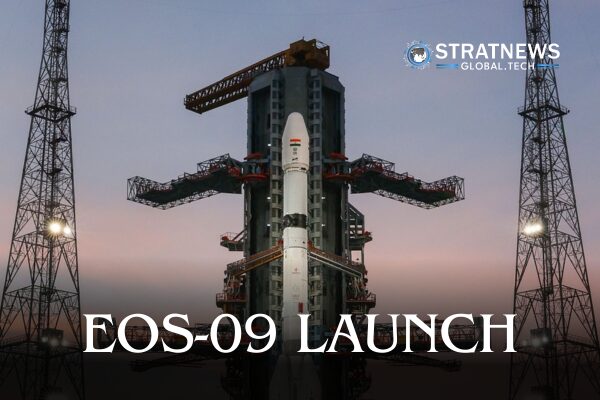
India’s space program is poised to reach a historic milestone with the launch of the PSLV-C61/EOS-09 mission, scheduled for May 18, 2025, at 5:59 AM IST. This mission will mark the 101st launch in the nation’s distinguished space journey.
Launching from the First Launch Pad at the Satish Dhawan Space Centre in Sriharikota, the mission will place the Earth Observation Satellite-09 (EOS-09) into a Sun-synchronous polar orbit using the Polar Satellite Launch Vehicle (PSLV) in its XL configuration.
About EOS-09
Weighing 1,710 kilograms, EOS-09 is equipped with advanced C-band Synthetic Aperture Radar (SAR) technology. This radar system enables continuous observation capabilities regardless of cloud cover, darkness, or adverse weather, offering vital support in national security, agriculture, disaster response, and environmental monitoring.
Standing 44.5 meters tall and weighing 321 tons at liftoff, the PSLV-C61 rocket exemplifies India’s engineering excellence. It utilizes a four-stage propulsion system and six PSOM-XL strap-on boosters to ensure accurate orbital insertion. Following deployment, EOS-09’s onboard Orbit Change Thrusters will reduce its altitude to meet global debris mitigation standards—highlighting ISRO’s commitment to sustainable space operations.
A recent time-lapse video capturing the rocket’s movement from the Payload Integration Facility to the Mobile Service Tower underscored ISRO’s precision and operational rigour.
Strategic and Civilian Applications
“EOS-09’s one-meter resolution imaging serves both strategic and civilian objectives. Its C-band SAR, operating at 5.35 GHz, penetrates vegetation and cloud cover, enabling the creation of detailed terrain maps essential for monitoring infiltration routes in sensitive regions such as Jammu and Kashmir,” explained Dr Srimathy Kesan, Founder and CEO of Space Kidz India.
Dr Kesan noted that EOS-09’s capabilities were pivotal during operations like the recent Operation Sindoor mission, which successfully neutralized security threats with timely intelligence. Building on the legacy of RISAT-1—India’s first indigenous SAR satellite—EOS-09 contributes to a formidable surveillance system that is especially critical amid heightened geopolitical tensions fueled by global conflicts like the Ukraine war.
Beyond defence, the satellite supports a wide array of civilian uses. Its five operational imaging modes allow flexibility between high-resolution detail and broader regional scans. These capabilities enhance glacier monitoring in the Himalayas, detect illegal logging, and bolster flood response systems, as demonstrated during the 2018 Kerala floods.
In an interaction with StratNewsGlobal, Dr Kesan stressed that “EOS-09 complements satellites like Resourcesat and Cartosat, forming an integrated Earth observation network vital for advancing the United Nations Sustainable Development Goals.”
Robust Space Infrastructure
India’s ambitions extend far beyond EOS-09. ISRO aims to deploy a 52-satellite constellation in collaboration with private aerospace firms by 2030. This multi-layered surveillance network—incorporating SAR, optical, and hyperspectral sensors powered by AI analytics—promises to transform domains such as maritime security, urban planning, and infrastructure monitoring, significantly enhancing India’s strategic edge in space.
The Mission
The PSLV-C61 mission follows a precisely choreographed sequence of stage ignitions and separations. The satellite is expected to separate at an altitude of over 530 kilometers, after which the rocket’s spent stage will deorbit using its own thrusters, in line with ISRO’s environmentally responsible practices and international norms.
A Symbol of Vision and Responsibility
As the world faces increasingly complex geopolitical and environmental challenges, space technology has become indispensable—not just for exploration but also for national security, economic stability, and disaster resilience.
“Missions like PSLV-C61/EOS-09 embody India’s technological self-reliance, strategic foresight, and commitment to peaceful global cooperation. From securing borders and empowering farmers with actionable data to aiding disaster relief and environmental stewardship, India’s space efforts demonstrate the transformative potential of space science,” she opines.
As ISRO continues to push boundaries with upcoming crewed missions and lunar explorations, EOS-09 reaffirms India’s leadership in harnessing space for planetary well-being and global progress.