


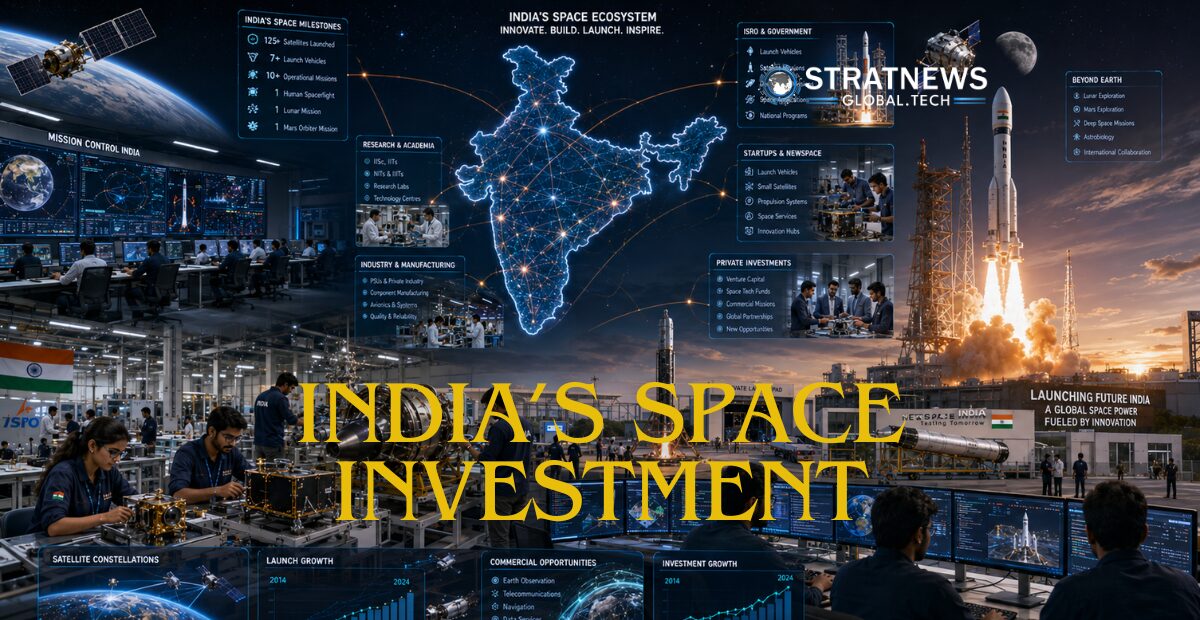
Private Investment in India’s Space Sector Crosses $618 Million, 17 Startups Receive Approval
India’s space sector has recorded significant growth following recent policy reforms, with cumulative private investment exceeding $618.5 million by March 31, 2026. The government has also authorised 105 private entities to undertake space-related activities while continuing to strengthen the regulatory framework to balance commercial expansion with national security requirements.
The figures were shared by Union Minister for Space, Science and Technology Jitendra Singh in a written reply to an unstarred question in the Rajya Sabha. According to the minister, the sector’s rapid growth reflects increasing confidence among domestic and global investors in India’s expanding space ecosystem.
Private Investment Sees Strong Growth
Jitendra Singh said cumulative private funding has increased nearly six-fold in recent years. Investment rose from $100.5 million in 2021–22 to $348.5 million in 2023–24 before reaching $618.5 million by the end of March 2026.
The steady rise in funding highlights growing investor interest in India’s commercial space sector following reforms that have opened the industry to greater private participation.
In addition, the minister informed the Rajya Sabha that 17 space startups have received authorisation from the Indian National Space Promotion and Authorisation Centre (IN-SPACe) to undertake space activities. These approvals underline the emergence of a growing startup ecosystem contributing to India’s space ambitions.
Startup Ecosystem Expands
According to the minister, the number of active space startups has increased from just one in 2014 to more than 400 today. This rapid expansion reflects the growing opportunities available to private companies in satellite technology, launch services and other commercial space activities.
Private Indian companies have also demonstrated launch and orbital capabilities while placing more than 30 satellites into orbit. Furthermore, they have flown nearly 45 payloads through platforms such as the PSLV Orbital Experimental Module (POEM), signalling increasing technological capability and commercial maturity within the sector.
Public-Private Partnership Gains Momentum
The government also highlighted progress in public-private collaboration through the Earth observation partnership programme. The initiative brings together leading Indian companies to develop the country’s first privately owned Earth observation satellite constellation.
The project has attracted a private investment commitment of around ₹1,200 crore, demonstrating growing industry confidence in India’s space reforms and commercial opportunities.
Government Strengthens Regulatory Framework
Alongside commercial growth, the government said it remains focused on maintaining strong national security safeguards. Jitendra Singh informed the Rajya Sabha that every application for private space activities is evaluated under IN-SPACe’s norms, guidelines and procedures, with due consideration given to strategic, security and national interests before authorisation is granted.
He further said IN-SPACe is preparing dedicated safety and security guidelines for space activities in consultation with stakeholders. These measures are intended to strengthen India’s regulatory architecture as private participation in the space sector continues to expand.