


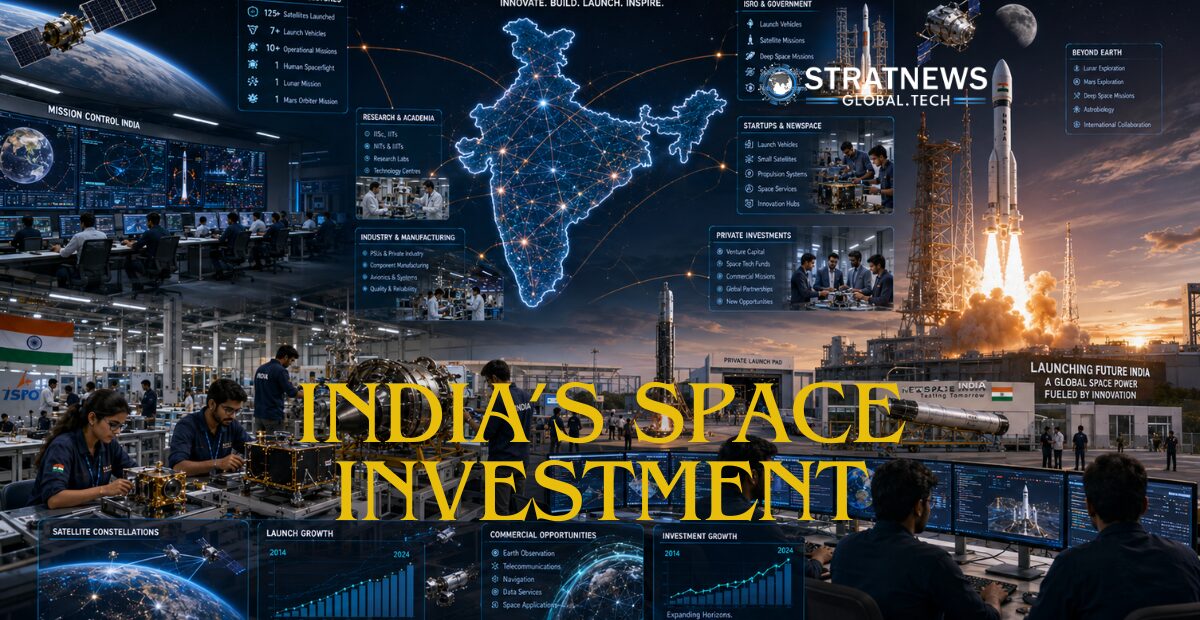
Private Investment in India’s Space Sector Crosses $618 Million as Startup Ecosystem Expands
India’s space sector is witnessing rapid growth as private investment, startup activity and commercial participation accelerate following policy reforms. The government says the country has attracted more than $618.5 million in private investment while strengthening the regulatory framework to encourage innovation without compromising strategic and national security interests.
Speaking in the Rajya Sabha, Union Minister of State (Independent Charge) for Science and Technology, Earth Sciences, and Minister of State in the Prime Minister’s Office, Personnel, Public Grievances and Pensions, Department of Atomic Energy and Department of Space, Jitendra Singh said the reforms have transformed India’s space ecosystem by attracting greater private participation and fostering a vibrant startup landscape.
Private Funding Surges After Space Reforms
Replying to an unstarred question in the Rajya Sabha, Singh said cumulative private investment in India’s space sector has increased nearly six-fold over the past few years.
Private funding rose from $100.5 million in 2021-22 to $348.5 million in 2023-24, before reaching $618.5 million as of March 31, 2026. According to the minister, the growth reflects increasing confidence among domestic and international investors in India’s expanding commercial space ecosystem.
He also informed the House that 105 authorisations have been issued to private entities under the country’s evolving regulatory framework, enabling greater industry participation in space activities.
Startup Ecosystem Continues to Grow
The minister said 17 space startups have received authorisation from the Indian National Space Promotion and Authorisation Centre (IN-SPACe) to undertake space activities.
He added that the broader startup ecosystem has expanded significantly over the past decade. Active space startups have grown from just one in 2014 to more than 400 today, highlighting the rapid emergence of private enterprise in the sector.
Indian private companies have also demonstrated increasing technological capabilities. According to Singh, they have successfully developed launch and orbital technologies, placed more than 30 satellites into orbit and flown nearly 45 payloads using platforms such as the PSLV Orbital Experimental Module (POEM).
These achievements indicate growing technical expertise and commercial maturity within India’s private space industry.
Earth Observation Project Signals Industry Confidence
The minister highlighted the government’s public-private partnership initiative in Earth observation as another milestone for the sector.
The programme brings together leading Indian companies to develop the country’s first privately owned Earth observation satellite constellation. The project has attracted a private investment commitment of approximately Rs 1,200 crore, demonstrating industry’s growing confidence in India’s space reforms and commercial opportunities.
The initiative is expected to strengthen domestic capabilities in satellite-based Earth observation while encouraging greater private investment in advanced space technologies.
Government Focuses on Security and Regulation
Alongside commercial expansion, the government says it is strengthening regulatory oversight to ensure private space activities remain aligned with national interests.
According to Singh, every application submitted by private companies is evaluated under IN-SPACe’s norms, guidelines and procedures, with strategic, security and national considerations forming part of the authorisation process.
He also informed the Rajya Sabha that IN-SPACe is preparing dedicated safety and security guidelines for space activities in consultation with industry stakeholders. The framework is intended to reinforce India’s regulatory architecture as private participation in the space sector continues to grow.
The government believes that balancing commercial innovation with strong regulatory safeguards will be essential as India’s private space industry expands and takes on a larger role in the country’s long-term space ambitions.
With inputs from Reuters