


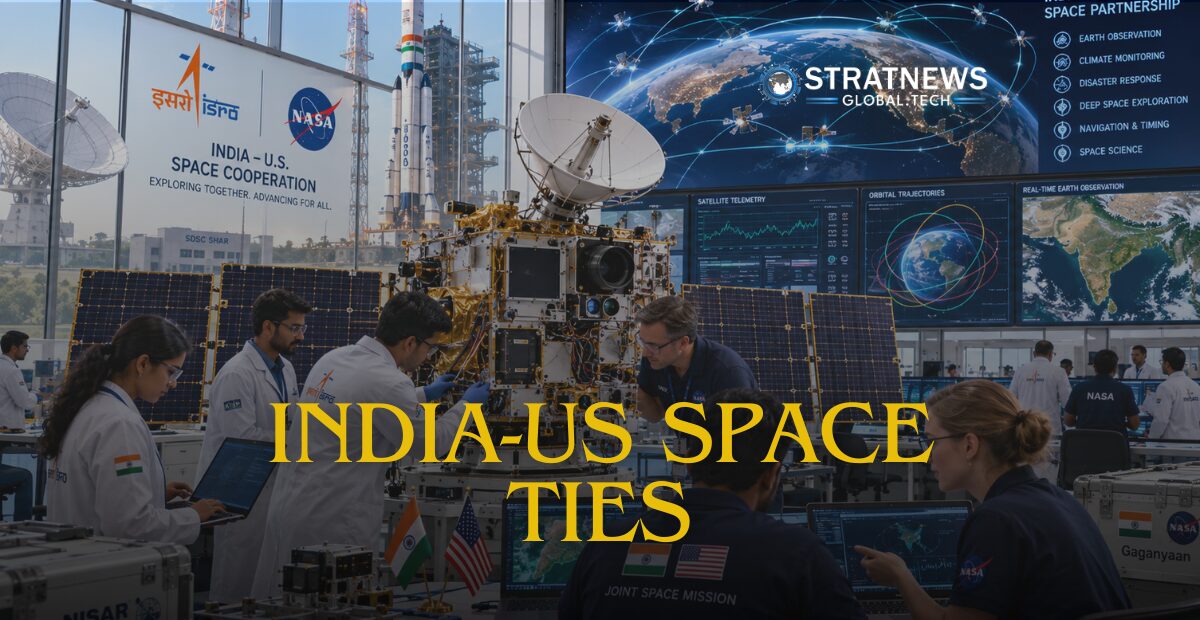
India and the United States are taking their space partnership into a new phase, with lunar exploration, human spaceflight, scientific data sharing and commercial opportunities emerging as key areas of cooperation.
The most significant development from the latest bilateral talks was NASA’s invitation to the Indian Space Research Organisation (ISRO) to participate in its Moon Base programme. The proposal could give India a role in a US-led effort to establish a sustained human and robotic presence near the lunar South Pole.
The invitation was extended during the ninth meeting of the India-US Civil Space Joint Working Group, held at ISRO headquarters in Bengaluru on August 5 and 6. Senior officials from ISRO, NASA and the US State Department discussed the next phase of cooperation, building on the two countries’ NISAR partnership.
NASA’s Moon Base programme envisages a phased build-up near the lunar South Pole, beginning with robotic missions and technology demonstrations, followed by infrastructure development and eventually longer-duration human operations. For India, participation could provide opportunities to contribute scientific instruments, technologies, data, robotics and other capabilities to a broader lunar exploration effort.
The discussions also covered continued cooperation on open scientific data sharing under the Artemis Accords. India joined the accords in 2023, becoming the 27th signatory to a framework for peaceful and transparent cooperation in lunar and broader space exploration.
The latest talks indicate that the partnership is expanding beyond Earth observation towards space science and human-spaceflight technologies. This comes as India develops its own human-spaceflight capabilities while the United States works towards longer-duration operations around and on the Moon.
The two countries also want to identify opportunities for scientists to share and use space-based scientific information more openly. The discussions are part of a wider effort to expand civil and commercial cooperation, including potential opportunities for companies working on satellite systems, launch services, space applications and lunar technologies.
NISAR remains a major pillar of the relationship. Launched from India on July 30, 2025, the NASA-ISRO Synthetic Aperture Radar mission is the first satellite jointly developed by the two agencies to use both L-band and S-band synthetic aperture radar.
NISAR is designed to monitor changes across Earth’s land and ice surfaces, including vegetation, glaciers, ice sheets and ground movement. Its data can support scientific research and applications related to natural hazards and environmental change.
The broader space relationship also includes space-related security cooperation. Earlier this year, India and the US discussed efforts to operationalise data-sharing arrangements concerning space situational awareness, aimed at improving understanding of objects and activity in orbit.
The two countries also reaffirmed support for United Nations Committee on the Peaceful Uses of Outer Space (COPUOS) guidelines on the long-term sustainability of space activities.
The strategic dimension of the relationship was visible during US Space Command chief Gen. Stephen Whiting’s visit to India in March. Discussions with Indian officials and industry representatives included ways to expand cooperation in the space domain.
The Bengaluru meeting was held under the broader India-US Transforming the Relationship Utilizing Strategic Technology, or TRUST, initiative.
For Washington, India is an increasingly capable space partner. For New Delhi, closer cooperation with the United States offers access to expertise, technologies, scientific networks and international opportunities while leaving room for India’s own space ambitions.