


Shenzhou-21 Astronauts Reflect on Record-Breaking 210-Day Space Mission
The three astronauts from China’s Shenzhou-21 crewed mission met the media in Beijing on Wednesday, marking their first public appearance since returning to Earth in late May. The crew reflected on their record-breaking mission, highlighting scientific achievements, operational challenges and several historic milestones in China’s crewed space programme.
Mission commander Zhang Lu, along with crew members Wu Fei and Zhang Hongzhang, appeared in good spirits as they shared their experiences and answered questions from reporters following their return.
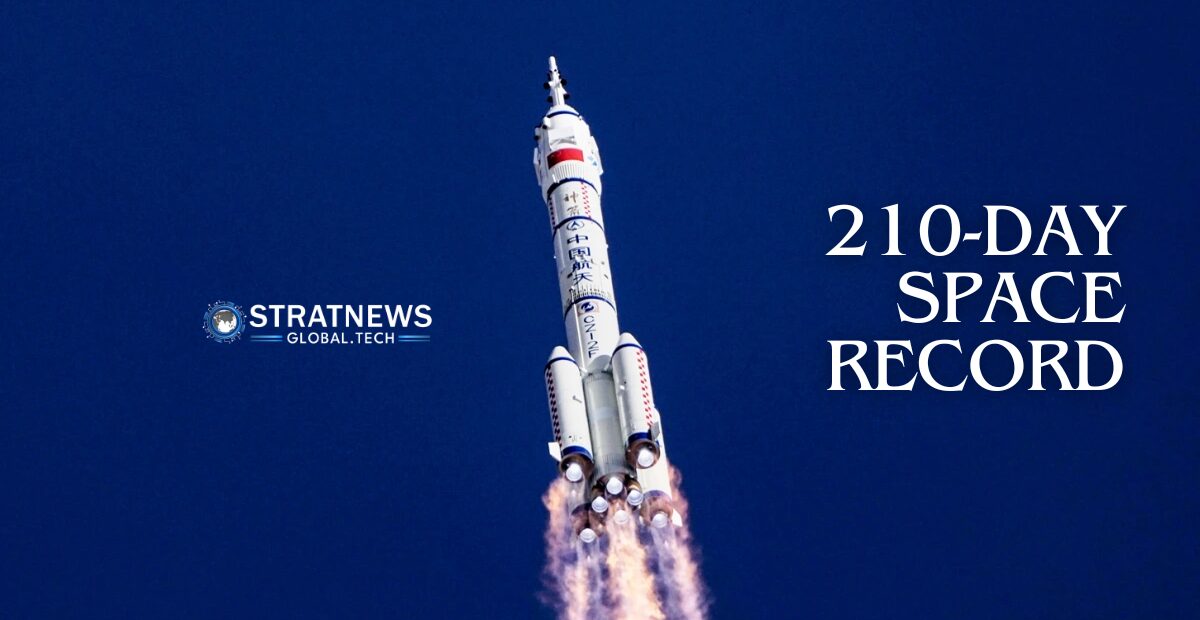
The Shenzhou-21 spacecraft lifted off from the Jiuquan Satellite Launch Center in northwest China on 31 October 2025. The mission established a new record for the longest single-crew stay aboard China’s space station, lasting a total of 210 days.
Crew Completes Key Space Station Operations
During their mission aboard the China Space Station, the astronauts successfully carried out three extravehicular activities (EVAs). In addition, they completed the inspection and photographic documentation of the Shenzhou-20 return capsule’s viewport window and installed protective devices designed to shield the station from space debris.
The crew also conducted multiple cargo transfer operations to support the continued functioning of the orbital laboratory. Meanwhile, they worked closely with ground teams to ensure that all scheduled operational tasks were completed efficiently.
Scientific Research Spanned Multiple Disciplines
Alongside routine station operations, the astronauts carried out a broad range of scientific experiments and technology demonstrations. Their work covered microgravity fundamental physics, space materials science, space life sciences, aerospace medicine and aerospace technology.
Working in close coordination with mission controllers on the ground, the crew completed numerous research activities designed to support the continued development of China’s space programme and expand scientific knowledge in the space environment.
Mission Marked by Historic Firsts
The Shenzhou-21 mission also became one of the most significant in the history of China’s crewed spaceflight programme due to several unprecedented events.
The astronauts experienced the first postponement of a spacecraft’s return caused by the impact of suspected space debris. They also became the first Chinese astronauts to return to Earth aboard a different spacecraft from the one in which they launched. In addition, the mission included China’s first emergency launch of a crewed spacecraft.
Originally, Shenzhou-21 was launched to carry out a routine crew rotation with the Shenzhou-20 mission. However, the Shenzhou-20 astronauts later discovered that their return capsule’s viewport window had sustained damage believed to have been caused by space debris, making the spacecraft unsuitable for re-entry.
As a result, on 14 November 2025, the Shenzhou-20 crew returned safely to Earth aboard the Shenzhou-21 spacecraft’s return capsule. Subsequently, China launched the Shenzhou-22 spacecraft on 25 November 2025 to provide a replacement return vehicle for the Shenzhou-21 astronauts, allowing them to complete their extended mission safely.
The successful completion of the Shenzhou-21 mission demonstrated the flexibility of China’s crewed space programme in responding to unexpected challenges while maintaining scientific research and ensuring astronaut safety throughout the record-setting stay in orbit.
With inputs from Reuters

