


Close Menu
Stratnews GlobalStratnews Global
    Facebook X (Twitter) Instagram
    Trending
    • Bharat VISTAAR Launched In Rajasthan To Empower Farmers With AI Support
    • India AI Impact Summit Signals $200 Billion AI Investments Push
    • RailTel AI Healthcare Panel Discussions Spotlight Public Health Innovation in India
    • AI Impact Summit Inaugurated By Narendra Modi
    • Ireland Grok Investigation Targets X Over Data And AI Images
    • Costa Rica Megafauna Fossils Reveal Rare Pleistocene Discovery
    • India Drone Ecosystem Drives Public Service Transformation
    • Nexperia Loan Boosts Chip Output And Global Production Plans
    Stratnews GlobalStratnews Global
    Write for Us
    Wednesday, February 18
    • Space
    • Science
    • AI and Robotics
    • Industry News
    Stratnews GlobalStratnews Global
    Home » Skyroot Successfully Test Fires India’s Largest Private Rocket Stage Ahead of Vikram-1 Launch

    Skyroot Successfully Test Fires India’s Largest Private Rocket Stage Ahead of Vikram-1 Launch

    Huma SiddiquiBy Huma SiddiquiAugust 8, 2025Updated:August 11, 2025 Space No Comments2 Mins Read
    Skyroot

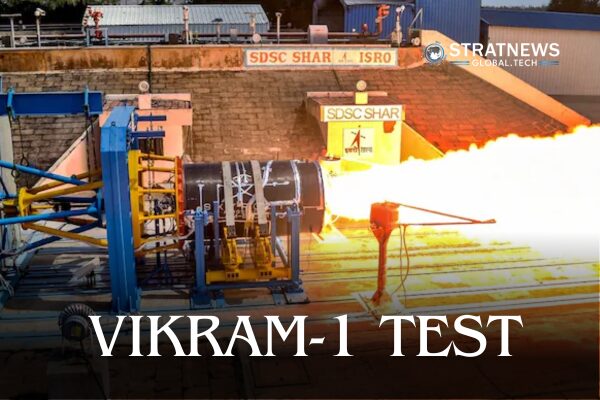
    Skyroot Aerospace has taken a significant step toward its first orbital mission, successfully completing a static fire test of the first stage of its Vikram-1 launch vehicle — marking a major milestone for India’s private space industry.

    The test was conducted at the Satish Dhawan Space Centre (SDSC-SHAR) in Sriharikota, under the supervision of the Indian Space Research Organisation (ISRO). This marks the first successful test firing of the Kalam-1200 solid rocket motor — now the most powerful monolithic solid-fuel rocket stage ever developed by an Indian private company.

    Measuring 11 meters in length and capable of delivering a peak vacuum thrust of 1200 kilonewtons, Kalam-1200 is named in honor of the late Dr. APJ Abdul Kalam, India’s former president and a pioneer in aerospace engineering. The motor is designed using carbon composite materials and features a flexible nozzle for steering, controlled by Vikram-1’s onboard mission computer.

    The test, which lasted around 110 seconds, confirmed key performance metrics such as thrust output, burn consistency, thermal protection, and the actuation of the flex nozzle system. These validations are critical as Vikram-1 prepares for its debut launch later this year.

    Once in flight, Kalam-1200 will propel the rocket to over 50 kilometers in altitude, after which a high-precision pneumatic separation system will disengage the first stage, allowing the upper stages to continue toward orbit.

    Skyroot Aerospace CEO and Co-founder Pawan Kumar Chandana called the moment “exhilarating and humbling,” crediting the achievement to years of effort by the company’s young engineering team. “This success highlights how access to ISRO’s facilities and IN-SPACe’s support is catalyzing private innovation in India’s space sector,” he said.

    Skyroot COO and Co-founder Naga Bharath Daka emphasized the importance of the milestone: “A successful booster test validates the integrated functioning of the stage — from propulsion to structural and thermal performance. This result energizes us as we approach the Vikram-1 launch.”

    Congratulating the team, IN-SPACe Chairman Dr. Pawan Goenka posted on X (formerly Twitter): “A landmark achievement. This successful static fire test puts Skyroot on the path to making history with India’s first private orbital launch.”

    Vikram-1 is set to become the first Indian privately developed rocket to reach space, aiming to deliver agile and cost-effective launch solutions for small satellite operators across the globe.

    Author

    • Huma Siddiqui
      Huma Siddiqui

      View all posts
    Dont miss
    Share. Facebook Twitter Pinterest LinkedIn Tumblr Email Reddit Telegram WhatsApp
    Huma Siddiqui
    Huma Siddiqui

      Keep Reading

      Crew-12 ISS Mission Begins With Historic Arrival At Space Station

      AI Takes Center Stage in India’s Space Sector Ahead of AI Summit

      Failed Supernova Black Hole Formation Observed in Andromeda

      Eutelsat, Starlink Rival Revenue Beats Forecasts

      Ariane 6 Amazon Satellite Launch Deploys 32 Spacecraft

      China Crewed Lunar Rocket Test Powers Through Max Q in Key Flight

      Add A Comment
      Leave A Reply Cancel Reply

      Anti Drone System (CUAS)
      Latest Posts

      Bharat VISTAAR Launched In Rajasthan To Empower Farmers With AI Support

      February 18, 2026

      India AI Impact Summit Signals $200 Billion AI Investments Push

      February 17, 2026

      RailTel AI Healthcare Panel Discussions Spotlight Public Health Innovation in India

      February 17, 2026

      AI Impact Summit Inaugurated By Narendra Modi

      February 17, 2026

      Ireland Grok Investigation Targets X Over Data And AI Images

      February 17, 2026

      Costa Rica Megafauna Fossils Reveal Rare Pleistocene Discovery

      February 17, 2026

      India Drone Ecosystem Drives Public Service Transformation

      February 17, 2026

      Nexperia Loan Boosts Chip Output And Global Production Plans

      February 17, 2026

      SpaceX Drone Contest Sparks Race For Autonomous Swarm Technology

      February 17, 2026

      Britain Under 16 Social Media Ban And Online Safety Act Reform

      February 16, 2026

      Subscribe to News

      Get the latest sports news from NewsSite about world, sports and politics.

      • Astronomical Events
      • Space Missions
      • Industry News
      • Science
      StratNewsGlobal Tech
      Facebook X (Twitter) Instagram LinkedIn YouTube
      © 2026 StratNews Global, A unit of BharatShakti Communications LLP
      • About Us
      • Contributors
      • Copyright
      • Contact
      • Write for Us

      Type above and press Enter to search. Press Esc to cancel.