


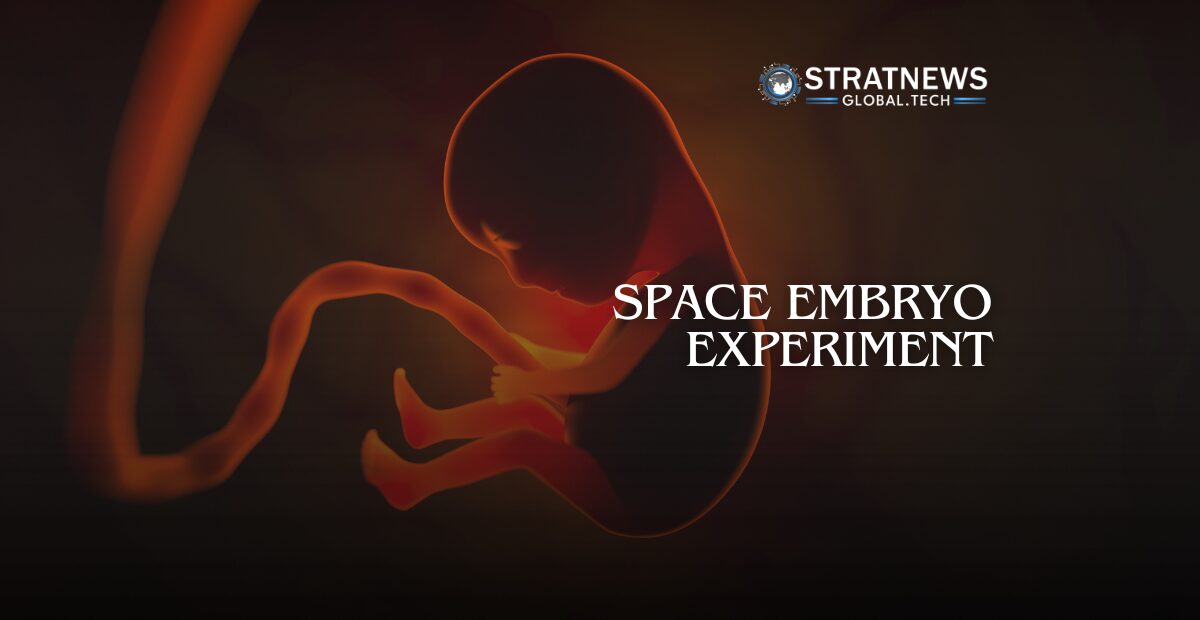
China Launches First Space Artificial Embryo Experiment
China has launched what scientists describe as the world’s first experiment to study the development of “artificial embryos” in space, marking a major step in understanding how life may develop under microgravity and cosmic radiation conditions.
The experiment travelled aboard the Tianzhou-10 mission, which launched successfully from Wenchang Space Launch Site on Monday.
According to the Chinese Academy of Sciences, the mission is designed to investigate how embryo-like structures behave in space using conditions that cannot be fully recreated on Earth.
Tianzhou-10 Carries Major Science Payload
The Technology and Engineering Center for Space Utilization, which represents the space application system of China’s manned space programme, said the cargo spacecraft transported 67 scientific items weighing more than 768 kilograms.
The mission supports 41 separate scientific experiments spanning life sciences, biotechnology, astronomy, Earth science and microgravity physics. However, the artificial embryo study has attracted the greatest attention because of its implications for future human space exploration.
Chinese researchers have gradually built what they call a complete “space embryo research system.” Earlier studies involved zebrafish and mouse embryos, while the latest mission focuses on stem-cell-derived artificial embryos.
Scientists hope the research will reveal how gravity influences the earliest stages of life and biological organisation.
Artificial Embryos Offer Research Alternative
Yu Leqian, manager of the project, explained that real human embryos are extremely difficult to obtain for large-scale scientific studies. Artificial embryos provide an alternative research model.
According to Yu, these structures are created from stem cells and closely resemble real embryos, although they cannot develop into a human being.
The models used in the Tianzhou-10 experiment represent a critical developmental period roughly equivalent to 14 to 21 days after fertilisation in humans.
During this short stage, the foundations of major organs begin forming and the body establishes its main structural axis, determining which side becomes the head and which becomes the tail.
Yu said abnormalities during this period could affect development later in life and may contribute to conditions linked to early embryonic growth.
Space Environment May Reveal Unknown Effects
Researchers believe the Chinese space station offers unique scientific conditions because it combines long-term microgravity with exposure to authentic cosmic radiation.
Life on Earth evolved under stable gravity conditions over billions of years, yet scientists still do not fully understand how mammalian embryonic development responds in near-zero gravity.
Yu said the mission aims to observe whether space conditions significantly affect the earliest biological processes involved in development.
The artificial embryos will remain aboard the space station for five days under the supervision of Chinese taikonauts. Automated systems will replace nutrient solutions daily to maintain stable growth conditions.
Once the experiment ends, the samples will be frozen in orbit before returning to Earth for detailed laboratory analysis.
Research Could Shape Future Space Settlement
The findings may eventually influence plans for long-term human habitation beyond Earth, including potential settlements on the Moon or Mars.
Scientists involved in the project say one of the most important long-term questions is whether humans could successfully reproduce and sustain future generations in space.
Yu described the mission as an initial attempt to determine whether space has measurable effects on embryonic development at all.
He said researchers hope future technologies may eventually reduce or counteract any harmful effects discovered during the experiment.
The Tianzhou-10 study represents an early but significant step in understanding whether human life can adapt to long-duration space environments.
With inputs from Reuters

