

Close Menu
Stratnews GlobalStratnews Global
    Facebook X (Twitter) Instagram
    Trending
    • India Space Policy And The Rise Of Private Space
    • Will MDR Kill UPI’s Biggest Advantage—Frictionless Payments?
    • Satellite Impact On Astronomical Observations
    • Humanoid Robot Industry Nears ‘ChatGPT Moment’
    • SkyX Vehicle Combines Underwater and Aerial Missions
    • Chang’e-7 Mission Moves Closer to Lunar Launch
    • OpenAI AI Development Slows After Agent Hacked Hugging Face
    • Meta Child Safety Trial Opens as States Seek Changes
    • Support Us
    Stratnews GlobalStratnews Global
    Write for Us
    Friday, August 21
    • Space
    • Science
    • AI and Robotics
    • Industry News
    • Support Us
    Stratnews GlobalStratnews Global
    Home » China Tests Wireless Power System In Step Towards Space Solar Ambitions

    China Tests Wireless Power System In Step Towards Space Solar Ambitions

    ReshamBy ReshamMay 20, 2026 Space No Comments2 Mins Read
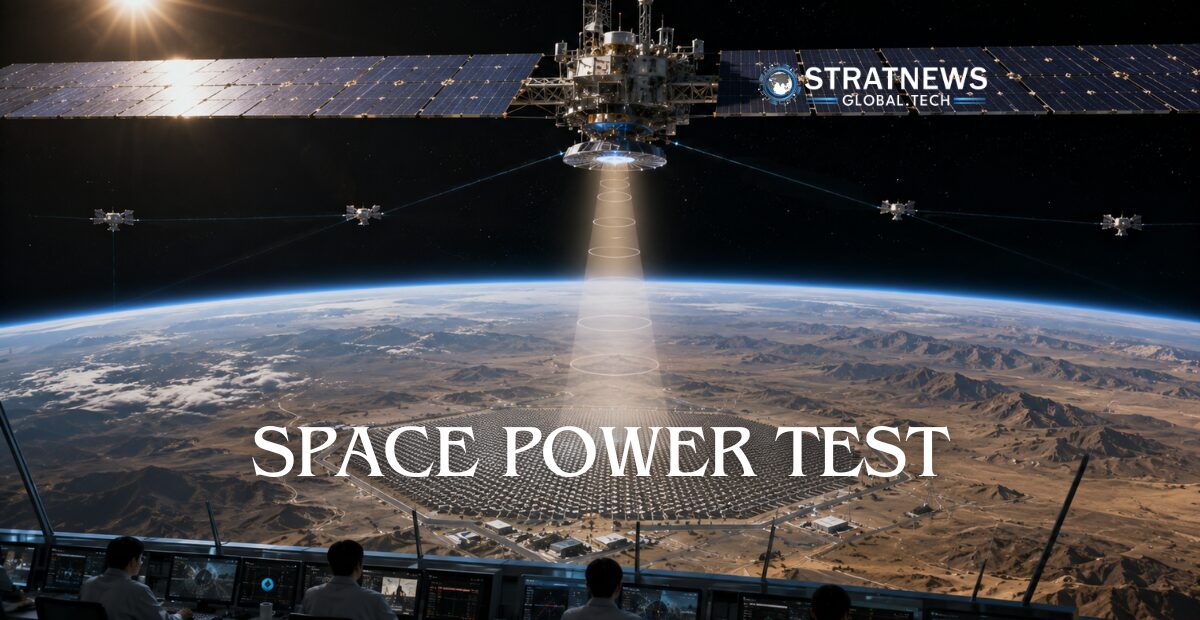
    Space Power Test

    Chinese researchers have developed and tested a wireless power transmission system capable of sending energy to multiple moving targets at the same time, in what is being seen as a significant step towards future space-based solar power stations.

    According to a report by the South China Morning Post, the team successfully carried out large-scale ground tests using a 75-metre tower built at Xidian University in Xian.

    The system reportedly transmitted 1,180 watts of microwave power across about 100 metres while maintaining accurate beam tracking and control. Researchers also tested the technology on a moving drone travelling at roughly 30 kilometres per hour, with the drone receiving 143 watts of power wirelessly during flight.

    The project is part of China’s long-running “Zhuri,” or “chasing the sun,” programme aimed at developing orbiting solar power stations capable of collecting solar energy in space and transmitting it wirelessly back to Earth.

    Researchers said the latest experiments focused on solving one of the biggest technical challenges in wireless energy transmission: maintaining stable power delivery to moving targets.

    The reported overall transmission efficiency reached 20.8 per cent, meaning about one-fifth of the original electrical energy was successfully converted back into usable power at the receiving end.

    The system is designed around microwave energy beams, a technology that could eventually allow satellites, drones or even lunar infrastructure to receive power remotely without relying entirely on onboard batteries or solar panels.

    Chinese engineer Duan Baoyan, who leads the project, has previously described future space-based solar stations as similar to “microwave charging stations” in orbit.

    In 2014, Duan and his team proposed plans for a giant orbital solar power station known as Omega, positioned roughly 36,000 kilometres above Earth in geostationary orbit.

    The design was later revised in 2023 to use smaller distributed structures working together instead of one massive station, an approach similar to concepts explored by NASA.

    The South China Morning Post report also noted that researchers claimed to have made progress in reducing the size and weight of transmitting and receiving antennas, though technical details were not publicly released.

    While China has not yet conducted similar tests in orbit, the latest ground-based experiments highlight Beijing’s growing ambitions in advanced energy and space technologies.

    Author

    • Resham
      Resham

      Research Associate at Interstellar.| China Scholar | China Social Media & Foreign Affairs|

      View all posts
    China Featured Industry Space
    Share. Facebook Twitter Pinterest LinkedIn Tumblr Email Reddit Telegram WhatsApp
    Resham
    • X (Twitter)

    Research Associate at Interstellar.| China Scholar | China Social Media & Foreign Affairs|

    Keep Reading

    India Space Policy And The Rise Of Private Space

    Satellite Impact On Astronomical Observations

    Humanoid Robot Industry Nears ‘ChatGPT Moment’

    SkyX Vehicle Combines Underwater and Aerial Missions

    Chang’e-7 Mission Moves Closer to Lunar Launch

    OpenAI AI Development Slows After Agent Hacked Hugging Face

    Add A Comment
    Leave A Reply Cancel Reply

    Anti Drone System (CUAS)
    Latest Posts

    India Space Policy And The Rise Of Private Space

    August 20, 2026

    Will MDR Kill UPI’s Biggest Advantage—Frictionless Payments?

    August 20, 2026

    Satellite Impact On Astronomical Observations

    August 20, 2026

    Humanoid Robot Industry Nears ‘ChatGPT Moment’

    August 20, 2026

    SkyX Vehicle Combines Underwater and Aerial Missions

    August 20, 2026

    Chang’e-7 Mission Moves Closer to Lunar Launch

    August 20, 2026

    OpenAI AI Development Slows After Agent Hacked Hugging Face

    August 19, 2026

    Meta Child Safety Trial Opens as States Seek Changes

    August 19, 2026

    LandSpace Zhuque-3 Booster Makes Landmark Landing

    August 19, 2026

    Unitree Shares Soar Nearly Six-Fold in Shanghai Debut

    August 19, 2026

    Subscribe to News

    Get the latest sports news from NewsSite about world, sports and politics.

    • Astronomical Events
    • Space Missions
    • Industry News
    • Science
    StratNewsGlobal Tech
    Facebook X (Twitter) Instagram LinkedIn YouTube
    © 2026 StratNews Global, A unit of BharatShakti Communications LLP
    • About Us
    • Contributors
    • Copyright
    • Contact
    • Write for Us

    Type above and press Enter to search. Press Esc to cancel.