


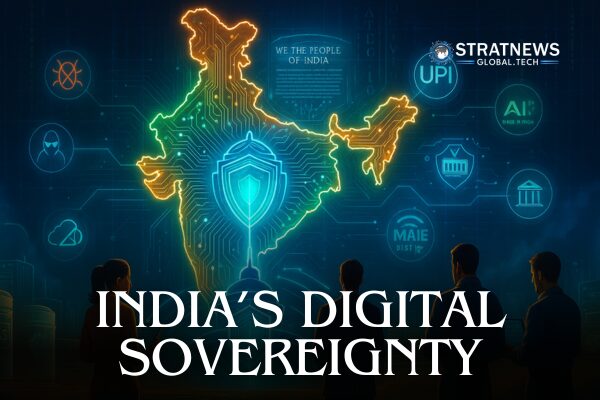
Attaining Digital Sovereignity: India’s Struggle Against Big Tech Dominance
India’s technology sector is undergoing turbulence – despite producing a gigantic pool of highly skilled workers and engineers, we continue to face heavy reliance on foreign tech giants, resulting in significant loss of value and innovation.
At an event titled ‘Digital Sovereignty, FTAs and National Security’ hosted in New Delhi, Abhishek Bhatt, CEO of Bharath Digital Infra Association, highlighted that in India, 98% of the cloud ecosystem is dominated by big techs. He further underscored the outsized influence of foreign technology companies in critical infrastructure. “There are at least 20-25 Indian cloud service providers who have their own patented technology stack, but they are struggling for just that 2% slice of the market. This is due to the absence of a coherent cloud policy.”
These challenges are further compounded by the brain drain phenomenon. Ambassador Smita Purshottam notes that the valuation of companies like NVIDIA has jumped four times to 4 trillion in just two years. Microsoft has also seen its valuation grow significantly. However, Indian talent forms the bulk of the workforce in these companies’ R&D units overseas, a situation she described as a “value loss” for India.
This talent outflow is not limited to MNCs. Startups with promising technologies are also seeing a trend of relocating abroad after early successes, leaving India deprived of intellectual property and long-term economic benefits. Ambassador Purshottam says, “We don’t have these people contributing to valuation in India. This startup flipping is a huge loss,” she added, highlighting the need for better domestic support systems.
While there is a lack of indigenous tech infrastructure in India, the issue also lies in over-reliance on the government. Sasmit Patra, Member of Parliament, noted the absence of a single Indian operating system, emphasizing how the government often bears the brunt of heavy lifting in artificial intelligence, semiconductors, and technology regulations, while the private sector reaps the benefits without sufficiently investing in R&D or infrastructure.
Addressing the problem, the panelists urged coordinated policy responses needed to nurture domestic innovation and ensure data sovereignty. “The next giant leap for us would be having a perfectly designed cloud policy with sovereignty… that would enable Indian entrepreneurs and provide legal control over technology,” said Bhatt.
Another important step for India to gain digital sovereignty would be to regulate the movement of data, says Amit Shukla, Joint Secretary of the Cyber Diplomacy division at the Ministry of External Affairs. “It needs to be done in such a way that those who own the data, their consent is taken before it gets commercialised. The important thing is that the rules should be the rules of the land, and of the territory where it has been implemented and are being used. It’s being utilised as a commercial service.”
The panelists also highlighted the urgent need to boost domestic R&D, craft clear cloud policies, and foster an ecosystem where Indian companies can thrive without the drain of talent and IP abroad in order to safeguard the country’s own interests and growth.

