


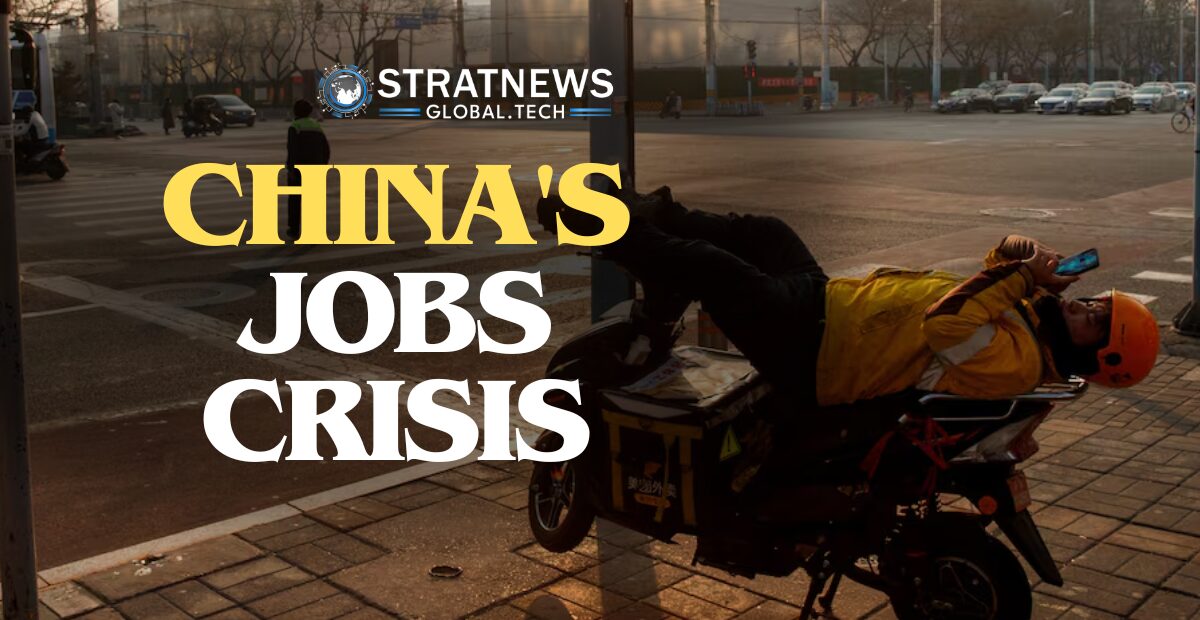
China’s economic slowdown is driving a profound shift in its labour market, with millions of workers abandoning traditional full-time employment for gig work as layoffs, weak hiring and rapid technological change reshape the country’s workforce.
Among them is 30-year-old Bao Zhang, who began driving for a ride-hailing platform in Beijing after losing his job as a software tester earlier this year. Despite spending nearly 17 hours a day on the road, Zhang says he sees little chance of returning to China’s once-booming technology sector.
“Those who used to take taxis now have to drive them themselves,” he said, describing the worsening employment situation.
After deducting vehicle rental and charging costs, Zhang earns around 6,000 yuan (about $885) a month.
His experience is becoming increasingly common across China.
According to the China New Employment Forms Research Center, the number of people in flexible employment jobs without permanent full-time contracts is expected to rise from 280 million in 2025 to around 320 million this year. That would account for roughly 44% of China’s workforce, highlighting the growing dependence on gig work.
Gig Economy Becoming China’s Employment Buffer
Economists say the expansion of the gig economy has become a crucial safety valve as the property sector downturn wipes out construction jobs, manufacturers automate production and companies continue cost-cutting amid weak domestic demand, overcapacity and tariff pressures.
Unlike in the past, the shift is no longer limited to migrant labourers.
Educated graduates, white-collar professionals and former technology workers are increasingly joining food delivery platforms, ride-hailing services and other flexible jobs.
Yang Zhan, a cultural anthropology expert at Hong Kong Polytechnic University, said the demographic profile of gig workers has changed significantly.
“It is no longer limited to rural migrants. It has spread to the middle class and university graduates,” she said, pointing to industrial restructuring and the growing impact of artificial intelligence on employment.
Growing Pressure On China’s Welfare System
While gig work provides immediate income after job losses, experts warn it also exposes weaknesses in China’s social security system.
Most gig workers are not required to contribute to pension, medical or unemployment insurance schemes, raising concerns about long-term financial security.
A government adviser told Reuters that the rapid expansion of flexible employment could place additional strain on China’s already underfunded welfare system, particularly as the country’s ageing population continues to grow.
Earlier studies by the Chinese Academy of Social Sciences warned that China’s national pension fund could face depletion within the next decade unless further reforms are implemented.
Many gig workers, however, remain reluctant to participate in the system.
Only a handful of the workers interviewed by Reuters said they voluntarily contributed to pension or medical insurance, while most preferred to save independently rather than rely on future government benefits.
“I can take control, rather than wait for decades for others to pay me,” said Angel An, a 24-year-old guide who supplements her income by promoting tourism services on social media.
Lower Security, Slower Consumption
Analysts say the rise of insecure gig work carries broader economic consequences.
HSBC economist Frederic Neumann warned that lower wages and weaker job security reduce consumer confidence, encouraging households to save rather than spend.
“A whole new generation is growing up unaccustomed to the security and confidence that their parents enjoyed,” he said.
Nomura’s chief China economist Ting Lu argued that expanding social security coverage for flexible workers would reduce economic anxiety and support domestic consumption.
“We need to reduce anxiety so that they save less and consume more,” he said.
Oversupply Begins To Hit Gig Workers
Even the gig economy is beginning to show signs of saturation.
While food delivery riders saw modest income growth last year, average earnings for China’s more than 37 million ride-hailing drivers declined as competition intensified.
Several Chinese cities, including Shenzhen, have already warned that the ride-hailing market has become oversaturated.
Despite falling earnings, many workers say they have little alternative.
Li, a cleaner in his fifties who also delivers food after work each evening, believes the growing number of delivery riders has reduced income per order but says he cannot afford to stop.
“At my age, without education, what could I possibly do?” he said. “In Beijing, even many university graduates are delivering food.”
For many Chinese workers, the gig economy has become less a choice than a necessity, reflecting the mounting pressures facing the world’s second-largest economy as it struggles to generate enough stable, well-paid jobs.
(with inputs from Reuters)

