


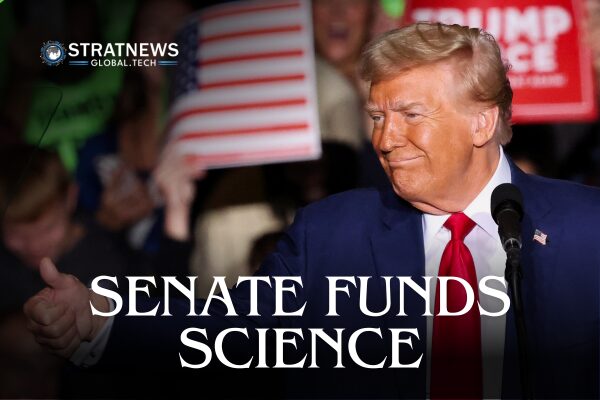
U.S. Senate Approves Major Science Funding, Rejects Trump’s Proposed Cuts
The U.S. Senate voted on Thursday to approve billions of dollars in funding for key federal science agencies, firmly rejecting deep budget cuts proposed by President Donald Trump. The bipartisan bill secures significant financial support for NASA, the National Science Foundation (NSF), and the National Oceanic and Atmospheric Administration (NOAA), reinforcing the government’s commitment to advancing research and innovation.
Strong Backing for Scientific Research
Under the legislation, the NSF will receive $8.75 billion for research initiatives, including projects in quantum information science, artificial intelligence, and emerging technologies. Democratic Senator Chris Van Hollen said the funding will enable nearly 10,000 new competitive research awards and support more than 250,000 scientists, engineers, teachers, and students nationwide.
The White House had sought to slash the NSF budget by 57%, a move widely criticised by lawmakers and scientists. The Senate’s rejection of those cuts highlights strong congressional support for maintaining America’s leadership in science and technology.
NASA Budget Secured for Key Missions
Lawmakers also rejected nearly all of Trump’s proposed reductions to NASA’s funding. While the president had pushed for a $6 billion cut from the agency’s $24.9 billion budget, the Senate approved $24.44 billion instead. The bill preserves funding for most NASA science programmes and overturns a proposal to eliminate 55 ongoing and planned missions.
NASA’s astrophysics division will receive $1.6 billion, including $300 million to complete a telescope designed to study dark energy and $500 million for the Dragonfly mission to explore Titan, Saturn’s largest moon. These investments are intended to sustain U.S. leadership in space exploration and astronomical research.
Bipartisan Support for Innovation
Senator Maria Cantwell, the top Democrat on the Senate Commerce Committee, described the bipartisan vote as “a vote for science.” Speaking to Reuters, she said, “Congress won by saying, ‘No, science does matter, and we’re going to invest in it.’” Cantwell added that the bill supports projects such as establishing a permanent outpost on the Moon, developing advanced space technologies to monitor extreme weather, and designing the microelectronics of the future.
White House science adviser Michael Kratsios defended the administration’s approach, saying that even amid proposed budget reductions, “the one area where we have kept a consistent amount of proposed budget funding has been in AI.”
Republican Senator Rand Paul, however, criticised the bill, arguing that it “wastes $8.75 billion on the National Science Foundation—a massive taxpayer-funded expansion with weak oversight, vague priorities, and no clear return for the public.”
Despite dissenting voices, the vote demonstrates strong congressional consensus in favour of sustained investment in American science, technology, and space exploration.
with inputs from Reuters

