

Close Menu
Stratnews GlobalStratnews Global
    Facebook X (Twitter) Instagram
    Trending
    • Global Equity Funds Inflows Hit Five Week High On AI Optimism
    • PM AI Roundtable Highlights India’s Deeptech Innovation Push
    • Architecting India’s AI Future With Autonomy Infrastructure And Mass Empowerment
    • AI For Oceans Of Tomorrow At India AI Impact Summit 2026
    • Meta Stock Option Cuts As Meta AI Investment Surges
    • Nvidia OpenAI Investment Nears 30 Billion Agreement
    • Gaganyaan Drogue Parachute Test Marks Major Milestone For India Space Mission
    • Budget 2026: Is India Attempting A Moonshot?
    Stratnews GlobalStratnews Global
    Write for Us
    Friday, February 20
    • Space
    • Science
    • AI and Robotics
    • Industry News
    Stratnews GlobalStratnews Global
    Home » Interstellar Visitor 3I/ATLAS Could Reveal Secrets from the Galaxy’s Earliest Days

    Interstellar Visitor 3I/ATLAS Could Reveal Secrets from the Galaxy’s Earliest Days

    Arushi PandeyBy Arushi PandeySeptember 3, 2025 Space No Comments3 Mins Read

    Interstellar Comet 3I/ATLAS Offers Rare Space Mission Opportunity

    Scientists are preparing for a unique opportunity to study Comet 3I/ATLAS, an interstellar object racing through our solar system. This rare visitor may reveal secrets from the early days of our galaxy, offering a glimpse into material much older than the sun and planets.
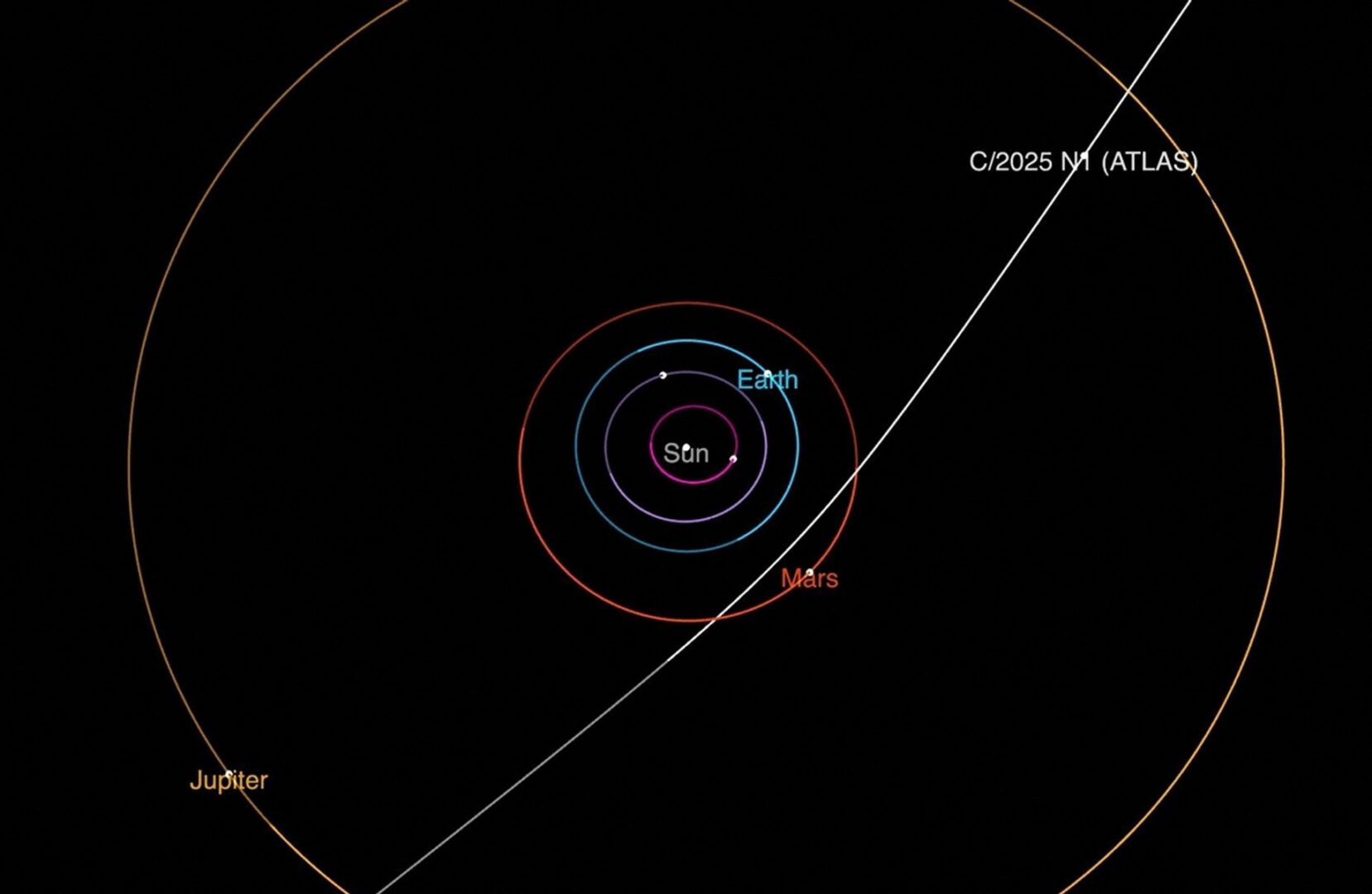
    Interstellar Comet 3I/ATLAS
    This undated diagram shows the trajectory of the interstellar comet 3I/ATLAS as it passes through the solar system, released by NASA on July 2, 2025. NASA/JPL-Caltech THIS IMAGE HAS BEEN SUPPLIED BY A THIRD PARTY

    Ancient Comet From the Galaxy’s Thick Disk

    Discovered on 1 July by the ATLAS survey, 3I/ATLAS is only the third known object believed to have entered our solar system from another star. It is travelling at around 130,000 mph (219,000 km/h). Research suggests it may come from the Milky Way’s thick disk, a region of older stars.

    This means the comet could be over 7 billion years old, predating our 4.6-billion-year-old solar system by at least 2.5 billion years. Studying it could provide insight into the conditions that existed during the galaxy’s formative period known as “cosmic noon”.

    As it nears the sun, solar heat causes its icy core to release gas, forming the glowing tail and halo we associate with comets. This material could give scientists a rare sample of ancient galactic matter.

    Earth Telescopes to Miss Crucial Moment

    Unfortunately, the comet will reach its closest point to the sun—called perihelion—on the far side of the sun from Earth. This will make it invisible to ground-based and Earth-orbiting telescopes like Hubble and the James Webb Space Telescope.

    Andreas M. Hein, a researcher from the University of Luxembourg, explained that viewing the comet during this period would require looking directly past the sun, which is not possible due to its brightness and the faint nature of 3I/ATLAS.

    Spacecraft Positioned for Prime Observations

    To overcome this challenge, researchers identified spacecraft that could observe the comet during perihelion. These include NASA’s Psyche mission and ESA’s Jupiter Icy Moons Explorer (JUICE). Thanks to a recent Venus gravity assist, JUICE will be ideally placed for observation.

    Other spacecraft, such as Mars orbiters (MRO, Tianwen-1, and Hope), will also have a clear view. JUICE will be about 43 million miles (68 million km) from the comet, while Mars orbiters will get as close as 18 million miles (29 million km). For comparison, Earth will be 168 million miles (269 million km) away at its nearest.

    Additionally, solar observation spacecraft like NASA’s Parker Solar Probe, ESA’s SOHO, and PUNCH could capture valuable data on the comet’s behaviour near the sun.

    Possibility of Dust Collection and Long-Term Study

    While some spacecraft like the Europa Clipper and Lucy may not have direct visual access, they might still pass through the comet’s tail. This could allow for indirect sampling of material released by 3I/ATLAS.

    Hein likened the comet to “an aeon-old fridge” soon to open, offering a peek into the early universe. Studying its composition could confirm its origin and age, potentially making it the oldest comet ever studied.

    Researchers also suggest that 3I/ATLAS may leave behind dust or fragments. These could enter the atmospheres of Earth or Mars, creating meteor showers or offering new study opportunities.

    As Hein noted, the next few months will be key: “We hope that some of its mysteries will be solved.”

    Author

    • Arushi Pandey
      Arushi Pandey

      View all posts
    Featured
    Share. Facebook Twitter Pinterest LinkedIn Tumblr Email Reddit Telegram WhatsApp
    Arushi Pandey

      Keep Reading

      Global Equity Funds Inflows Hit Five Week High On AI Optimism

      PM AI Roundtable Highlights India’s Deeptech Innovation Push

      Architecting India’s AI Future With Autonomy Infrastructure And Mass Empowerment

      AI For Oceans Of Tomorrow At India AI Impact Summit 2026

      Meta Stock Option Cuts As Meta AI Investment Surges

      Nvidia OpenAI Investment Nears 30 Billion Agreement

      Add A Comment
      Leave A Reply Cancel Reply

      Anti Drone System (CUAS)
      Latest Posts

      Global Equity Funds Inflows Hit Five Week High On AI Optimism

      February 20, 2026

      PM AI Roundtable Highlights India’s Deeptech Innovation Push

      February 20, 2026

      Architecting India’s AI Future With Autonomy Infrastructure And Mass Empowerment

      February 20, 2026

      AI For Oceans Of Tomorrow At India AI Impact Summit 2026

      February 20, 2026

      Meta Stock Option Cuts As Meta AI Investment Surges

      February 20, 2026

      Nvidia OpenAI Investment Nears 30 Billion Agreement

      February 20, 2026

      Gaganyaan Drogue Parachute Test Marks Major Milestone For India Space Mission

      February 20, 2026

      Budget 2026: Is India Attempting A Moonshot?

      February 19, 2026

      Google And Sea Partner To Develop AI Tools For E Commerce And Gaming

      February 19, 2026

      Microsoft Says ICE Not Using Its Technology For Mass Surveillance

      February 19, 2026

      Subscribe to News

      Get the latest sports news from NewsSite about world, sports and politics.

      • Astronomical Events
      • Space Missions
      • Industry News
      • Science
      StratNewsGlobal Tech
      Facebook X (Twitter) Instagram LinkedIn YouTube
      © 2026 StratNews Global, A unit of BharatShakti Communications LLP
      • About Us
      • Contributors
      • Copyright
      • Contact
      • Write for Us

      Type above and press Enter to search. Press Esc to cancel.