


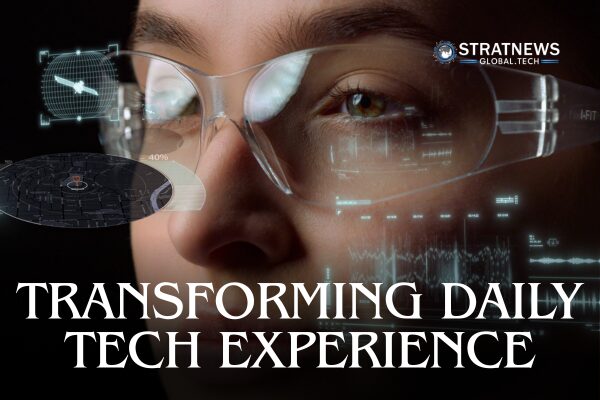
Imagine seeing a navigation map inside your spectacles as you drive. Or an answer quietly appearing on your lens mid-exam. This is no longer just a theory. Companies like Ray-Ban, Oakley, and Xiaomi are making it happen — weaving large language models into frames that sit on your face.
China has emerged as one of the primary testing grounds for this frontier. Of the 14.8 million smart glasses shipped globally in 2025, the Chinese market claimed 2.5 million — roughly 16.7 percent of the total. Tech giants like Xiaomi and Alibaba are leading the charge, with car manufacturer Li Auto also entering the space. A national subsidy program integrating AI into daily life offers a 15 percent discount, capped at 500 yuan per item.
The impact is already visible on the street. Commuters use Rokid glasses for navigation on scooters. Shoppers scan price tags to find better deals on e-commerce sites. Some even rent these devices on the Xianyu platform for 40 to 80 yuan a day. The academic use case is perhaps the most striking: students scan exam questions and view answers on the lens. At the Hong Kong University of Science and Technology, researchers using ChatGPT 5.2 with Rokid glasses ranked in the top five of a class of over 100 students.
Meta Ray-Bans have seen similar momentum in the West. Built around cameras, microphones, and speakers, they let users talk to Meta AI about their surroundings, listen to music, or capture photos and videos. The company is now preparing to launch two new models aimed specifically at prescription wearers, sold alongside EssilorLuxottica. Apple, long rumoured to be circling the eyewear space, is reportedly developing glasses with two camera lenses — one for computer vision, another for photos and videos.
Yet the hardware hasn’t caught up with the ambition. Most AI glasses weigh around 50 grams — double that of standard eyewear. They tend to overheat in summer and battery life remains a persistent problem, with most models lasting only a few hours per charge. Privacy concerns, too, remain largely unaddressed. Despite these limitations, the trajectory is clear: the world is increasingly being viewed through a new tint of artificial intelligence.

