


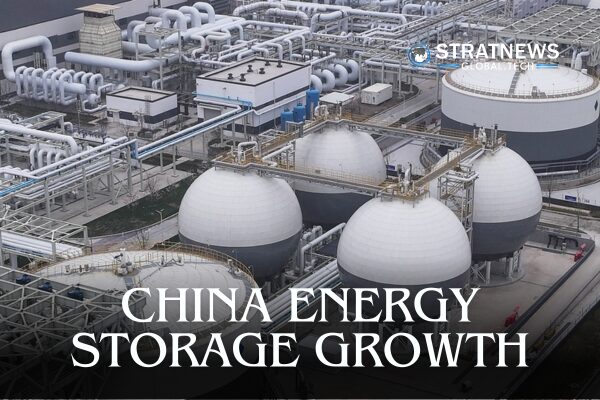
China Projects Surge In New-Type Energy Storage Capacity By 2030
China’s cumulative new-type energy storage capacity is set to exceed 370 gigawatts by 2030. This projection represents more than a 1.5-fold increase from the 144.7 gigawatts recorded by the end of 2025. A white paper on the energy storage industry, released on Tuesday, outlines this expected expansion and highlights the sector’s accelerating momentum.
Rapid Growth During The 14th Five-Year Plan
In 2025, the final year of the 14th Five-Year Plan period, China added 66 million kilowatts of new-type energy storage capacity. This figure marked a 51.9 percent increase compared with the previous year. Consequently, by the end of 2025, the total installed and operational capacity reached 136 million kilowatts. This level reflected an 84 percent rise from the end of 2024.
Moreover, the white paper emphasised the scale of this growth over a longer period. Compared with the end of the 13th Five-Year Plan period from 2016 to 2020, capacity expanded more than fortyfold. As a result, China secured the top global position in new-type energy storage capacity.
Rising Demand For Longer Storage Duration
As renewable energy continues to grow, the demand for longer energy storage durations is also increasing. According to Chen Haisheng, director of the Institute of Engineering Thermophysics at the Chinese Academy of Sciences, the average duration of cumulative installed capacity will rise significantly. It is expected to increase from 2.58 hours at present to 3.47 hours by 2030.
This shift reflects the changing requirements of the power system. As renewable sources contribute a larger share of electricity generation, the need for sustained and flexible storage solutions becomes more critical.
Transition Towards A Core Power System Component
The white paper further highlights a structural transformation within the energy storage sector. New-type energy storage is no longer limited to a supplementary role in balancing power supply. Instead, it is evolving into a foundational element of China’s power system.
At the same time, the continued rise in new energy generation is creating an urgent need for long-duration adjustment resources. Therefore, the move towards an average storage duration of nearly 3.5 hours by 2030 is expected to unlock significant industrial opportunities. Advanced long-duration technologies, in particular, are likely to benefit from this transition.
With inputs from Reuters

