


China Unveils Mission Logo For Tianzhou 10 Cargo Mission
China has revealed the official mission logo for the Tianzhou 10 cargo mission, marking a key milestone in its ongoing space station programme. The announcement came from the China Manned Space Agency, which confirmed that the mission forms one of three planned flights to the Tiangong space station in 2026.
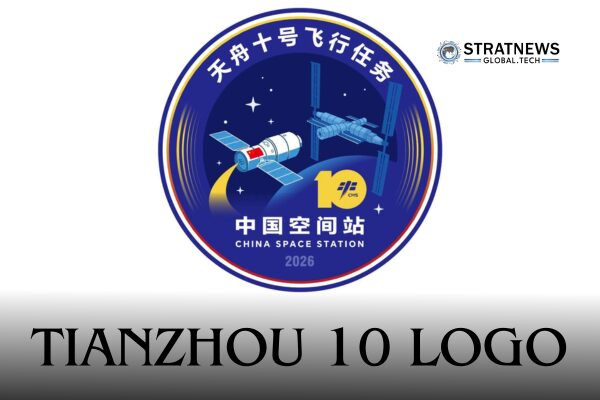
The newly unveiled logo features a cosmos blue background, creating a visual impression of deep space. At its centre, the Tianzhou cargo spacecraft follows a golden trajectory towards the Tiangong space station. Additionally, the stylised numeral 10 is integrated with the agency’s emblem, reinforcing the mission’s identity within the broader programme.
Moreover, the circular design symbolises both mission success and the harmony between Earth and space. A gradient accent transitioning from gold to red further highlights the determination and courage of China’s aerospace professionals. Consequently, the logo reflects both technical ambition and symbolic meaning.
Mission Significance And Launch Details
The Tianzhou 10 mission will represent the tenth flight of the Tianzhou class uncrewed cargo spacecraft. At the same time, it will serve as the ninth resupply mission to the Tiangong space station. The previous mission, Tianzhou 9, was launched on 15 July 2025, continuing a steady cadence of logistical support.
According to official plans, Tianzhou 10 will launch from the Wenchang Space Launch Site in 2026. Following liftoff, the spacecraft will dock at the rear port of the space station’s core module. This step is essential for maintaining uninterrupted operations aboard the station.
Furthermore, the mission will carry a range of critical supplies. These include crew provisions, maintenance components, propellant, and newly developed extravehicular activity suits. In addition, the cargo will feature experimental samples intended for applied science research, supporting ongoing innovation in space technology.
Role In China’s Expanding Space Programme
Once its mission concludes, the Tianzhou 10 spacecraft will deorbit and burn up in the atmosphere. This process will safely dispose of waste collected from the space station, thereby contributing to operational efficiency.
Meanwhile, China continues to expand its ambitions in human spaceflight. The agency has outlined plans for two crewed missions to the Tiangong space station in 2026. These missions will further strengthen long term habitation and research capabilities in orbit.
In addition, participation from the Hong Kong and Macao Special Administrative Regions is expected as early as this year. This development signals broader inclusion within the national space programme. At the same time, one astronaut from the upcoming Shenzhou 23 mission will undertake a one year extended duration experiment aboard the station.
With inputs from Reuters

