


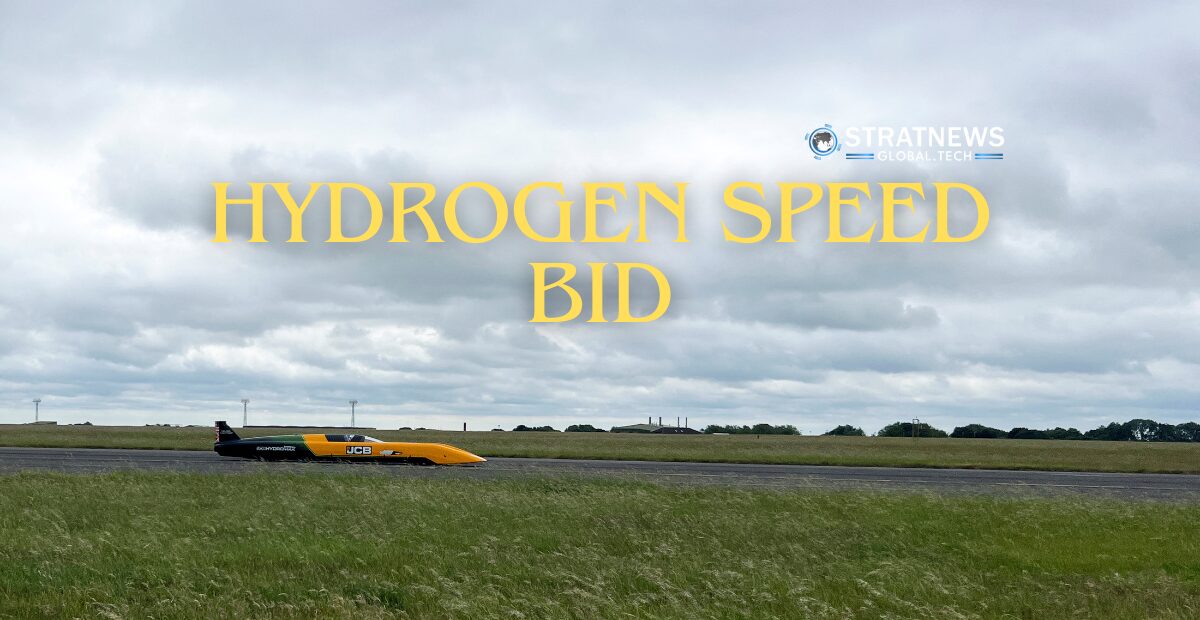
Andy Green Targets Hydrogen Speed Record With JCB Hydromax
Andy Green made history in 1997 when he broke the sound barrier in the jet-powered Thrust SSC. Now, the former Royal Air Force fighter pilot is pursuing a different milestone with a vehicle powered by hydrogen rather than traditional fuels.
At 63, Green still holds the land speed world record of 763.035 mph (1,227.985 kph). However, his latest challenge focuses on demonstrating the potential of hydrogen-powered internal combustion technology. He describes the JCB Hydromax as the “coolest zero-carbon racecar ever created”.
The 32-foot-long vehicle will attempt to surpass the diesel speed record of 350.092 mph at Bonneville, Utah, in August. Notably, that record was set 20 years ago by JCB Dieselmax, a vehicle that Green also drove across the famous salt flats.
Showcasing Hydrogen Engine Technology
Green views the project as an opportunity to highlight the future of internal combustion engines. Following recent test runs at RAF Wittering in central England, he emphasised the importance of demonstrating next-generation technology.
Although the target speed is significantly lower than his world-record achievement, Green believes the challenge remains impressive. He noted that reaching around 360 mph would still feel remarkably fast from the cockpit.
Meanwhile, testing will continue during the coming week to take advantage of favourable weather conditions. After that, the team will prepare the vehicle for shipment to the United States ahead of the record attempt.
A Tougher Challenge Than Dieselmax
JCB launched the Hydromax project in June 2025 and later announced its collaboration with Prodrive, Ricardo and Xtrac. During recent testing, the car reached 177 mph, close to the maximum possible speed over the available runway distance.
Bonneville’s course now stretches between nine and 10 miles. By comparison, the track measured 11 miles when Dieselmax achieved its record in 2006. Salt mining and environmental conditions have reduced the available distance.
As a result, Green believes the hydrogen-powered machine faces a greater challenge than its diesel predecessor. Even matching the earlier achievement will require stronger performance because the track is shorter. After a high-speed run, the vehicle can stop using brakes alone, although a rear parachute will assist. The complete stopping distance is expected to exceed two miles.
Engineering Behind The JCB Hydromax
The record attempt has received approval from the FIA and comes ahead of JCB opening a new $500 million factory in San Antonio, Texas, which will employ 1,500 people producing machines for the United States market.
In addition, JCB has invested £100 million in developing hydrogen-powered internal combustion engines. The Hydromax project supports the company’s efforts to promote hydrogen-powered construction equipment entering production.
JCB considers hydrogen a practical zero-emissions alternative to diesel in locations where machinery operates continuously and requires a highly mobile fuel source. In such situations, electric power may not be available or practical.
The Hydromax uses two production-based 74 bhp hydrogen engines that have been tuned to generate a combined 1,600 bhp. The vehicle also produces substantial torque and contains more than one kilometre of wiring.
During a record attempt, the car will move a bathtub of air every half-second through a titanium turbo compressor rotating at more than 150,000 rpm and temperatures approaching 300C. It will consume just over two kilograms of hydrogen while producing 18 litres of water.
The engines sit sideways at opposite ends of the vehicle to reduce overall height and connect to two Xtrac gearboxes. Green explained that cooling remains one of the biggest engineering challenges. Each engine circulates roughly one litre of oil per second, with seven litres of oil moving through the system every seven seconds. According to Green, around half of that oil exists simply to prevent the pistons from melting.
With inputs from Reuters