


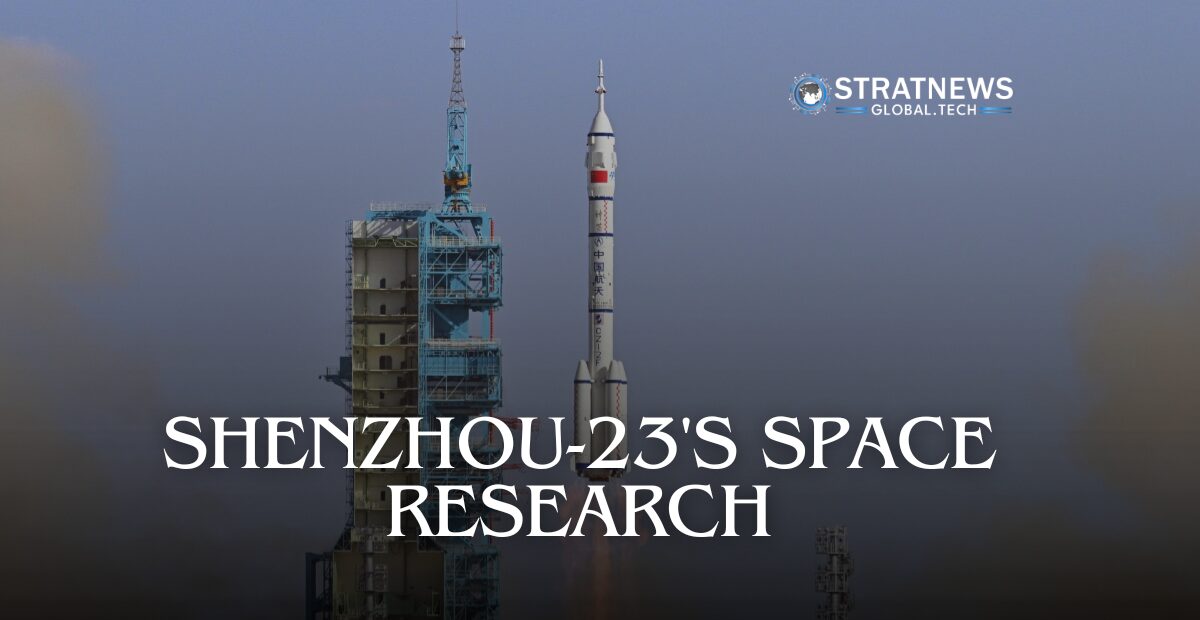
Shenzhou-23 Crew Advances Space Research Aboard Tiangong Station
The crew of the Shenzhou-23 spacecraft has completed a series of scientific experiments aboard the orbiting Tiangong space station during the past week, contributing to ongoing research in space medicine, robotics and microgravity science.
The three taikonauts, Zhu Yangzhu, Zhang Zhiyuan and Lai Ka-ying, arrived at the space station on May 25. Since then, they have carried out a broad range of experiments focused on human health, electroencephalogram (EEG) studies, human-robot interaction and physical sciences in a microgravity environment.
Space Medicine Experiments Continue
The crew used ultrasound diagnostic equipment to assist one another in performing scans of the neck, wrist, abdomen and several other parts of the body. These examinations formed part of a wider programme to better understand how prolonged exposure to space affects the human body.
The information collected will support multiple research projects. These include studies into pan-vascular blood flow spectroscopy, the spatio-temporal evolution of blood flow and the remodelling of sensitive muscle groups. As a result, researchers will gain valuable data to improve knowledge of physiological changes experienced during long-duration space missions.
Human-Robot Interaction and EEG Studies
The taikonauts also worked with a robot to complete a series of touch-interaction tests. Researchers will use the collected data to refine motion behaviour planning methods for robots operating aboard future space missions. Consequently, these findings could help improve robotic assistance for astronauts during extended stays in orbit.
In addition, the crew conducted several electroencephalogram (EEG) experiments using specialised acquisition equipment. These tests examined visual-motor processing as well as behavioural responses to different lighting conditions. The results are expected to enhance understanding of neurological performance and human adaptation in space.
Microgravity Science and Health Monitoring
As part of the station’s microgravity research programme, the crew installed several experiment modules and units. They also cleaned and replaced samples inside the experimental cavity of the containerless materials cabinet. These activities support ongoing investigations into material behaviour under microgravity conditions.
Meanwhile, the crew continued routine health management tasks using a traditional Chinese medicine (TCM) four-diagnosis instrument. The device collected relevant physiological data to support long-term health monitoring of taikonauts during their time in orbit. Furthermore, the information gathered will provide researchers with a stronger foundation for assessing the health effects of extended spaceflight.
With inputs from Reuters

