


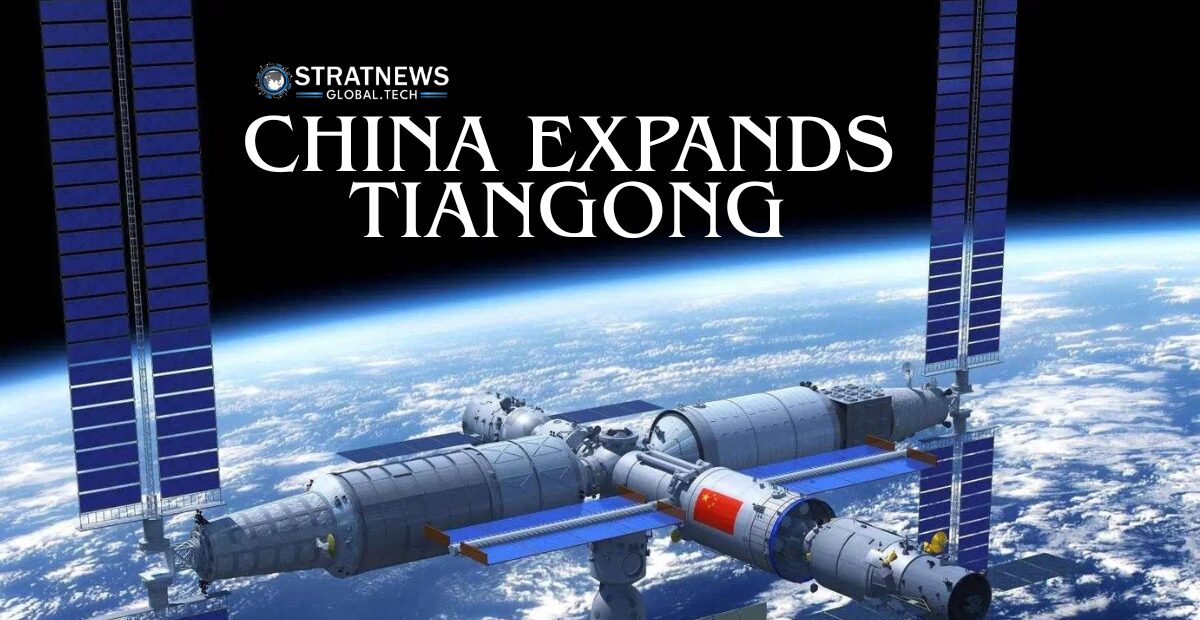
China is preparing to expand its Tiangong space station, adding a new module that will increase its research capacity, support larger astronaut crews and pave the way for more ambitious space missions.
The three-module Tiangong station, which has been fully operational since 2022, will receive a new 20-tonne multifunctional module attached to the Tianhe core module. The addition will transform the station from its current T-shaped configuration into a cross-shaped complex, providing more laboratory space, storage and docking facilities.
The expansion comes as scientific activity aboard Tiangong continues to grow. China says the station has supported more than 260 research and application projects, with dozens of new experiments launched over the past year. More than a tonne of research materials has been delivered to the station, while scientists have received over 150 terabytes of data from space-based experiments.
With more cargo and crewed missions planned, Chinese engineers say the station needs additional docking ports to avoid operational bottlenecks. The new module will also add another airlock for spacewalks, expanded laboratory facilities and greater storage capacity, allowing astronauts to conduct more experiments simultaneously.
China is also preparing Tiangong for longer-duration missions and larger crews. Planned upgrades include improved living quarters, better exercise facilities and enhanced emergency support systems. The station is also being designed to carry out more complex in-orbit servicing, including spacecraft maintenance and equipment repairs.
The expansion is part of Tiangong’s original modular design, which allows new sections to be added without major structural changes. Beijing’s long-term goal is to develop the station into a six-module orbital complex with a total mass of about 180 tonnes, nearly double its current size.
A major addition to China’s space programme is expected in 2027 with the launch of the Xuntian Space Telescope. Unlike conventional space telescopes, Xuntian will operate independently in the same orbit as Tiangong, docking with the station only for maintenance and upgrades. This will allow it to conduct high-precision astronomical observations while remaining serviceable in orbit.
Together, Tiangong and Xuntian are expected to create an integrated platform for human spaceflight, scientific research, technology demonstrations and astronomy.
The expansion comes as China continues to invest heavily in its space programme, positioning Tiangong as a long-term platform for research in low-Earth orbit as the International Space Station moves closer to the end of its operational life.