


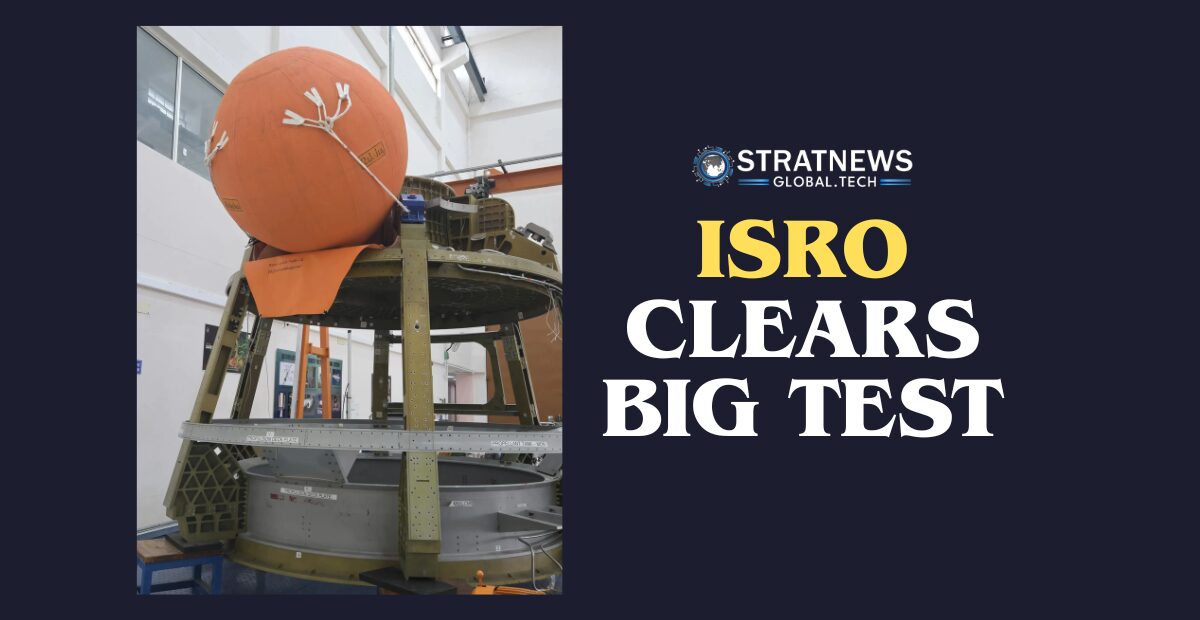
The Indian Space Research Organisation (ISRO) has successfully completed three major qualification tests for the Crew Module (CM) of its ambitious Gaganyaan human spaceflight mission, marking another important milestone towards India’s first crewed space mission.
The tests validated critical systems responsible for astronaut safety during splashdown, module separation and atmospheric re-entry.
Crew Module Up-righting System Successfully Tested
One of the key tests involved the Crew Module Up-righting System (CMUS), which ensures that the crew capsule returns to an upright position after splashing down in the sea.
ISRO tested the complete flotation system using stored high-pressure cold gas to inflate the flotation devices. The qualification test confirmed that the primary flotation system deployed successfully and met the required performance standards across the full operating range of gas bottle pressures.
The system is designed to ensure the crew module remains stable in the water, significantly improving astronaut safety during recovery operations.
Crew-Service Module Separation Validated
ISRO also successfully carried out the qualification test for the Crew Module Service Module Connect & Disconnect System (CSCDS).
The system acts as the electrical and hydro-pneumatic connection between the Crew Module and the Service Module throughout the mission, enabling communication and supporting the Environmental Control and Life Support System (ECLSS).
During the test, engineers successfully demonstrated the clean separation of the Crew Module-side umbilical (CSU-2) while confirming the structural stability of the module and validating the system’s design margins.
Crew Module Structure Passes Load Test
The third qualification involved validating the structural integrity of the Crew Module during the separation of its Apex Cover, which protects the parachute system during flight.
Before parachute deployment, the apex cover is jettisoned using pyrotechnically actuated thrusters. To simulate this event, ISRO applied loads approximately 1.75 times higher than the expected flight loads to a simulated Crew Module.
Measurements of strain and deformation confirmed that the structure comfortably met design requirements and could safely withstand the forces generated during the apex cover separation event.
Another Step Towards Gaganyaan
The successful completion of all three qualification tests further strengthens the readiness of the Gaganyaan programme.
India is preparing to send astronauts into Low Earth Orbit aboard an indigenous spacecraft, making it the fourth country after Russia, the United States and China to independently develop human spaceflight capability.
The latest tests build on a series of recent milestones as ISRO continues validating the spacecraft’s safety and reliability ahead of the mission’s upcoming uncrewed test flights.