


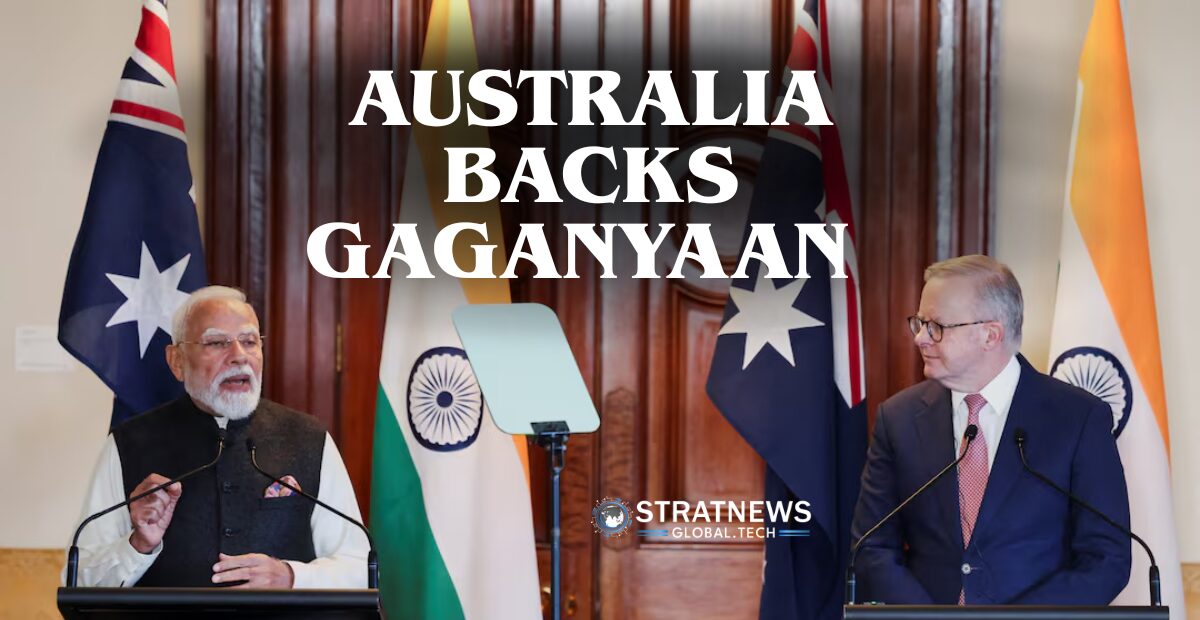
India and Australia have strengthened their space partnership with the commissioning of a temporary space tracking terminal on Australia’s Cocos (Keeling) Islands to support India’s Gaganyaan human spaceflight programme.
The announcement was made during the Third Australia-India Annual Summit, where Prime Minister Narendra Modi and Australian Prime Minister Anthony Albanese reaffirmed their commitment to expanding cooperation in space technology, innovation and advanced manufacturing. The two leaders also stressed the need for stronger collaboration between government agencies and the private sector.
The telemetry terminal on the Cocos (Keeling) Islands will provide critical tracking support for all four planned Gaganyaan missions, beginning with the first uncrewed test flight expected to launch from the Satish Dhawan Space Centre. Australia’s contribution is being led by the Australian Space Agency in partnership with government agencies and defence and space company Nova Systems.
Announcing the initiative, Albanese said the two countries had agreed to commission the temporary tracking terminal to support India’s “landmark Gaganyaan Human Space Flight Programme.”
The leaders also welcomed Australia’s continued support for Gaganyaan and expressed confidence in expanding cooperation between the Indian Space Research Organisation (ISRO) and the Australian Space Agency.
Gaganyaan aims to send three Indian astronauts into low Earth orbit for a three-day mission before returning them safely to Earth. A successful mission would make India only the fourth country to independently develop and execute a human spaceflight programme.
Australian Minister for Regional Development, Local Government and Territories Kristy McBain said the Cocos Islands would play a key role in the historic mission by providing vital telemetry tracking, strengthening Australia’s position as a trusted partner in international space collaboration.
Assistant Minister for Science, Technology and the Digital Economy Andrew Charlton said the project reflected the growing importance of India in Australia’s space ambitions.
Western Australia’s Minister for Science and Innovation Stephen Dawson said the initiative showcased the state’s capabilities in the global space sector.
Australian Space Agency Head Enrico Palermo said Australia’s geography, extensive coastlines and established tracking infrastructure made it well placed to support international human spaceflight missions, adding that the project demonstrated the strength of the bilateral partnership with India.
The announcement comes as ISRO continues preparations for Gaganyaan’s first uncrewed mission. The agency recently completed the fifth Integrated Main Parachute Airdrop Test (IMAT-05), validating the reliability of the crew module’s main parachute system ahead of the upcoming test flight.
India and Australia have steadily expanded civil space cooperation since signing a bilateral agreement in 2012. In 2024, Australia committed A$18 million to three joint space projects under its International Space Investment programme. Later that year, ISRO and the Australian Space Agency signed an agreement covering crew and crew module recovery for Gaganyaan.
Commercial ties are also gathering pace. Australia’s Space Machines Company is partnering with NewSpace India Limited to launch its Optimus Orbital Servicing Vehicle aboard India’s Small Satellite Launch Vehicle in 2026, while the Space MAITRI initiative is fostering collaboration between researchers, startups and industry from both countries.
Australian Earth observation company LatConnect60 has also expanded its India operations and is working with Skyroot Aerospace to launch an Earth observation satellite from India in early 2027. The company is exploring further partnerships in satellite manufacturing, geospatial intelligence and AI-enabled Earth observation, highlighting the growing role of private industry in the India-Australia space partnership.