


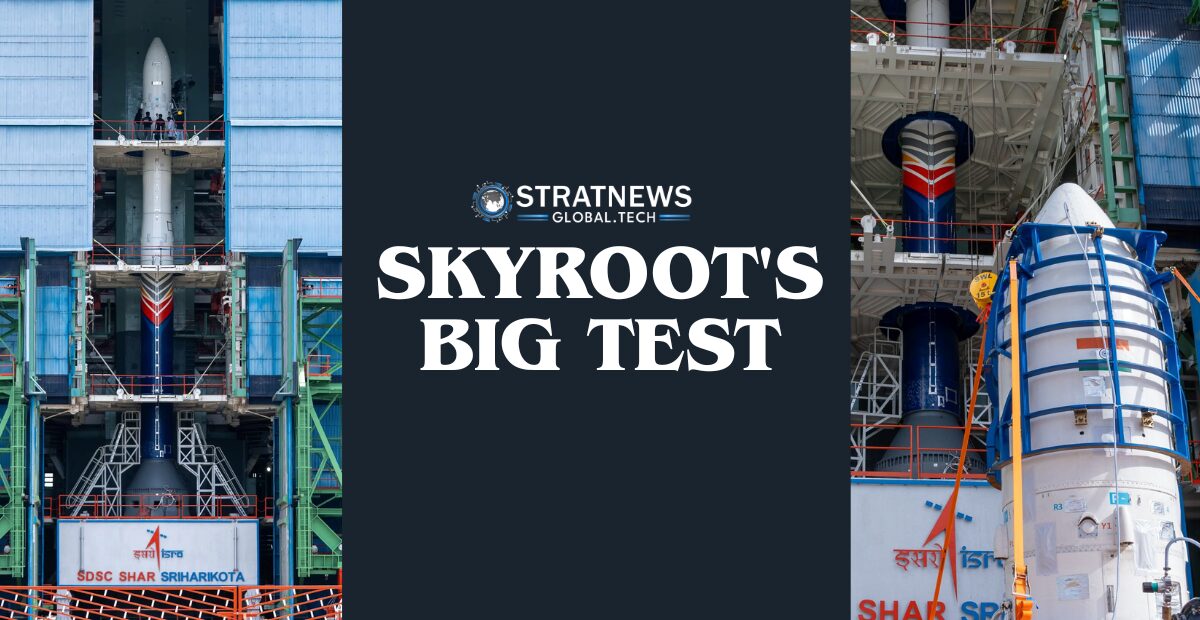
Hyderabad-based Skyroot Aerospace is preparing for what could become a defining moment for India’s private space industry. Its Vikram-1 launch vehicle is scheduled to make its maiden flight under Mission Aagaman during a launch window between July 12 and August 4 from the Satish Dhawan Space Centre in Sriharikota.
The rocket has already been fully stacked at the First Launch Pad, with final checks now underway. If the mission succeeds, Skyroot will become the first Indian private company to place a launch vehicle into orbit, marking a major milestone in the country’s commercial space ambitions.
For India’s fast-growing space startup ecosystem, the launch is about much more than reaching orbit. It will demonstrate whether private companies can design, build and operate complete orbital launch systems that compete in the global commercial market.
Unlike Vikram-S, Skyroot’s suborbital technology demonstrator launched in 2022, Vikram-1 is an operational orbital rocket built to deploy satellites. The maiden mission will target a 450-kilometre Low Earth Orbit at a 60-degree inclination while collecting critical flight data across every phase of the mission.
That data will validate hundreds of integrated systems, including propulsion, avionics, guidance, navigation, stage separation, flight software and mission control. Engineers consider these in-flight measurements indispensable because many cannot be replicated during ground testing. The results will shape the vehicle’s certification and future commercial launches.
From a technology standpoint, Vikram-1 showcases several innovations developed within India.
The rocket uses an all-carbon composite airframe, reducing structural weight while improving performance compared with traditional metallic designs. It is powered by Skyroot’s indigenously developed propulsion systems, combining the Kalam series of solid rocket motors with the company’s Raman liquid engines, manufactured using advanced metal 3D printing. Additive manufacturing enables faster production, reduces part counts and allows engineers to build complex engine geometries that would be difficult to produce using conventional methods.
The vehicle is designed to carry payloads of up to 350 kilograms into Low Earth Orbit and 260 kilograms into Sun-Synchronous Orbit, placing it squarely in the fast-growing small satellite launch market. Demand for dedicated launches has risen sharply as Earth observation, communications, defence and Internet of Things constellations continue to expand worldwide.
Equally significant is Vikram-1’s autonomous flight architecture.
After liftoff, the rocket will fly without manual intervention. Its onboard computer, named Ramanujan, works with the Guidance, Navigation and Control system to process sensor inputs, calculate trajectory corrections and execute flight decisions in real time. Such autonomy is becoming increasingly important for modern launch vehicles, improving mission reliability while reducing dependence on ground-based commands.
Mission Aagaman also reflects how quickly India’s space sector has evolved since the government opened it to private participation. Support from ISRO and the Indian National Space Promotion and Authorisation Centre (IN-SPACe) has enabled startups to move beyond supplying components to building complete launch vehicles, satellite platforms and space technologies.
For Skyroot, however, the first mission is not about commercial payload volumes. It is fundamentally a technology demonstration designed to validate the rocket’s performance under operational conditions. Every second of telemetry collected during the flight will feed into future upgrades before Vikram-1 begins routine commercial service.
Whenever the countdown begins at Sriharikota, the mission will represent more than another rocket launch. It will test whether India’s private space industry is ready to make the transition from promising startup ecosystem to a reliable provider of orbital launch services—an achievement that could reshape the country’s role in the global space economy.