


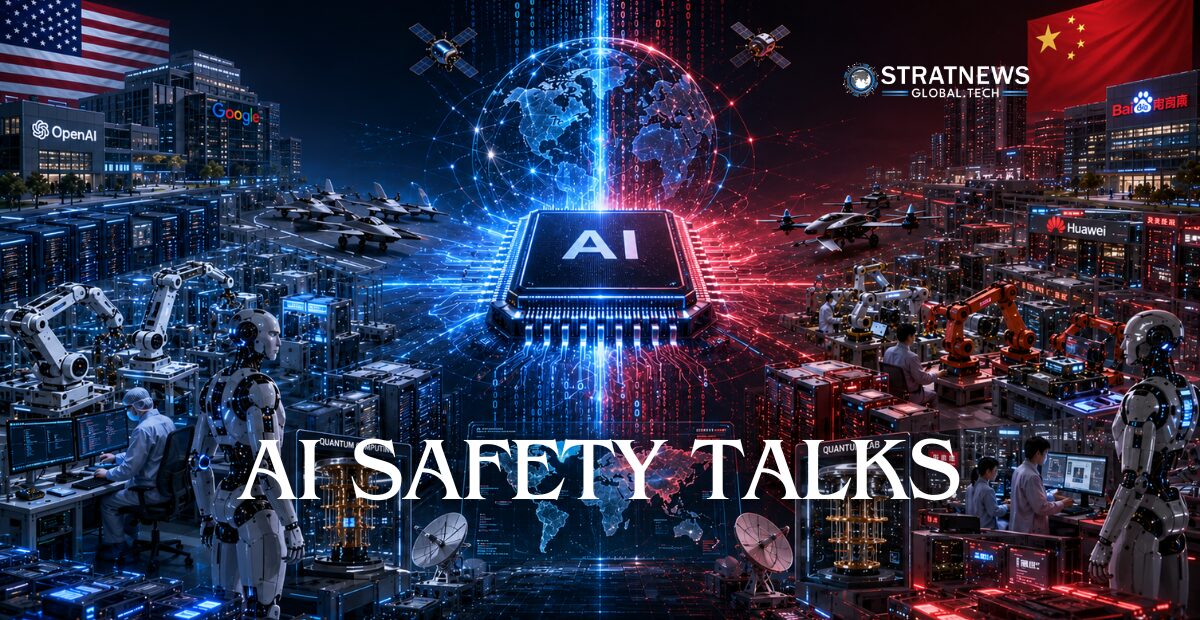
US-China AI Tensions Threaten Planned Safety Dialogue
Growing tensions between the United States and China over artificial intelligence could undermine efforts to establish bilateral cooperation on AI safety, as Washington considers sanctions against Chinese AI developers over alleged intellectual property theft and export-control violations. Analysts warn that escalating disputes risk derailing planned diplomatic engagement at a time when increasingly powerful AI models are raising fresh security concerns.
Sanctions Threat Casts Shadow Over AI Cooperation
The latest dispute follows accusations by U.S. officials that Chinese AI laboratory Moonshot distilled its Kimi K3 model from Anthropic’s advanced Fable 5 model. Distillation is a technique that trains a new AI model using the outputs of a more advanced system, reducing the computational cost of developing high-performing models.
Following the allegations, U.S. Treasury Secretary Scott Bessent warned that sanctions against Moonshot could be considered. At the same time, the Commerce Department’s Bureau of Industry and Security is investigating whether Chinese companies, including Moonshot, have illegally accessed advanced U.S. semiconductor chips to train artificial intelligence systems. Moonshot did not respond to requests for comment.
Analysts say the dispute highlights a growing contradiction in the global AI race. While both Washington and Beijing increasingly view frontier AI as a strategic asset, experts argue that cooperation on safety standards has become more important as advanced models gain capabilities that could be misused for cyberattacks and other harmful purposes.
September AI Talks Face Uncertainty
The accusations, together with reports that Washington is considering restrictions on Chinese open-weight AI models, have fuelled concerns that both countries could introduce retaliatory measures.
Paul Triolo, a partner at DGA-Albright Stonebridge Group, warned that extensive sanctions or punitive actions against Chinese AI firms could jeopardise both the planned U.S.-China AI dialogue in September and the scheduled meeting between U.S. President Donald Trump and Chinese President Xi Jinping on 24 September.
The tensions also build on years of U.S. export controls aimed at limiting China’s access to advanced semiconductor technology, an issue that has become central to broader trade negotiations between the world’s two largest economies.
Meanwhile, Reuters previously reported that Beijing is considering restrictions on overseas access to some Chinese AI models as a possible retaliatory measure.
Safety Concerns Grow Over Advanced AI Models
Researchers increasingly argue that both countries share a common interest in establishing AI safety standards before more capable systems create significant security risks.
Industry experts have also raised concerns about open-weight AI models, which can be downloaded, modified and redistributed with relatively few restrictions. Consequently, software-based export controls become more difficult to enforce once such models are publicly available.
AI researcher Yoshua Bengio warned during China’s flagship AI forum that decisions to release advanced open-weight models are effectively irreversible because safety protections can be removed more easily after publication. He argued that governments and developers should evaluate frontier models carefully and avoid releasing systems that exceed acceptable levels of risk.
Some researchers have also called for stricter pre-release safety testing and independent third-party evaluations for advanced AI systems in both countries before deployment.
Resource Constraints Shape China’s AI Strategy
Chinese AI developers must currently complete government safety and content reviews before releasing models. However, existing regulations do not cover modifications made after public release.
Industry observers note that, unlike major U.S. AI companies such as OpenAI and Anthropic, many Chinese laboratories have fewer computing resources available for extensive safety training. As a result, they often prioritise improving model capabilities over conducting comprehensive safety evaluations.
Kristy Loke, a research fellow at MATS specialising in China’s AI governance, said China could eventually reconsider its approach to releasing open-weight frontier models, although the threshold for such policy changes remains high.
She added that an ideal outcome would see both countries establish common standards for pre-release testing while agreeing on limits for the most advanced open AI models.
Washington Remains Divided Over Chinese AI
Opinion within the United States remains divided over how to respond to rapidly improving Chinese AI models, which account for a significant share of usage on the OpenRouter platform among U.S. companies.
Some American AI firms have urged policymakers to impose tighter restrictions on lower-cost Chinese models, arguing they could weaken domestic competitiveness. Others, however, caution against excessive regulation.
White House AI adviser David Sacks argued that competition should remain fair and warned against imposing unnecessary restrictions that could hinder U.S. innovation. He also dismissed concerns surrounding Moonshot’s Kimi model, saying the debate had become overblown.
The differing views underscore the broader challenge facing policymakers as they attempt to balance national security, technological leadership and international cooperation in an increasingly competitive AI landscape.
With inputs from Reuters