


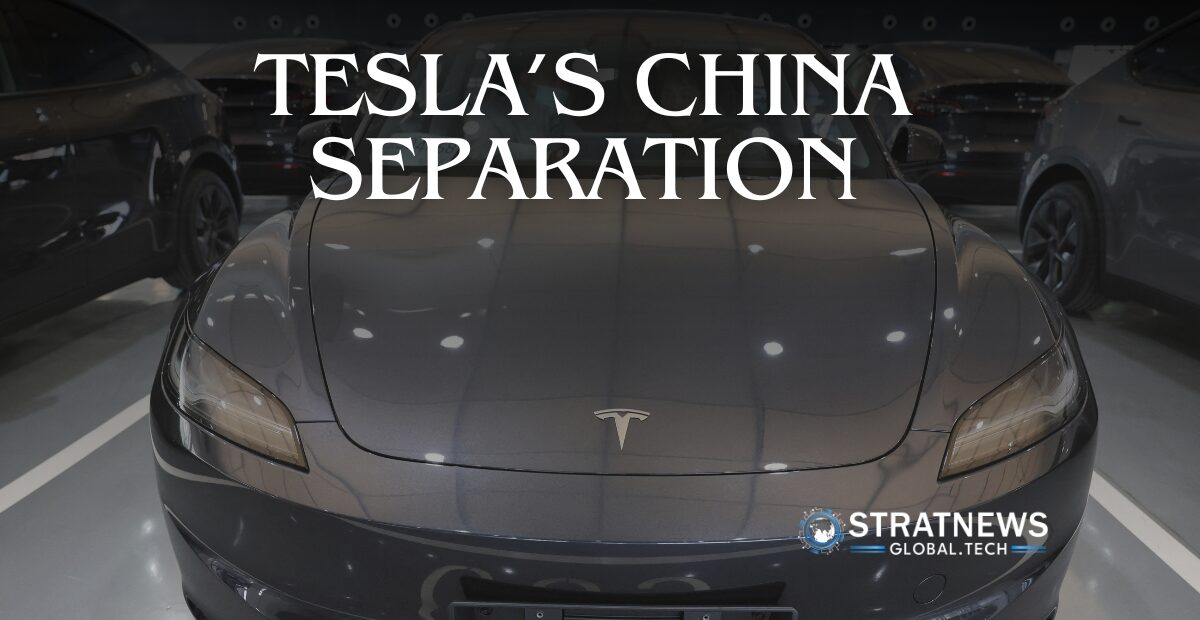
Tesla Prepares China Business Separation Amid Reported SpaceX Merger Talks
Tesla executives have reportedly been instructed to prepare for a possible separation of the company’s China business as discussions continue around a potential merger with SpaceX, according to a Wall Street Journal report citing a person familiar with the matter.
The reported move reflects the growing geopolitical and regulatory challenges that such a merger could face. In particular, Tesla’s extensive operations in China contrast with SpaceX’s role as a major U.S. defence contractor involved in national security and satellite programmes.
Tesla and SpaceX did not immediately respond to requests for comment outside regular business hours. However, Elon Musk dismissed the report on X, describing it as “fake news”.
Separation Options Under Discussion
According to the report, Tesla advisers have examined several possible approaches to separating the company’s China operations. These include spinning off the business, selling it or even closing it. However, the report added that no final decision has been made, and the plans could still change.
Investors and analysts have speculated for years about combining Musk’s electric vehicle and space companies. More recently, those discussions intensified during SpaceX’s record $75 billion initial public offering process.
Furthermore, the Wall Street Journal reported that Musk had instructed Tesla executives in recent years to organise the company with a clear division between its U.S. and China operations. The reported objective was to ensure that the U.S. side of Tesla could continue operating if geopolitical tensions between the two countries escalated.
Unlike many international car manufacturers operating in China, Tesla does not run its Chinese vehicle business as a joint venture with a local partner.
Shanghai Factory Remains Central to Tesla
Tesla’s Gigafactory Shanghai continues to be the company’s largest and most productive manufacturing facility worldwide. In addition, it serves as a major export hub for Europe, Canada and the Asia-Pacific region.
Historically, the factory has accounted for more than half of Tesla’s global vehicle deliveries. It also has an annual production capacity exceeding 950,000 vehicles.
The Wall Street Journal further reported that executives have discussed creating a separate sales entity to manage exports from the Shanghai factory. In addition, Tesla could establish separate office systems and restrict direct access between China-based employees and other company divisions.
Through its China operations, Tesla has achieved its lowest manufacturing costs for the Model 3 and Model Y by working with more than 400 domestic suppliers. Previously, a Tesla China executive said that more than 60 of those suppliers also provide components to Tesla’s global operations.
Moreover, Tesla has stated that it sources more than 95% of the components used in the China-made Model 3 and the refreshed Model Y from local suppliers.
National Security Concerns Could Complicate Merger
Earlier this month, Musk declined to rule out a merger between Tesla and SpaceX. Instead, he noted that the growing overlap between the companies could make such a combination possible.
Nevertheless, JPMorgan analysts have highlighted the practical challenge of securing regulatory approvals, especially in China. They said national security concerns linked to SpaceX’s U.S. government relationships could create significant obstacles.
China remains Tesla’s second-largest market after the United States, although the company faces strong competition from domestic manufacturers such as BYD.
Meanwhile, deliveries of China-made Model 3 and Model Y vehicles increased by 24.4% year on year in June. Second-quarter sales and exports from the Shanghai factory also rose by 32.8%.
SpaceX President and Chief Operating Officer Gwynne Shotwell also acknowledged potential advantages of combining the businesses. Speaking to CNBC in June, she said that bringing the companies together “might make Elon’s life a little easier” by simplifying management across his businesses.
With inputs from Reuters

