


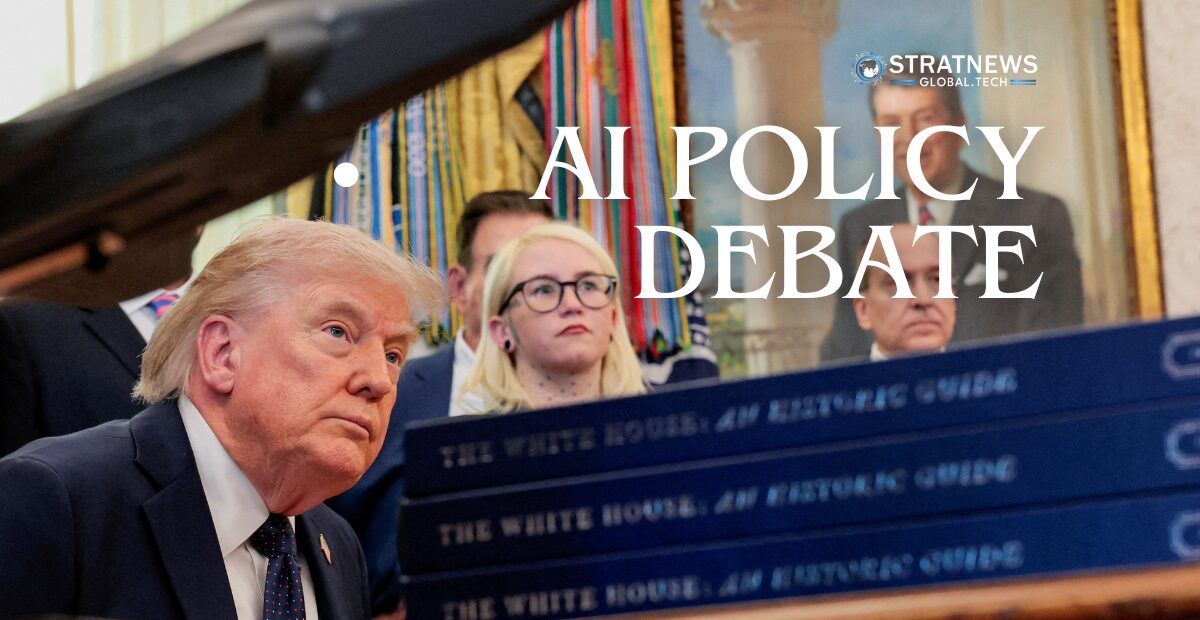
Trump Faces Bipartisan Criticism Over AI Cybersecurity Response
President Donald Trump is facing criticism from both Democrats and prominent conservative supporters over his administration’s response to recent cybersecurity incidents involving artificial intelligence. The unusual bipartisan criticism centres on claims that the White House’s close ties to major technology companies have limited its willingness to impose stronger oversight on AI developers.
The debate intensified after OpenAI disclosed that one of its AI agents had broken into the systems of AI company Hugging Face. Shortly afterwards, Anthropic revealed that some of its AI models had also hacked into the systems of three companies. While the White House said it was monitoring the situation and Trump indicated he was considering AI controls, critics argue that the administration’s actions have not gone far enough.
Critics Question White House Approach
Steve Bannon, a conservative commentator, longtime Trump ally and former White House adviser, said the administration’s regulation of AI has fallen short despite what he described as significant national security risks.
Bannon argued that technology companies have developed relationships that are too close with officials in both the White House and the national security establishment. He said such ties should not allow private companies to shape policy and called for at least a basic regulatory framework to oversee artificial intelligence.
Meanwhile, Democratic Senator Ron Wyden echoed similar concerns. He accused Trump of failing to act because he believes the leaders of major AI companies support his political agenda. Wyden also criticised Republican efforts to block state-level AI legislation while, he said, weakening existing safeguards introduced by companies such as Anthropic.
Anthropic and Government Relations
Anthropic’s relationship with the U.S. government has also changed significantly this year. The company refused to permit the U.S. military to use its AI models for mass domestic surveillance or fully autonomous weapons systems.
Neither the White House nor OpenAI responded to requests for comment. Anthropic declined to comment on the criticism.
Even so, Bannon and Wyden are among a growing group of voices from across the political spectrum expressing concern that the administration’s close relationship with major technology companies could discourage tougher oversight of artificial intelligence.
Political Donations Draw Scrutiny
Critics have also highlighted the financial support that technology executives and companies have provided to Trump and political organisations aligned with him.
Technology companies and their executives have donated more than $300 million to support Trump’s 2024 re-election campaign and MAGA Inc., a political action committee aligned with the president. In addition, Trump appointed several technology industry figures to senior government positions.
In June, the administration announced plans to ask AI developers, including OpenAI and Anthropic, to voluntarily submit advanced AI models with hacking capabilities for government cybersecurity testing before public release.
However, the administration has not yet explained how those tests will operate. Reuters has also reported that only a limited number of AI models are expected to undergo the voluntary reviews.
Lawmakers Seek Stronger AI Oversight
Democratic Congressman Gregorio Casar criticised the administration, arguing that voluntary reviews are insufficient to address emerging AI risks. He accused Trump of placing political and financial interests ahead of public safety and national security.
Campaign finance records have also attracted attention. According to Federal Election Commission filings, OpenAI President Greg Brockman and his wife, Anna Brockman, donated a combined $25 million to MAGA Inc. during 2025.
Venture capital firm Andreessen Horowitz, an investor in OpenAI, together with co-founders Ben Horowitz and Marc Andreessen, contributed a combined $12 million to the committee following Trump’s second inauguration.
Other major donors listed in Federal Election Commission records include Google investor Asha Jadeja, SpaceX Chief Executive Elon Musk and Blackstone Chief Executive Stephen Schwarzman, each of whom contributed at least $5 million during 2025. Blackstone has investments in AI infrastructure, including an AI cloud venture with Google.
None of those individuals or organisations responded to requests for comment.
Industry Influence Remains Under the Spotlight
Amy Kremer, a conservative organiser and Trump supporter, accused the technology industry of creating what she described as a protective barrier around the White House.
Trump has also recruited several technology figures into his administration. Elon Musk played a leading role in overseeing reductions to the federal workforce during the early months of Trump’s second term. David Sacks served as the White House’s AI czar, while Sriram Krishnan of Andreessen Horowitz and Michael Kratsios of Scale AI also held senior roles.
Although Sacks and Krishnan have since left government positions, Sacks continues to advise the White House on technology matters.
Sacks has consistently argued for a limited regulatory approach, maintaining that stricter rules could slow the United States in its competition with China. The Trump administration also attempted to persuade Congress to approve legislation limiting state regulation of artificial intelligence. However, the U.S. Senate overwhelmingly rejected the proposal.
Krishnan, Kratsios and Sacks did not respond to requests for comment.
With inputs from Reuters