


Collaborative Robots (Cobots): The Practical Guide to MSME Automation in India
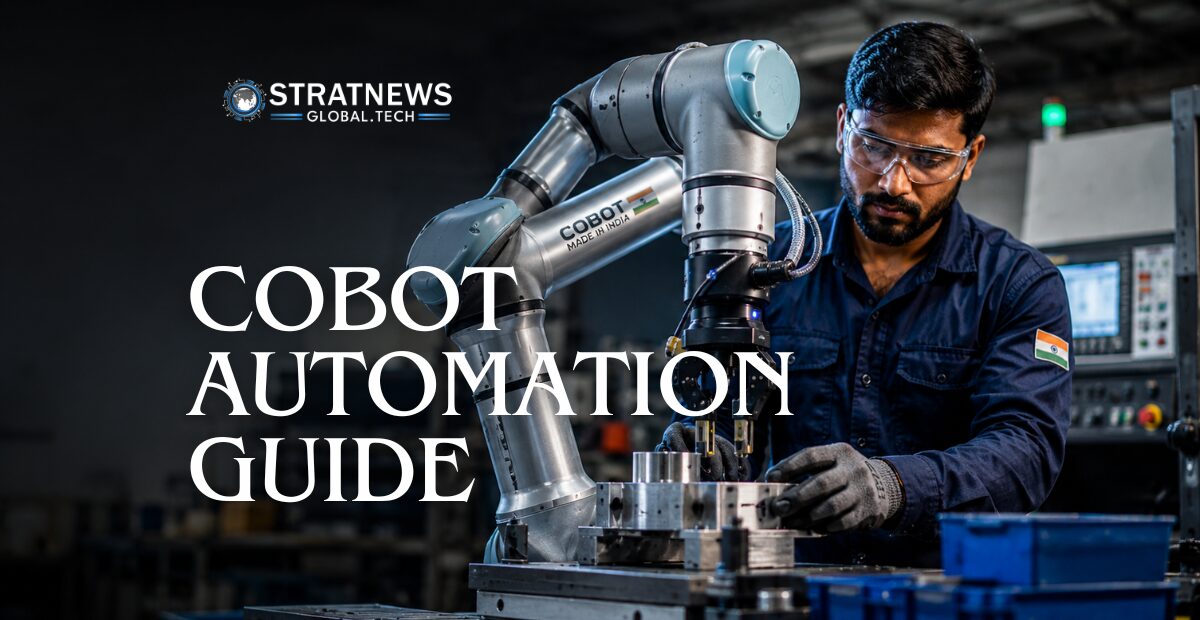
A cobot works next to a person on the same shopfloor, no cage required. A traditional industrial robot moves faster and lifts heavier loads, but it needs fencing, dedicated floor space, and specialist programmers to run safely. That difference matters most to India’s smaller manufacturers, where floor space and engineering budgets stay tight.
Call this shift “democratization”: automation that used to require a large capital plan and an in-house engineering team now fits a business with a handful of machines and one supervisor who can learn the controls in a day. India’s manufacturing MSMEs face a labor shortage on skilled shopfloor roles and inconsistent product quality across shifts. Cobots address both problems directly, working the same repetitive task at the same tolerance, shift after shift, without needing a new engineer on payroll.
The gap this closes is real. India’s robot density sits at roughly 5 to 7 units per 10,000 manufacturing workers, against a global average of 162, according to International Federation of Robotics data. That gap represents unmet demand, not a ceiling. Cobots give small manufacturers a lower-cost entry point into a category of technology that used to belong only to large factories with dedicated automation budgets.
How cobots work with people, not around them
International safety standard ISO 10218 sets the rules for how industrial robots and cobots operate around humans. Cobots meet that standard through four collaborative modes: safety-rated monitored stop, hand-guiding, speed and separation monitoring, and power and force limiting. Power and force limiting matters most for small shopfloors — the robot senses resistance and stops or slows automatically if it contacts a person, removing the need for a safety cage around the entire work cell.
That single feature changes the economics of adoption. A traditional robot cell needs fencing, light curtains, and interlocked doors, adding cost and consuming floor space a small manufacturer often cannot spare. A cobot operates fenceless in most applications, sitting directly beside an existing workstation instead of claiming a separate zone.
Programming follows the same logic of removing specialist dependency. Lead-through programming lets an operator grip the robot arm and physically move it through a task, recording each waypoint as it moves. No code gets written, and no robotics engineer needs to fly in for setup. A machine operator who already knows the process can teach the cobot that process directly.
| Feature | Traditional Industrial Robots | Collaborative Robots (Cobots) |
|---|---|---|
| Safety | Safety Cages/Fencing Required | Power & Force Limiting (Fenceless) |
| Setup | Weeks; Specialized Engineers | Days; Existing Shopfloor Staff |
| Footprint | Large & Fixed | Compact & Portable |
| Cost | High Initial Outlay | Lower Entry Point / Faster ROI |
What a cobot actually costs
Entry-level cobots in India start around ₹8 lakh, with mainstream industrial models from Universal Robots, Fanuc, and ABB running roughly ₹8 lakh to ₹20 lakh depending on payload and reach. Heavier six-axis arms built for welding or machine tending run past ₹1 crore, but most MSME pick-and-place and inspection tasks fall well inside the entry-level band.
Payback periods for single-shift deployments typically run 12 to 24 months, shortening to well under a year when a manufacturer runs the cobot across multiple shifts. A cobot working three shifts displaces more labor cost per rupee invested than one working eight hours a day, so shift structure should factor directly into the purchase decision.
Robotics-as-a-Service (RaaS) removes the upfront capital question entirely. Under this model, a manufacturer pays a monthly fee for the robot, software, and support instead of buying the hardware outright. That structure suits MSMEs testing a new production line or lacking the balance sheet for a lump-sum purchase, and it shifts maintenance risk onto the vendor rather than the buyer.
Government financing narrows the gap further. The Credit Linked Capital Subsidy Scheme (CLCSS) offers a 15% upfront subsidy on eligible plant and machinery purchased through a bank loan, capped at ₹15 lakh on investments up to ₹1 crore. A cobot purchase that qualifies as a technology upgrade under CLCSS’s approved sub-sectors can cut real acquisition cost by roughly a seventh, provided the manufacturer routes the purchase through a bank term loan rather than paying cash.
Where cobots fit on an Indian shopfloor
Pick-and-place tasks suit cobots well because the work is repetitive, low-variance, and easy to teach through lead-through programming. A cobot moving components from a conveyor to a tray runs at consistent speed and consistent grip force, cutting the defect rate that comes from operator fatigue on long shifts.
Precision welding benefits from a cobot’s repeatable positioning, which holds tolerance better than a tired human hand late in a shift. Small and mid-size fabrication units running spot welding or arc welding on standardized parts can mount a welding-rated cobot on a compact cell that fits inside an existing bay, without the ventilation and fencing overhead of a full industrial welding robot.
Quality inspection tasks pair a cobot arm with a camera or sensor, moving the part through a fixed set of check points at a consistent angle and distance. This removes the inconsistency that comes from different inspectors applying different judgment calls across a shift.
Indian shopfloors carry constraints a standard automation pitch often ignores. Many MSME units run on single-phase or unstable three-phase power, so cobot selection should confirm voltage tolerance and include a stabilizer where the local supply fluctuates. Floor space runs tight in most tier-2 and tier-3 manufacturing clusters, which favors compact, wheel-mounted cobot carts that can move between stations rather than fixed installations claiming permanent floor area.
Starting a pilot
Pick one repetitive, high-defect-rate task and run a single cobot pilot on it before committing to a wider rollout. A narrow pilot surfaces power, space, and training issues at low cost, and gives the shopfloor team hands-on experience before the business scales the deployment. Choose a task where the current defect rate or labor cost is already tracked, since a pilot without a clean baseline makes the ROI case harder to prove to ownership later.
Apply for CLCSS financing through your bank when the loan application goes in, not after equipment arrives, since the subsidy routes through the loan process rather than as a direct reimbursement. Confirm the cobot purchase falls under one of the 51 approved technology sub-sectors before applying, and keep the vendor invoice and technology approval documentation ready for the bank’s nodal agency.
Pursue MSME Sustainable (ZED) Certification alongside the automation pilot; the certification process pushes a manufacturer toward the same quality and process discipline a cobot deployment needs to succeed, and it improves standing with lenders and export buyers. Treat the first cobot as a proof point, then use its measured output — defect rate, cycle time, labor hours saved — to build the case for the next one. A documented pilot result carries more weight with a bank or an export customer than any vendor’s projected numbers.

