


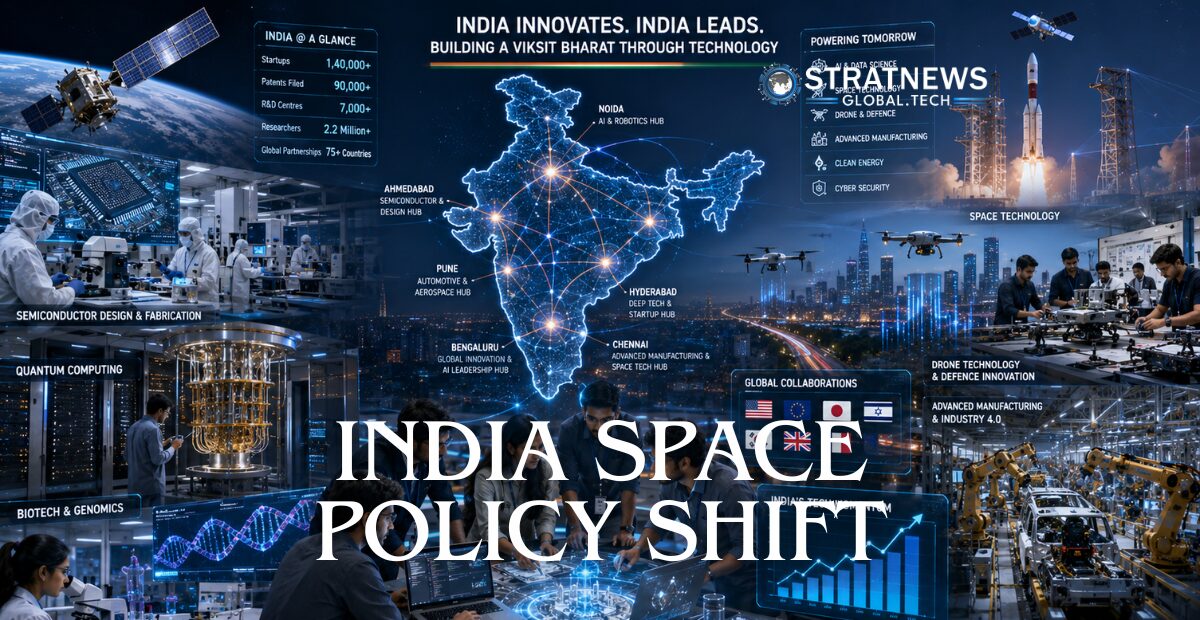
India’s Private Space Race Signals A Strategic Policy Shift
On July 18, 2026, Skyroot Aerospace’s Vikram-1 rocket reached a 450-kilometre orbit and released four payloads. The achievement made the Hyderabad-based startup the first Indian private company to reach orbit. It also made India the fourth country, after the United States, China and Russia, with demonstrated private orbital-launch capability.
Coverage understandably focused on Skyroot itself. The decade-old startup, backed by a valuation of roughly $1.1 billion, had succeeded where India’s state agency ISRO spent decades building comparable capability.
Yet Skyroot’s achievement, alongside the more technically ambitious effort by Agnikul Cosmos, represents more than an entrepreneurial success story. Instead, both companies reflect a broader reorientation of Indian space policy that has been developing since the mid-2000s. A programme once centred primarily on civilian development has increasingly acquired security and national-prestige dimensions.
From Civilian Development To Strategic Capability
For most of its six-decade history, India’s space programme followed the developmental vision of Vikram Sarabhai and Homi Bhabha. Space technology focused on socio-economic challenges, including rural communications, weather forecasting, agriculture and disaster management.
India also criticised Cold War-era antisatellite tests by the superpowers and opposed Washington’s Strategic Defense Initiative. Furthermore, it deliberately maintained a separation between its civilian space programme and defence establishment.
India’s private space race therefore does not represent a retreat by the state. Instead, it reflects a reorganisation of national capability. The government continues to establish priorities, control critical infrastructure, authorise operations, transfer mature technologies and shape demand.
Meanwhile, private firms are taking larger roles in design, production, launch services and technological experimentation. This emerging model is better described as state-enabled commercialisation. Capability is spreading across a broader ecosystem, while strategic direction remains substantially public.
China’s ASAT Test Changed India’s Calculus
In January 2007, China destroyed one of its ageing weather satellites with a ballistic interceptor. The test scattered thousands of pieces of debris and demonstrated a capability that no other Asian power possessed.
Indian officials continued for a time to publicly oppose the weaponisation of space. However, security scholar Rajeswari Pillai Rajagopalan said the test forced “a re-evaluation of India’s traditional declaratory policy against the militarization of space”.
That reassessment eventually produced an Indian capability of its own. On March 27, 2019, Prime Minister Narendra Modi announced that a DRDO interceptor had destroyed an Indian satellite in low Earth orbit during Mission Shakti. India consequently became the fourth country, after Russia, the United States and China, to test a kinetic antisatellite weapon.
The government subsequently institutionalised that capability. A tri-service Defense Space Agency, approved in the previous year and headquartered in Bengaluru, was established. By November 2024, it was conducting its first simulated space-warfare exercise, Antariksha Abhyas.
However, India’s earlier ambivalence has not completely disappeared. In December 2022, the country abstained rather than support a UN resolution calling for a moratorium on destructive antisatellite testing. India was unwilling to completely rule out an option it had recently exercised itself.
Capacity Constraints Accelerate Privatisation
The connection between India’s security shift and its decision to open launch-vehicle production to private companies is also practical. Rajagopalan and co-author Dimitrios Stroikos identify “capacity crunch within the state space agencies” as one factor behind India’s move towards the private sector.
The figures underline that pressure. ISRO operates with a budget of roughly $2 billion and a workforce of around 16,000. That is a fraction of the resources committed by China or the United States to their space programmes.
At the same time, ISRO must support a growing military satellite constellation, the Gaganyaan human spaceflight programme and routine commercial launch demand. Consequently, the agency’s monopoly on rocket production had to change.
The 2020 reforms and Indian Space Policy of 2023 formalised that transition. They established IN-SPACe as a single-window regulator and directed ISRO to transfer mature launch systems, including the Polar Satellite Launch Vehicle, to industry.
The regulatory changes produced a rapid response. Around 290 companies applied for authorisation during the policy’s first years. Meanwhile, registered space startups increased from one company in 2014 to 189 by the end of 2023.
The government has also set ambitious economic targets. Officials aim to increase India’s space economy from roughly $8 billion to $44-50 billion by the end of the decade. They also want India’s share of the global space market to rise from about 2% to closer to 9%.
Skyroot And Agnikul Take Different Routes
Skyroot and Agnikul have emerged as the two companies furthest along the path towards independent orbital launch. Nevertheless, they are pursuing notably different engineering approaches.
Skyroot uses conventional solid- and liquid-fuelled staging. Agnikul, meanwhile, has developed a 3D-printed semi-cryogenic engine and India’s first privately built and operated launchpad, with technical support from the Department of Space.
Agnikul has yet to reach orbit. Its planned Mission-02 aims to combine an orbital debut with recovery of the first-stage booster. That represents a more ambitious sequence and suggests that future competition could depend on reusable architecture as much as on reaching orbit first.
Commercial Space Has Wider Strategic Stakes
The strategic implications extend beyond the competition between the two companies. Retired Air Marshal R. Radhish has argued that India’s security establishment needs to integrate commercial space capabilities into national defence planning.
He has pointed to the US Department of Defense and NATO as examples of organisations that have formalised commercial-space strategies. Dependence on foreign providers, he argues, can create operational risks.
The interruption of Starlink service to Ukrainian forces in 2022 is frequently cited as an example. A domestic private launch industry could provide India with greater redundancy, faster technology cycles and less exposure to foreign leverage during a crisis. Indian military planners have explicitly drawn lessons from the war in Ukraine.
Commercialisation also has implications beyond defence. An internationally competitive private space sector could enable New Delhi to offer launch, satellite and data services to partners across the Indo-Pacific and the Global South.
In turn, this could strengthen India’s position as an alternative technological partner without requiring formal security alignment. Private space capability therefore supports domestic resilience and economic growth while advancing India’s pursuit of status, strategic autonomy and influence over the emerging governance of space.
Lessons For Israel
None of this means India has created a mature industry. One successful orbital flight does not resolve the capital constraints that have historically made Indian space startups harder to fund than their American or European counterparts.
Nor does it close the multi-year gap between demonstrating a capability and establishing a sustained commercial launch cadence. Nevertheless, Skyroot’s July 2026 flight represents more than a commercial milestone.
It is the latest and most visible marker of a policy shift that began not in a boardroom but in the debris field created by a Chinese missile test in January 2007.
What can Israel learn from these developments in India? First, it can recognise the importance of the private sector in space. Although Israel often describes itself as a “leading space power”, a degree of modesty is warranted.
The Israeli space ecosystem faces a severe lack of investment alongside extensive regulation. When almost every aspect of the sector is treated as security-related, Israeli companies and entrepreneurs can find it difficult to operate in space while also becoming exporters.
Israel can therefore learn from India’s efforts to establish simpler bureaucratic channels for private space ventures. It can also support entrepreneurial activity by, for example, keeping a launch site under government control while allowing a private company to operate the launcher.
Moreover, government commitments to purchase services from private space companies could improve their cash flow. Such commitments could also make it easier for those companies to attract investment from other countries.
Tal Inbar is an expert focusing on strategic aerospace research at GeoHorizon and a Senior Research Fellow at the Missile Defense Advocacy Alliance.
Dr. Lauren Dagan Amos is a member of the Deborah Forum, a lecturer and a researcher in the Department of Political Science and the Security Studies Program at Bar-Ilan University. She specialises in Indian foreign policy.
With inputs from Reuters