

Close Menu
Stratnews GlobalStratnews Global
    Facebook X (Twitter) Instagram
    Trending
    • SpaceX IPO Could Top $1 Trillion as Investors Rush In
    • Time Names AI Architects as 2025 Person of the Year
    • NAACP Issues Framework to Prevent Bias in Healthcare AI
    • Cambridge Study Finds Fake Accounts Can Be Created for Just Cents
    • Caribbean Nations Unite to Harness Geothermal Energy Potential
    • U.S. Pushes to End Reliance on Chinese Lidar Technology
    • Trump Moves to Block Broadband Funds Over State AI Regulations
    Stratnews GlobalStratnews Global
    Write for Us
    Saturday, December 13
    • Space
    • Science
    • AI and Robotics
    • Industry News
    Stratnews GlobalStratnews Global
    Home » The James Webb Space Telescope Discovers a Jeweled Ring in the Cosmos

    The James Webb Space Telescope Discovers a Jeweled Ring in the Cosmos

    ReshamBy ReshamJuly 15, 2024 Science No Comments3 Mins Read
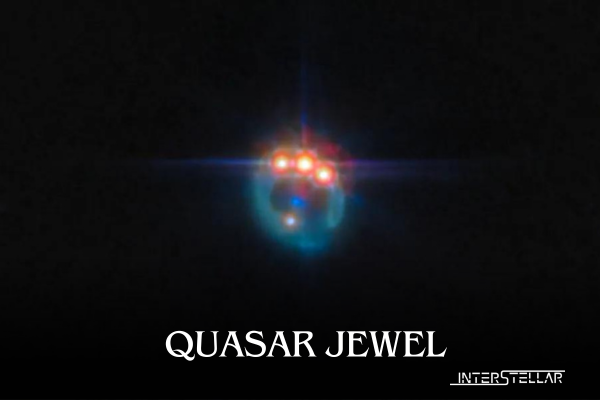
    James Webb Telescope Image

    Cosmic Jewel: James Webb Space Telescope Captures Quasar in Stunning Detail

    A mesmerizing image of a sparkling jeweled ring, created by a cosmic phenomenon known as gravitational lensing, has been captured by the James Webb Space Telescope (JWST). This new image showcases a distant quasar, RX J1131-1231, situated about 6 billion light-years from Earth.

    Unveiling the Cosmic Ring

    The powerful gravitational field of a nearby elliptical galaxy warps the light from the quasar, an extremely luminous active galactic nucleus (AGN), resulting in a bright arc and duplicate views of the quasar. This warping effect creates a visual resembling gemstones on a ring. The elliptical galaxy, appearing as a small blue dot at the center of the ring, acts as a natural telescope, magnifying the light from the distant quasar which would otherwise be too far away to study in detail.

    The Phenomenon of Gravitational Lensing

    Gravitational lensing occurs when a massive object, such as a galaxy, bends the light from a more distant source. This effect allows astronomers to study regions near the black holes at the centers of distant quasars. Quasars are powered by large amounts of gas and dust falling into a galaxy’s supermassive black hole, making these regions shine brightly.

    “Measurements of the X-ray emission from quasars can indicate how fast the central black hole is spinning, providing crucial clues about black hole growth over time,” stated European Space Agency (ESA) officials.

    Insights from the Image

    The JWST image, taken using its Mid-Infrared Instrument (MIRI), is part of a larger study of dark matter and its distribution in the universe. The elliptical galaxy’s gravitational lensing effect magnifies the light from RX J1131-1231, offering astronomers a closer look at the quasar.

    “If a black hole grows primarily from collisions and mergers between galaxies, it accumulates material in a stable disc, leading to a rapidly spinning black hole,” ESA officials explained. “Conversely, if the black hole grows through numerous small accretion episodes, it accumulates material from random directions. Observations indicate that the black hole in this quasar is spinning at over half the speed of light, suggesting it has grown via mergers.”

    Significance of the Discovery

    The new observations, combined with previous data from other telescopes, make RX J1131-1231 one of the best-lensed quasars discovered to date. This finding not only enhances our understanding of black hole growth and quasar characteristics but also contributes to the study of dark matter and its role in the universe.

    Author

    • Resham
      Resham

      Research Associate at Interstellar.| China Scholar | China Social Media & Foreign Affairs|

      View all posts
    Featured
    Share. Facebook Twitter Pinterest LinkedIn Tumblr Email Reddit Telegram WhatsApp
    Resham
    • X (Twitter)

    Research Associate at Interstellar.| China Scholar | China Social Media & Foreign Affairs|

    Keep Reading

    SpaceX IPO Could Top $1 Trillion as Investors Rush In

    Time Names AI Architects as 2025 Person of the Year

    NAACP Issues Framework to Prevent Bias in Healthcare AI

    Cambridge Study Finds Fake Accounts Can Be Created for Just Cents

    Caribbean Nations Unite to Harness Geothermal Energy Potential

    U.S. Pushes to End Reliance on Chinese Lidar Technology

    Add A Comment
    Leave A Reply Cancel Reply

    Anti Drone System (CUAS)
    Latest Posts

    SpaceX IPO Could Top $1 Trillion as Investors Rush In

    December 12, 2025

    Time Names AI Architects as 2025 Person of the Year

    December 12, 2025

    NAACP Issues Framework to Prevent Bias in Healthcare AI

    December 12, 2025

    Cambridge Study Finds Fake Accounts Can Be Created for Just Cents

    December 12, 2025

    Caribbean Nations Unite to Harness Geothermal Energy Potential

    December 12, 2025

    U.S. Pushes to End Reliance on Chinese Lidar Technology

    December 12, 2025

    Trump Moves to Block Broadband Funds Over State AI Regulations

    December 12, 2025

    December 11, 2025

    Financial Inclusion Revisited: Counting Lives Changed

    December 11, 2025

    DAE Reports Record Nuclear Power Generation and Scientific Milestones in 2025

    December 11, 2025

    Subscribe to News

    Get the latest sports news from NewsSite about world, sports and politics.

    • Astronomical Events
    • Space Missions
    • Industry News
    • Science
    StratNewsGlobal Tech
    Facebook X (Twitter) Instagram LinkedIn YouTube
    © 2025 StratNews Global, A unit of BharatShakti Communications LLP
    • About Us
    • Contributors
    • Copyright
    • Contact
    • Write for Us

    Type above and press Enter to search. Press Esc to cancel.